
09 Mar Industry 4.0 & Smart Packaging: IoT and AI Revolutionizing Packaging Machinery
I. Industry 4.0 and the Evolution of Smart Packaging Machinery
Industry 4.0: From Automation to Intelligent Packaging Systems
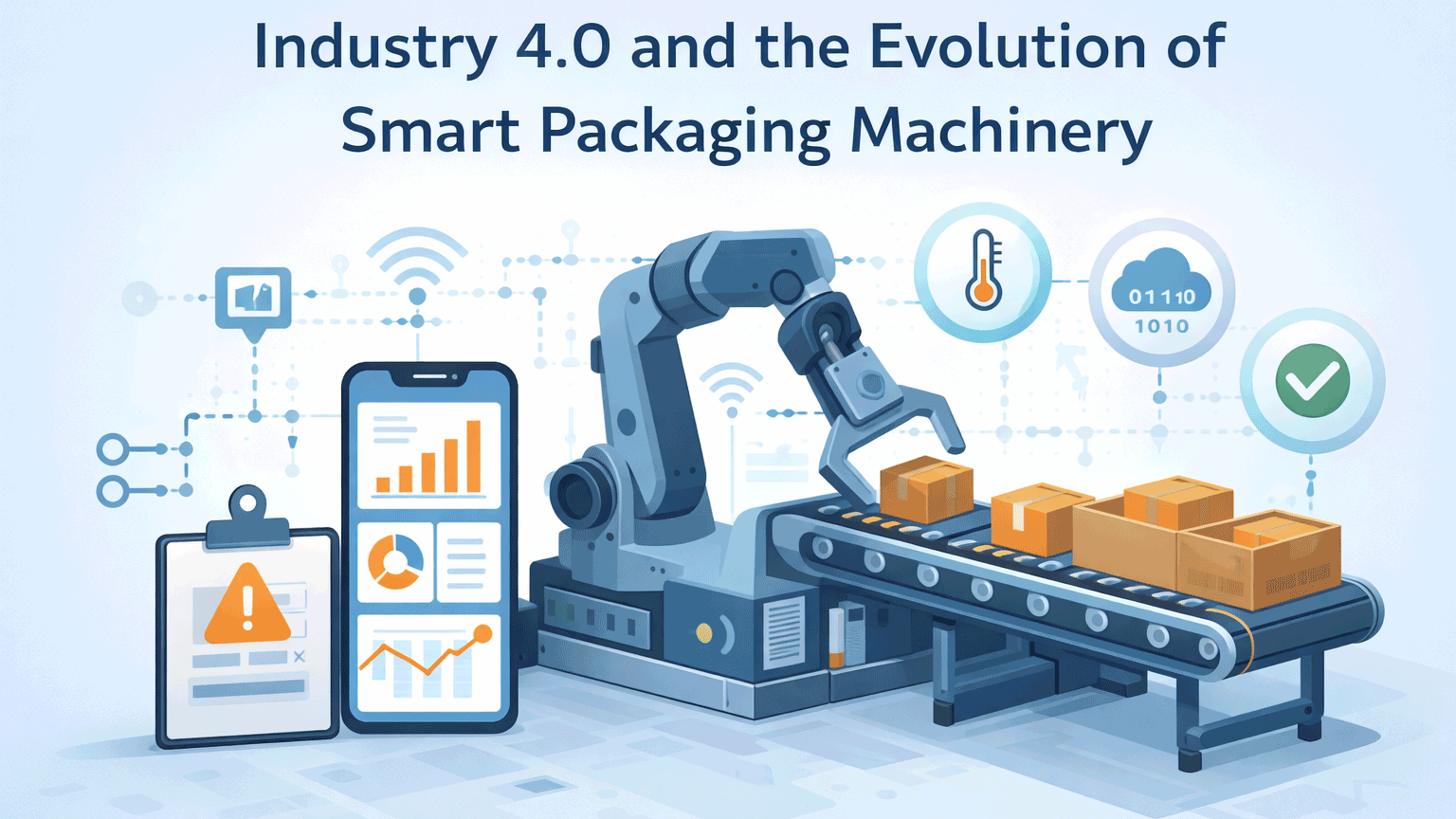
Industry 4.0 represents a fundamental shift in manufacturing, driven by advanced technologies such as artificial intelligence, machine learning, data analytics, automation, and connected systems. In the packaging industry, this transformation goes far beyond traditional automation. Packaging machinery is no longer limited to executing predefined tasks but is increasingly capable of monitoring conditions, collecting data, and supporting informed decisions across various aspects of production.
Traditional packaging equipment focused on speed and repetition. Under Industry 4.0, machines become intelligent physical assets that interact with digital systems in real time. Sensors, software, and artificial intelligence enable packaging equipment to understand operational conditions, adapt to changing market conditions, and respond dynamically to customer demands. This evolution allows manufacturers to improve efficiency while maintaining high levels of product quality and safety.
Within modern manufacturing environments, packaging machinery plays a strategic role in business processes. It directly influences productivity, operational efficiency, and the ability of companies to respond to market volatility. Industry 4.0 transforms packaging from a downstream function into a data-driven component of the entire manufacturing process.
Real-Time Data as the Foundation of Smart Packaging
Real time data is the foundation of smart packaging systems. Through continuous data collection, packaging machines monitor temperature, vibration, pressure, energy usage, and performance metrics. This live data allows operations teams to understand what is happening on the production floor at any given moment.
Collecting data has evolved from passive record keeping into an active, real time process. Sensors embedded in equipment provide real time monitoring, allowing manufacturers to identify deviations as they occur. Data analytics platforms process this information instantly, generating real time insights that support immediate decision making.
Live data also enables continuous improvement. By combining historical data with real time data, organizations can identify trends, detect inefficiencies, and optimize production processes. This data driven approach improves efficiency, reduces costs, and supports consistent manufacturing performance.
Smart Packaging Machinery within the Modern Supply Chain
Smart packaging machinery acts as a critical data node within the entire supply chain. Real time production data feeds into broader systems that manage inventory, logistics, and distribution. This integration improves coordination between manufacturing operations and downstream services.
By sharing live data across the supply chain, businesses gain visibility into production schedules, output rates, and potential bottlenecks. This transparency supports better planning and allows organizations to respond quickly to disruptions caused by changing market conditions or customer demands.
Industry 4.0 enables packaging equipment to support supply chain resilience. Data integration across infrastructure and systems allows companies to optimize resources, reduce delays, and maintain stable operations across regions and markets.
II. Predictive Maintenance and Operational Efficiency Enabled by IoT and AI
Predictive Maintenance through Real-Time Monitoring
Predictive maintenance is one of the most powerful benefits of Industry 4.0 in packaging machinery. Instead of reacting to equipment failure, manufacturers use real time monitoring and predictive analytics to identify issues before they occur.
Sensors continuously monitor vibration, temperature, motor currents, and other critical parameters. Machine learning models analyze both historical data and live data to detect patterns associated with wear or failure. When anomalies occur, systems generate alerts, allowing maintenance teams to intervene proactively.
This approach significantly reduces downtime. By addressing maintenance needs before equipment failure occurs, manufacturers improve efficiency, protect physical assets, and extend equipment life. Predictive maintenance transforms maintenance from a cost center into a strategic contributor to operational efficiency.
From Reactive Repair to Proactive Decision Making
Traditional maintenance strategies relied on scheduled inspections or reactive repair after breakdowns occurred. These approaches often resulted in unplanned downtime, increased costs, and safety issues. Industry 4.0 introduces data driven maintenance strategies that support proactive decision making.
Real time insights generated through data analytics allow manufacturers to prioritize maintenance activities based on risk and impact. Instead of shutting down entire systems, targeted interventions can be performed at optimal times. This minimizes disruptions to production schedules and improves overall performance.
Proactive maintenance also supports change management. As companies introduce new systems and technologies, predictive maintenance reduces uncertainty and enables smoother transitions. Decision making becomes more informed, consistent, and aligned with long-term operational goals.
Enhancing Operational Efficiency with Live Machine Data
Operational efficiency is directly influenced by access to live data. Smart packaging machines continuously monitor performance indicators such as cycle time, output rates, and energy usage. Artificial intelligence analyzes this data and automatically adjusts parameters to improve efficiency.
For example, packaging equipment can optimize speed, material usage, and power consumption based on real time conditions. These adjustments improve productivity while reducing costs and minimizing waste. Live data enables packaging operations to remain efficient even under high production volumes.
By leveraging data driven optimization, manufacturers achieve increased efficiency across production processes. This capability is essential in competitive markets where small performance gains can deliver significant business benefits.
III. Quality Control and Digital Twins in a Virtual Packaging Environment
AI-Driven Quality Control Using Real-Time Inspection
Quality control is a critical aspect of packaging operations. Industry 4.0 enables a shift from sampling-based inspections to continuous, real time quality control. Artificial intelligence systems analyze visual and sensor data to identify defects instantly.
Real time inspection systems monitor seal integrity, labeling accuracy, and packaging consistency. When quality issues occur, defective products are automatically identified and removed without interrupting production. This ensures consistent product quality and reduces the risk of safety issues.
By combining real time data with machine learning, quality control systems improve over time. Each inspection generates data that enhances model accuracy, enabling continuous improvement in product quality and increased customer satisfaction.
Digital Twins: Creating a Virtual Environment for Packaging Lines
Digital twins represent a virtual modeling of physical assets and production processes. In packaging machinery, digital twins create a virtual environment that mirrors real world operations in real time.
Data collected from equipment feeds directly into the digital twin, synchronizing physical and virtual systems. This allows manufacturers to visualize performance, simulate changes, and test scenarios without disrupting live operations. Digital twins support deeper understanding of production processes and system behavior.
Within Industry 4.0, digital twins serve as essential tools for optimization. They enable manufacturers to experiment with process changes, evaluate new technologies, and identify potential risks in a controlled environment.
Simulation, Optimization, and Risk Reduction
Simulation within a virtual environment allows manufacturers to test production scenarios safely. Changes to equipment settings, materials, or production schedules can be evaluated using virtual modeling before implementation.
This approach reduces trial-and-error costs and minimizes the risk of unexpected failures. By identifying potential issues early, companies can optimize processes and ensure stable operations. Digital twins support continuous improvement by providing insights into system performance under various conditions.
Risk reduction is particularly important in complex manufacturing environments. Digital twins help organizations manage safety issues, maintain product quality, and ensure efficient use of resources across production processes.
IV. Data Collection, Real-Time Decision Making, and the Future of Smart Packaging
Data Collection as a Strategic Asset in Industry 4.0
Data collection has become a strategic asset within Industry 4.0. Packaging equipment generates large volumes of data related to operations, performance, energy usage, and quality. When analyzed effectively, this data provides valuable insights that support informed decisions.
Data analytics platforms integrate information from multiple systems, enabling organizations to understand relationships across various aspects of manufacturing. This holistic view supports better planning, improved efficiency, and alignment between business processes and operational goals.
Treating data as an asset allows manufacturers to move beyond intuition-based management. Decisions become evidence-based, consistent, and responsive to real time conditions.
Real-Time Decision Making Across Packaging Operations
Real time decision making is a defining feature of smart packaging systems. Live data enables managers and operators to respond immediately to changes in production conditions. Artificial intelligence systems identify deviations and recommend corrective actions.
For example, if performance drops or quality issues occur, systems generate real time insights that guide operational adjustments. This rapid response capability shortens reaction times and prevents minor issues from escalating into major disruptions.
Data driven decision making also improves coordination across operations. By sharing real time insights, teams align production, maintenance, and supply chain activities, resulting in smoother workflows and increased efficiency.
Toward Autonomous and Self-Optimizing Packaging Systems
The future of smart packaging lies in autonomous systems capable of self-optimization. Industry 4.0 technologies enable packaging machinery to monitor performance, analyze data, and implement improvements without human intervention.
Artificial intelligence and machine learning allow systems to adapt continuously to changing market conditions, customer demands, and production requirements. Packaging lines become flexible, resilient, and capable of maintaining optimal performance across diverse scenarios.
As companies continue to invest in advanced technologies, smart packaging systems will evolve from supportive tools into central drivers of productivity and competitive advantage. The future of manufacturing will be defined by intelligent, connected, and data driven packaging operations.
