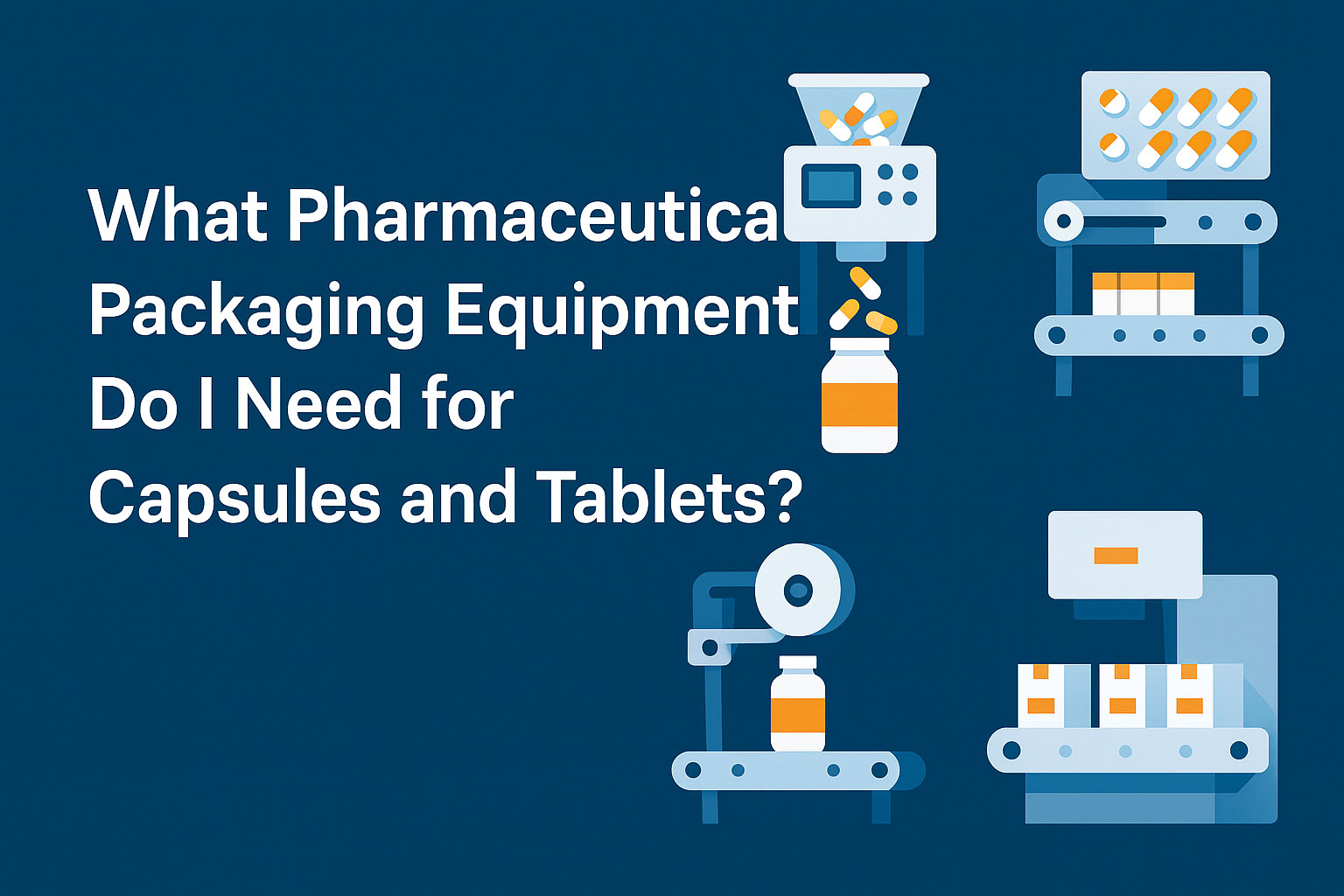
04 Oct What Pharmaceutical Packaging Equipment Do I Need for Capsules and Tablets?
In the pharmaceutical industry, packaging plays a critical role in ensuring product quality, patient safety, and regulatory compliance. Selecting the right pharmaceutical packaging equipment for capsules and tablets is essential to meet production goals, satisfy customer expectations, and maintain stringent quality standards. This article explores the comprehensive range of packaging equipment required for capsules and tablets, detailing how pharmaceutical manufacturers can incorporate flexible and cost-effective solutions, including automated packaging lines, labeling machines, blister machines, and more.
1. Introduction to Pharmaceutical Packaging Equipment
Pharmaceutical packaging is far more than just enclosing products; it is an integral component of the pharmaceutical sector that protects sensitive medicines, ensures dosage accuracy, and facilitates safe transportation and storage. For capsules and tablets, packaging must preserve product integrity and support patient safety throughout the product lifecycle.
Pharmaceutical manufacturers are increasingly turning to advanced packaging machines and innovative packaging solutions that offer robust design, automation, and line integration to enhance efficiency and reliability. Packaging equipment selections depend largely on the packaging process, container size, product type, and available floor space.
2. Primary Packaging Machines for Capsules and Tablets
The primary packaging process focuses on directly enclosing the pharmaceutical product in a protective container or blister pack, providing unit doses for patient use.
2.1 Tablet Counting and Filling Machines
Tablet counting and filling machines are foundational in bottling capsules and tablets. These pharmaceutical packaging machines precisely count unit doses and fill them into containers such as bottles or jars. The robust design characterizing these counters supports high-speed operations and prevents product damage during handling.
These machines can incorporate cap feeders and closing machines to automate the entire packaging line. Their modular design allows pharmaceutical manufacturers to integrate them with existing machinery or third-party machines, ensuring seamless line integration.
2.2 Blister Machines for Unit Dose Packaging
Blister machines are widely used to package capsules and tablets in unit doses, offering enhanced protection from moisture, contamination, and physical damage. Rotary continuous models dominate this segment for their speed range and efficiency, particularly in high-volume production lines.
Pharmaceutical packaging equipment in blister machines typically includes thermoforming or cold-forming stations, sealers, and feeders. Packaging materials such as Alu-PVC or Alu-Alu provide superior barrier properties, preventing contamination and preserving product stability, including semi-solid products.
2.3 Liquid Filling Machines
Although capsules and tablets are primarily solid forms, liquid filling machines are indispensable in packaging related pharmaceutical products such as oral liquids or suspensions. These machines are designed for precise dosing and operate under sterile conditions to maintain product integrity, eliminating condensation risks during freeze drying or liquid filling processes.
Liquid filling machines form part of complete turnkey solutions and often incorporate GMP washers and automated cleaning process equipment, critical in biopharma product packaging to prevent contamination.
3. Secondary Packaging and Labeling Machines
After primary packaging, secondary packaging involves placing the packaged capsules or tablets into cartons, cases, or other outer packaging to protect the product and provide additional information.
3.1 Cartoning Machines and Closing Machines
Cartoning machines automate the folding, loading, and sealing of cartons containing bottles or blister packs. Their flexible solutions cater to diverse packaging needs, offering compact design and the ability to provide custom layouts based on available floor space and user requirement specifications.
Closing machines, integrated with cartoning machines, ensure cartons are securely sealed, supporting leak detection and maintaining the pharmaceutical packaging line’s integrity.
3.2 Labeling Machines
Labeling machines apply labels to bottles, blister cards, cartons, or other packaging components. These machines are critical for compliance with regulatory requirements and providing patients with necessary product information.
High-speed labeling machines utilize advanced vision systems like CCD recognition to verify label placement and print quality. They are designed for modularity, allowing pharmaceutical manufacturers to incorporate promach manufactured machines or third-party machines within their packaging line.
3.3 Leak Detection and Package Integrity Testing
Ensuring the integrity of pharmaceutical packaging is vital, especially for blister packs and bottles that protect sensitive capsules and tablets. Leak detection equipment uses automated visual inspection and pressure testing to identify defects that could compromise sterility or shelf life.
Such innovative and cost-effective solutions can be integrated into packaging lines as part of line solutions to enhance patient safety and satisfy stringent pharmaceutical sector standards.
4. Auxiliary Equipment to Enhance Efficiency and Compliance
Beyond primary and secondary packaging machines, pharmaceutical manufacturers often incorporate auxiliary equipment to improve product quality, streamline the packaging process, and meet GMP compliance.
4.1 Capsule Polishing and Automated Cleaning Process Equipment
Capsule polishing machines remove dust and debris from capsules before packaging, enhancing the final product’s appearance and quality. Automated cleaning process equipment, including GMP washers, is essential for maintaining sterile conditions, especially in biopharma and clinical trial packaging phases.
4.2 Freeze Drying (Lyophilization) Equipment
Freeze drying equipment is critical for stabilizing sensitive pharmaceutical products, particularly semi-solid or liquid formulations, by eliminating moisture while preserving efficacy. This process often occurs upstream of packaging but requires integration with the packaging line to eliminate condensation risks during subsequent packaging.
4.3 Line Automation, Integration, and Custom Layouts
Pharmaceutical manufacturers benefit from comprehensive packaging line solutions that provide seamless line integration and automation. Conveyor systems, robotic handling, and data tracking software enhance operational efficiency and traceability.
Custom layouts are designed to optimize available floor space and meet user requirement specifications, enabling pharmaceutical manufacturers to adapt packaging lines as production needs evolve. Dedicated applications engineering ensures packaging solutions are tailored to specific pharmaceutical products and customer expectations.
5. Considerations for High-Speed Production and Flexible Solutions
Efficient pharmaceutical packaging lines must balance speed, flexibility, and compliance to keep pace with evolving market demands.
5.1 Scalability and Modular Design
High-speed pharmaceutical packaging equipment, including blister machines and rotary continuous models, allows manufacturers to scale operations effectively. Modular design principles facilitate the addition or removal of machinery, supporting flexible solutions that adapt to changes in product lines or packaging formats.
5.2 Compliance with Regulatory Standards and GMP
Pharmaceutical packaging equipment must comply with GMP regulations, ensuring all materials and processes maintain patient safety and product quality. Packaging lines often include leak detection and sterile packaging components, especially when handling clinical trial materials or biopharma products.
Pharmaceutical manufacturers work closely with sales departments and engineering teams to select packaging machines and materials that meet these stringent standards while offering innovative cost-effective solutions.
5.3 Maintenance, Support, and Future-Proofing
Ongoing maintenance and support services ensure pharmaceutical packaging machines operate at peak efficiency. Pharmaceutical manufacturers must plan preventive maintenance schedules and leverage dedicated support to minimize downtime.
Additionally, packaging equipment should allow for future upgrades and line expansions, incorporating third-party machines or new technologies to remain competitive in the pharmaceutical sector.
Conclusion
Choosing the appropriate pharmaceutical packaging equipment for capsules and tablets requires careful consideration of the packaging process, product type, regulatory requirements, and production scale. From tablet counting and filling machines to blister machines, labeling machines, and auxiliary equipment such as capsule polishers and freeze drying units, pharmaceutical manufacturers have access to a comprehensive range of packaging solutions.
By focusing on flexible, modular, and automated line solutions, manufacturers can optimize their packaging lines for high-speed, efficient, and compliant production. Incorporating robust design and user requirement specifications ensures packaging lines meet customer expectations and maintain patient safety across the pharmaceutical product lifecycle.
Pharmaceutical packaging is a complex but critical aspect of the industry, and investing in the right equipment and line integration strategies ensures manufacturers are well-positioned to succeed in an evolving market.
