07 Apr Automation and Robotics: The Future of Packaging Line Efficiency
Automation and Robotics: The Future of Packaging Line Efficiency
Packaging is no longer a back-end activity limited to product protection. Across food, nutraceutical, pharmaceutical, and consumer goods manufacturing, packaging automation has become a strategic driver of productivity, quality, and business competitiveness. As production volumes increase, product formats diversify, and labor markets tighten, manufacturers are accelerating the transition from manual labor to automated packaging systems powered by robotics, artificial intelligence, and intelligent software solutions.
Packaging automation reshapes packaging processes by improving packaging throughput, reducing costs, minimizing product waste, and enhancing food safety and quality control. At the center of this transformation are industrial robots, collaborative robots, advanced vision systems, and modular automation solutions designed to integrate seamlessly into modern packaging operations.
I. Packaging Automation as a Core Driver of Modern Packaging Processes
From Manual Operations to Automated Packaging Systems
Traditional packaging processes relied heavily on human workers performing repetitive, time-consuming tasks such as sorting, filling, labeling, and packing. While manual labor offered flexibility, it also introduced variability, fatigue-related errors, safety risks, and rising labor costs. As production needs expanded and customers demanded higher consistency and faster delivery, manual operations increasingly became a bottleneck.
Automated packaging systems address these challenges by standardizing tasks through machines, robotics, and software-driven automation processes. Packaging automation improves accuracy, repeatability, and reliability by reducing direct human contact with products. This is especially critical in food and nutraceutical packaging, where food safety and hygiene standards require strict control over contamination risks and personal data provided for traceability.
Automation solutions also strengthen quality control by embedding sensors, vision systems, and real-time monitoring into packaging operations. Automated inspection ensures defective products are detected early, reducing downstream product waste and protecting brand reputation. In highly regulated manufacturing environments, automation supports compliance by enabling precise documentation, consistent processes, and controlled packaging systems.
Beyond quality, packaging automation significantly reduces operational downtime. Automated systems operate with predictable cycles, allowing manufacturers to optimize production scheduling and throughput while minimizing unplanned stoppages caused by human error or inconsistent workflows.
High Speed and Cost Effective Packaging Automation Solutions
Modern manufacturing demands speed, but speed alone is not enough. High speed packaging must also be cost effective, scalable, and adaptable to changing production needs. Packaging automation solutions are increasingly designed to balance throughput and costs while maintaining reliability and safety.
High speed automated packaging lines allow companies to process large volumes with fewer machines and fewer human workers. Industrial robots and delta robots excel in applications that require rapid sorting, counting, and placement. These robots operate at consistent speeds over long production runs, supporting stable packaging throughput without fatigue.
Cost effectiveness is achieved not only through higher speed but also through reduced labor costs, lower error rates, and improved equipment utilization. Automation reduces dependency on manual labor, which is subject to turnover, training requirements, and wage inflation. Over time, automated packaging delivers measurable cost savings by lowering rework, reducing product waste, and improving energy efficiency.
Automation solutions also enable faster changeovers between product formats. Modern packaging machines use software-controlled recipes and adjustable end effectors, allowing packaging systems to adapt quickly to new SKUs without extensive mechanical reconfiguration. This flexibility is essential for manufacturers serving diverse customers and short production runs.
Making Automation Easier Across Packaging Systems
Historically, automation was perceived as complex, expensive, and suitable only for large manufacturers. Today, the focus is on making automation easier, more accessible, and more modular across packaging systems.
Modular automation architectures allow manufacturers to automate packaging processes step by step rather than committing to a full line replacement. Standardized interfaces, open software platforms, and plug-and-play equipment simplify integration with existing machines. This approach lowers barriers to adoption for small and mid-sized companies seeking gradual automation.
Integration is further supported by smart sensors and intelligent software that enable communication between machines, robots, and packaging systems. Data flows seamlessly across operations, allowing teams to monitor performance, optimize processes, and support predictive maintenance strategies.
By simplifying integration and reducing technical complexity, automation solutions empower manufacturing teams to adapt packaging processes to evolving business needs while maintaining operational continuity.
II. Industrial Robots Transforming Automated Packaging Performance
Industrial Robots and Delta Robots in High Speed Packaging
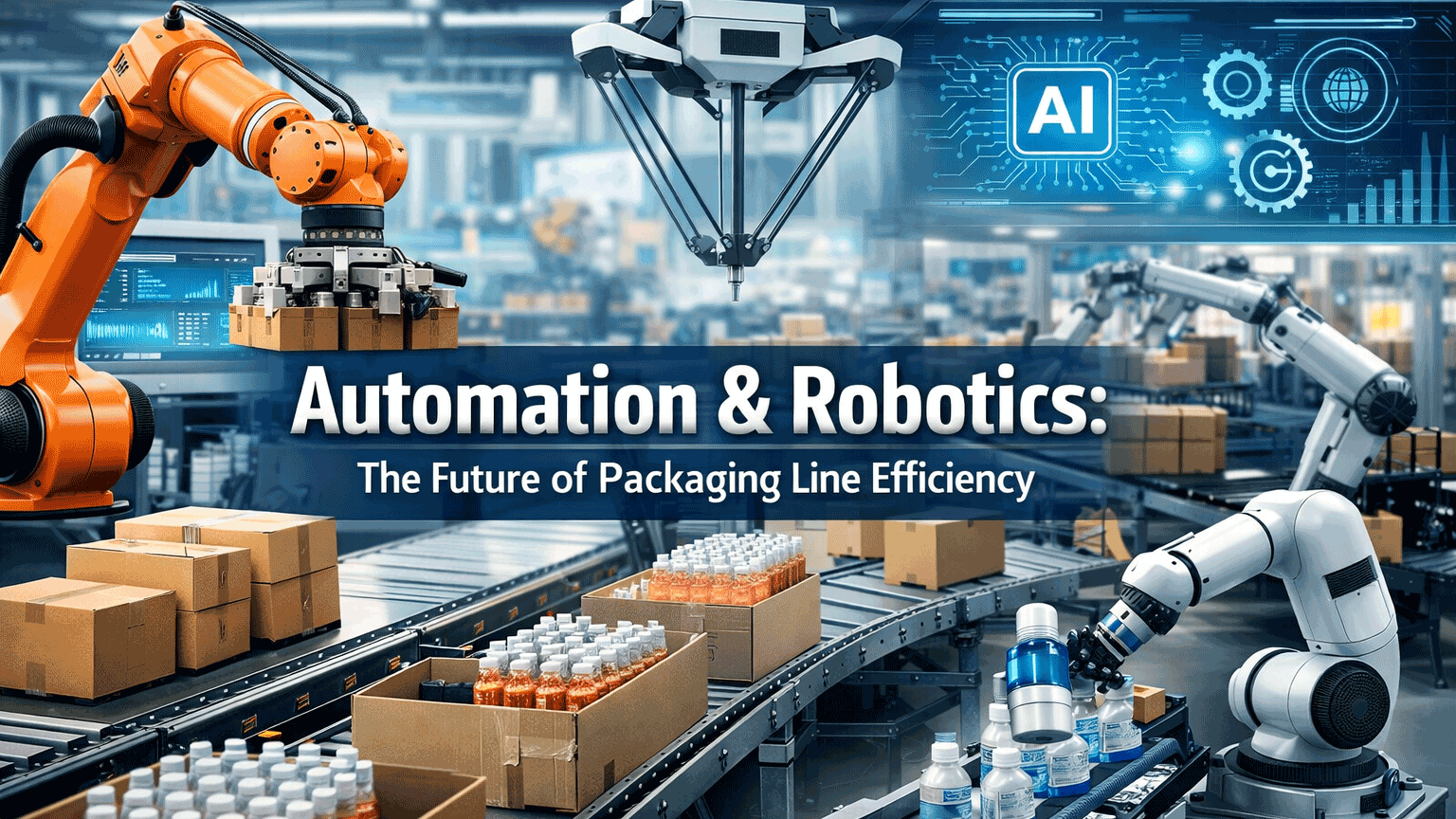
Industrial robots play a central role in automated packaging environments. Designed for durability, speed, and precision, these robots handle demanding packaging tasks with minimal variation. Applications include robotic pick, case packing, palletizing, and bin picking, where speed and repeatability are critical.
Delta robots are particularly well suited for high speed packaging operations. Their lightweight design and parallel kinematics allow rapid acceleration and deceleration, making them ideal for sorting and placing small food or consumer products. Delta robots excel in environments where space is limited and throughput requirements are high.
Robotic pick systems dramatically improve packaging throughput by eliminating pauses between manual handling steps. Vision systems guide robots to identify product orientation and position, enabling precise placement even when items arrive randomly on conveyors. This capability supports flexible production while maintaining consistent output.
By automating repetitive tasks, industrial robots reduce strain on human workers and increase overall productivity across packaging operations.
Robotic Pick-and-Place with Advanced End Effectors
End effectors are a critical component of robotic packaging systems. These tools interface directly with products, determining how robots grip, lift, and place items during packaging processes. Advanced end effectors enhance versatility, allowing a single robot to handle multiple product types.
Modern end effectors use vacuum, mechanical gripping, or hybrid designs to accommodate different shapes, weights, and materials. This adaptability is essential for manufacturers packaging diverse food, nutraceutical, or consumer products within the same production space.
Robotic pick solutions equipped with flexible end effectors reduce the need for dedicated machines for each product format. This lowers capital costs and supports tailored automation strategies aligned with specific production needs.
By minimizing dropped products and misplacement, advanced end effectors contribute directly to reduced product waste and improved packaging quality.
Robotics Enabling Smarter and More Efficient Packaging Systems
Robots operate continuously with minimal interruption, delivering consistent performance across long production cycles. Unlike human workers, robots do not experience fatigue, ensuring stable speed and reliability throughout packaging operations.
This consistency enhances quality control by maintaining uniform handling and placement. Automated systems detect deviations early, allowing corrective action before defects propagate downstream. As a result, packaging systems achieve higher reliability and predictable throughput.
Importantly, robotics does not eliminate the role of humans. Instead, automation frees human workers from repetitive tasks, enabling them to focus on supervision, optimization, and quality assurance. Human expertise remains essential for process improvement, system tuning, and responding to unexpected challenges.
III. Collaborative Robots and Intelligent Automation Solutions Shaping the Future
Collaborative Robots Enhancing Human–Machine Packaging Processes
Collaborative robots, often referred to as cobots, represent a new generation of automation designed to work alongside humans. Unlike traditional industrial robots, cobots are equipped with sensors and safety features that allow close interaction without physical barriers.
Cobots support packaging operations by handling tasks such as packing, kitting, labeling, and inspection at moderate speeds. Their ability to work alongside humans increases flexibility, especially in environments with frequent changeovers or limited space.
By automating strenuous or repetitive tasks, collaborative robots improve ergonomics and reduce injury risks. This is particularly valuable in addressing labor shortages and reducing reliance on manual labor for physically demanding packaging tasks.
Cobots allow companies to increase productivity without fully restructuring existing operations, making them a suitable automation solution for gradual deployment.
Intelligent Automation Solutions in Advanced Packaging Automation
Artificial intelligence plays an increasingly important role in packaging automation. AI-driven vision systems enable robots to recognize products, assess orientation, and adapt to variations in real time. This capability is critical for bin picking applications, where products are randomly arranged.
AI also supports process optimization by analyzing data from sensors and machines across packaging operations. Intelligent software identifies inefficiencies, predicts equipment wear, and recommends adjustments to improve throughput and reduce costs.
Automation solutions that combine robotics, AI, and sensors create self-optimizing packaging systems. These systems adapt to production changes without manual intervention, improving efficiency while maintaining quality and safety.
Industry Leaders Driving the Shift Toward Smart Packaging Automation
Across manufacturing sectors, industry leaders are adopting packaging automation as a long-term strategic investment rather than a short-term efficiency upgrade. Automation enables companies to respond faster to customer demands, scale production, and maintain consistent quality.
By integrating robotics and intelligent automation into their operations, industry leaders build resilient packaging systems capable of adapting to market volatility and regulatory requirements. Automation supports sustainable manufacturing by reducing waste, optimizing resource usage, and minimizing unnecessary rework.
The focus is shifting from basic automation to tailored solutions that align with specific production goals, space constraints, and business strategies.
Comparative Overview: Manual vs Automated Packaging Operations
|
Aspect |
Manual Packaging |
Automated Packaging |
|---|---|---|
|
Packaging throughput |
Limited by human speed |
High speed and consistent |
|
Labor costs |
High and variable |
Reduced and predictable |
|
Quality control |
Operator dependent |
Sensor and vision based |
|
Product waste |
Higher risk |
Reduced through precision |
|
Food safety |
Increased human contact |
Minimal human contact |
|
Flexibility |
Skill dependent |
Software and tooling driven |
|
Reliability |
Variable |
High reliability |
The Strategic Value of Automation and Robotics in Packaging Systems
Packaging automation represents a fundamental shift in how packaging operations are designed, managed, and optimized. By combining robotics, artificial intelligence, and intelligent software, manufacturers can increase productivity, reduce costs, and enhance quality across packaging processes.
Collaborative robots and industrial robots will define next-generation packaging systems by enabling flexible, scalable, and cost effective automation. These technologies allow human workers and machines to work together, maximizing efficiency while preserving safety and adaptability.
As packaging moves from compliance-driven operations to performance-driven systems, automation becomes a strategic advantage. Companies that invest in advanced automation technologies today position themselves to meet future production needs, support customers more effectively, and remain competitive in an evolving manufacturing landscape.
