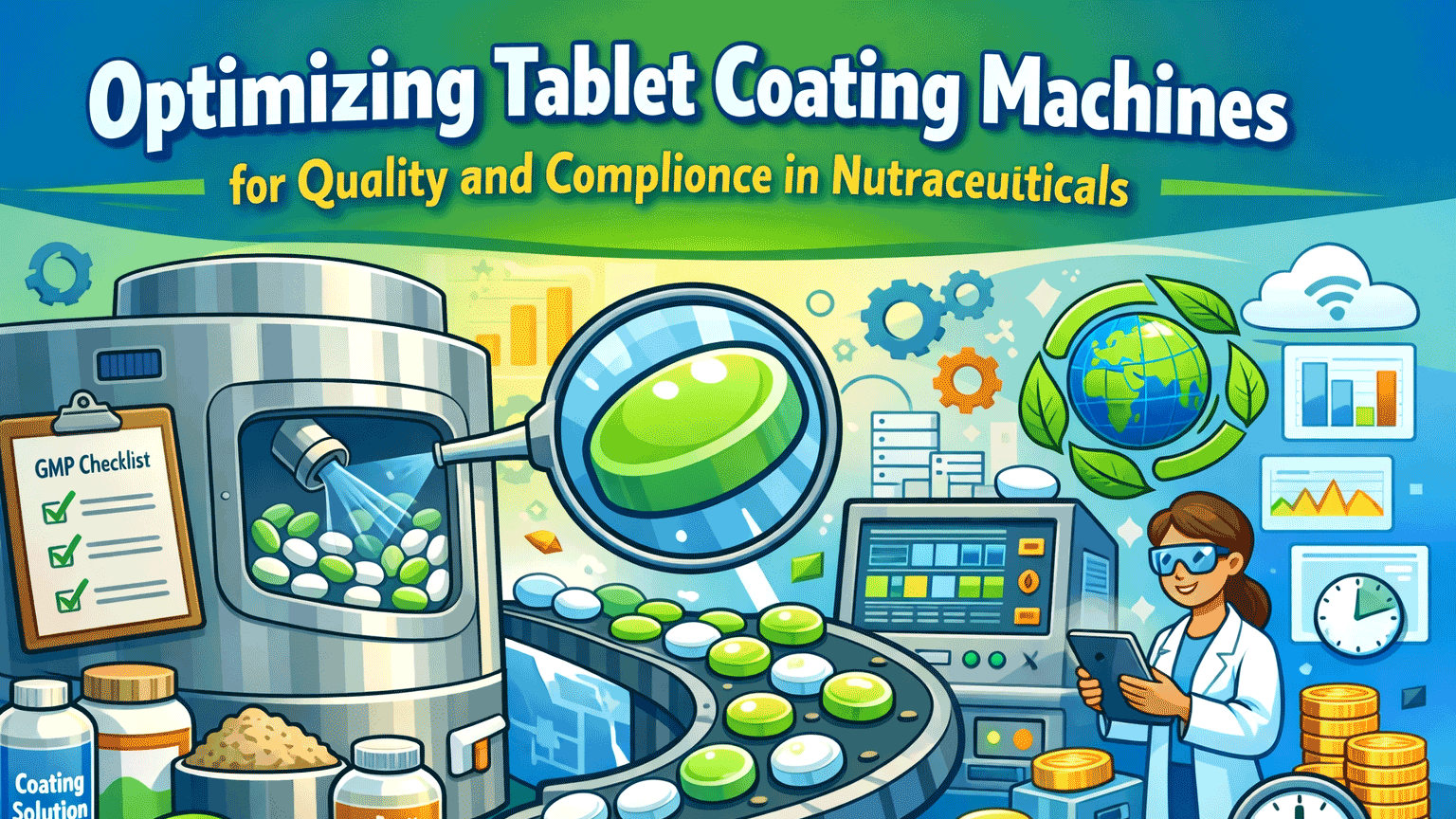
22 Apr Optimizing Tablet Coating Machines for Quality and Compliance in Nutraceuticals
The nutraceutical manufacturing industry continues to face increasing demands from regulators, customers, and global markets. As consumer expectations rise and compliance requirements become more rigorous, manufacturers must focus not only on producing effective products, but also on ensuring consistent quality, operational efficiency, and regulatory alignment. Within this environment, the tablet coating machine plays an essential role in determining the overall performance of the final product.
Tablet coating is no longer viewed as a purely cosmetic step. Instead, it is a crucial process that affects product stability, appearance, moisture resistance, and long-term protection against environmental factors. Optimizing tablet coating machines is therefore a strategic priority for any company seeking to improve compliance, reduce cost, and enhance business competitiveness.
Tablet Coating Machine Design and GMP Compliance in Modern Nutraceutical Manufacturing
1.1 The Role of Tablet Coating Machines in GMP-Compliant Production
A tablet coating machine is a critical element in GMP-compliant nutraceutical manufacturing. The coating process directly influences product quality, consistency, and safety, making it an area closely examined during regulatory audits. Poorly controlled coating operations can lead to batch-to-batch variability, contamination risks, and coating defects that compromise the final product.
One of the most common GMP challenges in tablet coating is achieving consistent results across production batches. Variations in coating thickness, surface appearance, or gloss can indicate instability in the process. These inconsistencies may affect dissolution behavior, moisture resistance, and the ability of tablets to withstand handling and transportation.
Another major concern is contamination. During coating, tablets are exposed to air, spray systems, coating solution, and internal machine surfaces. If the tablet coating machine is not designed for controlled environments and effective cleaning, the risk of cross-contamination increases. This is especially critical when manufacturing different medications or nutraceutical formulations on shared equipment.
Modern tablet coating machine design addresses these issues by supporting controlled process conditions, repeatable operations, and documented production parameters. Advanced systems allow manufacturers to set precise spray rates, airflow, temperature, and pan speed, ensuring that the coating process is applied correctly every time. This level of control enables companies to produce consistent, high-quality tablets while meeting strict GMP expectations.
1.2 High-Efficiency Tablet Coating Machines and Process Optimization
High-efficiency tablet coating machines have transformed the film coating process by significantly reducing production time while improving quality. Traditional coating operations often require long processing cycles, which increase operational cost and limit manufacturing flexibility. In contrast, optimized film coating process designs can reduce coating time by up to 30–35%.
By shortening coating cycles, manufacturers can achieve the same output with fewer machines. This reduction simplifies validation activities, lowers operational risk, and improves batch traceability. From a GMP perspective, fewer machines mean fewer variables to control, fewer cleaning operations, and a reduced chance of human error.
Process optimization also benefits business performance. Faster coating cycles allow manufacturers to respond more quickly to customer demands and market orders. Shorter production time translates directly into lower energy usage, reduced labor cost, and improved efficiency across manufacturing operations.
A well-optimized tablet coating machine supports smoother workflow integration, enabling coating operations to align with upstream compression and downstream packaging processes. This alignment helps companies meet delivery deadlines while maintaining compliance and quality standards.
1.3 Compliance Beyond 2010: Evolving GMP Expectations in 2025
While GMP requirements have existed for many years, expectations in 2025 go far beyond basic compliance. Regulatory authorities now place stronger emphasis on process control, data integrity, and reproducibility. Manufacturers are expected to demonstrate not only that their coating process works, but that it performs consistently over time and across different production conditions.
Modern tablet coating machines are increasingly integrated with automated process monitoring systems. These systems track critical parameters such as spray rate, inlet air temperature, exhaust humidity, and pan speed in real time. Electronic batch records provide documented proof that each coating process meets predefined specifications.
Real-time monitoring allows operators to identify deviations early and make adjustments before defects occur. This proactive approach improves product quality while reducing waste and rework. As regulatory audits become more data-driven, tablet coating machines designed for future compliance offer a significant advantage to manufacturers seeking long-term operational stability.
Film Coating Process Optimization: Uniformity, Mixing, and Coating Solution Efficiency
2.1 Achieving Uniform Film Coating with Minimal Weight Gain
Film coating uniformity is a key indicator of process quality. Traditional film coating methods often rely on thicker coatings to achieve acceptable appearance and surface coverage. Typically, conventional systems require a 4–5% weight gain to produce uniform tablets. This approach increases raw materials consumption and raises manufacturing cost.
Modern film coating process optimization enables uniform film coating with significantly lower weight gain, often around 1.5–2%. Achieving this level of efficiency requires precise control of spray parameters, airflow, and tablet movement within the tablet coating machine.
Uniform film coating directly affects tablet appearance, gloss, and surface smoothness. It also influences taste masking and dissolution behavior, which are essential for customer acceptance and regulatory compliance. A thinner, evenly applied film provides an effective protective barrier without negatively impacting tablet performance.
Reducing coating thickness also lowers the consumption of coating solution and raw materials. Over time, this reduction translates into meaningful cost savings and improved sustainability. Manufacturers can produce more tablets per batch while maintaining consistent quality and appearance.
2.2 Advanced Mixing Systems in Tablet Coating Machines
Effective mixing is crucial for achieving uniform film coating. Tablets must remain in constant motion to ensure that each surface is evenly exposed to the spray zone. Poor mixing creates dead zones within the tablet bed, leading to uneven coating, surface defects, and increased abrasion.
Advanced tablet coating machines use optimized pan geometry and internal mixing baffles to enhance tablet movement. These systems continuously move tablets forward and backward, eliminating slow-moving areas and ensuring consistent exposure to the coating spray.
Improved mixing prevents common defects such as twinning, where tablets stick together during the coating process. Twinning is particularly problematic for flat or elongated tablets, which are more likely to adhere under certain conditions. By maintaining a thinner tablet bed and continuous motion, modern systems reduce the likelihood of such defects.
Uniform mixing is especially important for nutraceutical tablets that contain sensitive raw materials or functional ingredients. Consistent coating ensures that each tablet meets quality specifications and delivers reliable performance to customers.
2.3 Optimizing Coating Solution Utilization and Spray Efficiency
The efficient use of coating solution is a critical factor in both quality and cost control. In traditional systems, inefficient airflow patterns often cause spray drying, where coating droplets partially dry before reaching the tablet surface. This leads to coating solution waste, buildup on machine surfaces, and increased cleaning requirements.
Spray drying also affects coating quality. Dried droplets may fail to spread evenly on the tablet surface, resulting in rough texture, poor gloss, and inconsistent film formation. These defects can compromise the protective barrier intended to shield tablets from moisture and environmental factors.
Modern tablet coating machines address this issue through improved airflow design. Airflow is directed in alignment with tablet movement, minimizing direct contact between hot air and airborne spray droplets. As a result, coating solution remains wet upon contact with the tablet surface, allowing the film to form smoothly and uniformly.
This optimization reduces coating solution waste, improves film properties, and enhances overall process efficiency. Manufacturers benefit from lower raw material consumption, reduced filter loading, and more stable operations.
Sustainable, Cleanable, and Future-Ready Tablet Coating Machines
3.1 Pan Geometry and Its Impact on Film Coating Quality
Pan geometry plays a crucial role in determining coating efficiency and quality. Traditional tablet coating machines often use short, wide pans that create deep tablet beds. These conditions increase the likelihood of dead zones and uneven exposure to the spray zone.
Modern tablet coating machines use elongated, narrow pan designs that spread the tablet bed more evenly. This geometry increases the surface area exposed to the spray and improves coating uniformity. Tablets enter the spray zone more frequently, resulting in faster and more efficient film coating.
Improved pan geometry reduces defect rates, particularly for flat tablets and elongated shapes that are prone to sticking. Consistent tablet movement minimizes abrasion and surface damage, preserving tablet appearance and structural integrity throughout the coating process.
By improving coating efficiency, optimized pan design supports higher throughput and more consistent production campaigns, contributing to better overall manufacturing performance.
3.2 Reduced Cleaning Requirements and Operational Efficiency
Excessive coating solution waste directly increases cleaning frequency and operational downtime. Traditional systems often require frequent wash cycles to remove buildup from pans, spray arms, and filters. Each cleaning cycle consumes large volumes of water and generates wastewater that must be treated.
Modern tablet coating machines are designed to minimize coating buildup by improving spray efficiency and airflow control. With less wasted coating solution, manufacturers can run longer continuous campaigns before stopping for cleaning.
Reduced cleaning frequency improves operational efficiency by increasing available production time. It also lowers water usage and reduces the environmental impact of manufacturing operations. From a cost perspective, fewer cleaning cycles mean lower labor requirements, reduced use of cleaning agents, and longer filter life.
These advantages support sustainability goals while helping companies save money and improve resource utilization.
3.3 Tablet Coating Machines in 2025: Automation, Digital Control, and Sustainability
In 2025, tablet coating machines are increasingly integrated with automation and digital control technologies. Automated recipe management allows manufacturers to store and reuse validated process parameters, ensuring consistency across batches and production sites.
Closed-loop film coating process control systems continuously adjust spray rate, temperature, and airflow based on real-time feedback. This approach improves process stability and reduces the risk of defects caused by environmental changes such as humidity fluctuations.
Sustainability is also a growing focus in tablet coating machine design. Energy-efficient systems, reduced solvent usage, and optimized water consumption align with global manufacturing trends and customer expectations. Companies that invest in future-ready equipment are better positioned to meet evolving regulatory demands and market pressures.
By adopting advanced tablet coating machines, manufacturers gain long-term GMP compliance, faster return on investment, and scalable operations capable of supporting business growth.
