09 Oct Powder Mixing Equipment for Supplements: V Blender, Ribbon Mixer, and 3D Mixer Compared
Choosing the right powder mixing equipment is one of the most important decisions for supplement factories producing protein powder, electrolyte powder, probiotic powder, herbal powder, greens powder, meal replacement powder, mineral blends, and other powdered products. A mixing machine is not only used for blending powders. It directly affects product quality, uniform mixing, batch consistency, cleaning efficiency, cross-contamination control, energy efficiency, and the quality of the final products.
In supplement manufacturing, the goal of the mixing process is to turn different raw materials into a homogeneous mixture. These raw materials may include vitamins, minerals, amino acids, plant extracts, proteins, fibers, flavors, sweeteners, probiotics, colors, or functional ingredients. Some ingredients are used in large amounts, while others are added in very small quantities. Without high quality mixing, the final product may not have even distribution of active ingredients, taste, color, or texture.
Powder mixing machines are widely used in the food industry, pharmaceutical industries, food processing, chemicals, pigments, fertilizers, bakery applications, and many other industries. However, supplement powders have their own specific needs. Many formulations contain dry ingredients with different particle sizes, densities, flowability, moisture sensitivity, and fragility. Some powders are free-flowing, while others are sticky, dusty, cohesive, or easy to segregate. This is why the choice of powder mixers must be based on the real material characteristics and production goals.
Common powder blending equipment for supplements includes V blenders, ribbon mixers, ribbon blenders, 3D mixers, paddle mixers, dry powder mixer systems, continuous mixers, and other industrial mixers. Each type of equipment has its own functionality, advantages, limitations, and suitable applications. The right machine depends on batch sizes, desired output, cleaning requirements, hygiene standards, production volume, mixing precision, and the specific requirements of the formula.
For a factory, choosing powder mixing equipment should not only focus on price or tank volume. A mixer must support homogeneous mixing, easy cleaning, stable performance, low waste, and efficient integration with the production line. The best equipment is not always the largest machine. It is the machine that can produce a consistent batch, maintain supplement quality, and adapt to the factory’s current and future production needs.
Powder Mixing Equipment Basics for Supplement Manufacturing
Why Uniform Mixing Matters for Powdered Products
Uniform mixing is essential for powdered supplement products because consumers usually take the product by serving size. A protein powder may be scooped into a shaker. An electrolyte powder may be packed into stick packs. A probiotic powder may be filled into sachets or jars. A greens powder may be blended with water or smoothies. In each case, the customer expects every serving to contain a consistent distribution of ingredients.
If powder mixing is not controlled, the product may separate during blending, discharge, filling, storage, or transportation. This can create quality problems. One serving may contain too much of one ingredient, while another serving may contain too little. In formulas with vitamins, minerals, probiotics, botanical extracts, or sweeteners, this can affect product quality, taste, color, label claim consistency, and customer satisfaction.
A good powder mixing machine helps ensure even distribution across the batch. The mixer should move powders in a controlled way so that large-volume ingredients and small-volume ingredients are properly dispersed. The mixing process should also avoid excessive damage to fragile materials. For example, some probiotic powders, coated granules, or flavor particles may be sensitive to high shear. In such cases, gentle blending may be more suitable than aggressive mixing.
For supplement factories, ensuring uniformity is not only a technical goal. It is also part of quality control. A factory may need to prove that the batch has reached acceptable homogeneous mixing before the powder is released to filling and packaging. This may involve blend sampling, in-process testing, particle distribution checks, or other suitable methods depending on industry standards and product requirements.
Product quality depends on many factors, but mixing is one of the most critical steps. Even if the raw materials are high quality, poor mixing can still lead to inconsistent final products. This is why industrial powder mixing machines should be selected carefully and tested with actual formulations before full-scale production.
How Powder Characteristics Affect the Choice of Powder Mixers
Different powders behave in very different ways. Before choosing powder mixing equipment, a factory should study the raw materials and understand how they move, flow, settle, absorb moisture, and interact with other ingredients. Powder characteristics can strongly influence the choice between V blenders, ribbon mixers, 3D mixers, paddle mixers, and other industrial mixing equipment.
Particle size is one of the first factors. If all ingredients have similar particle size, homogeneous mixing is easier to achieve. If particle sizes are very different, segregation may occur. Larger particles may move differently from fine powders, and dense particles may settle toward the bottom. This is common in electrolyte powders, mineral blends, and formulas containing both fine powders and granules.
Density also matters. A light botanical powder and a heavy mineral powder may not mix evenly without the right mixing process. If the mixer is too gentle, the dense material may not distribute properly. If the mixer is too aggressive, fragile particles may break. The goal is to find the right balance between mixing force and product protection.
Flowability is another important factor. Free-flowing dry powder may work well in V blenders or 3D mixers. Cohesive powders may need stronger mechanical movement from ribbon mixers or paddle mixers. Sticky or wet materials may not be suitable for a standard dry powder mixer unless the equipment is specially designed for both wet and dry mixing. In supplement production, many products are mainly dry ingredients, so dry powder mixing performance is especially important.
Moisture sensitivity also affects equipment choice. Probiotic powder, effervescent powder, and some vitamin blends may require low humidity conditions and quick transfer after mixing. If the mixer takes too long to discharge or is difficult to clean and dry, it may increase quality risks. For such products, easy cleaning, sealed operation, and fast batch changeover become very important.
The final decision should be based on the specific needs of the formula. A machine that works well for bakery powder may not be suitable for probiotic supplements. A mixer used for fertilizers or chemicals may not meet the hygiene requirements of food and pharmaceutical industries. Supplement factories should choose equipment that matches both material behavior and industry standards.
V Blenders, Ribbon Mixers, and 3D Mixers Compared
V Blenders and 3D Mixers for Gentle Dry Powder Blending
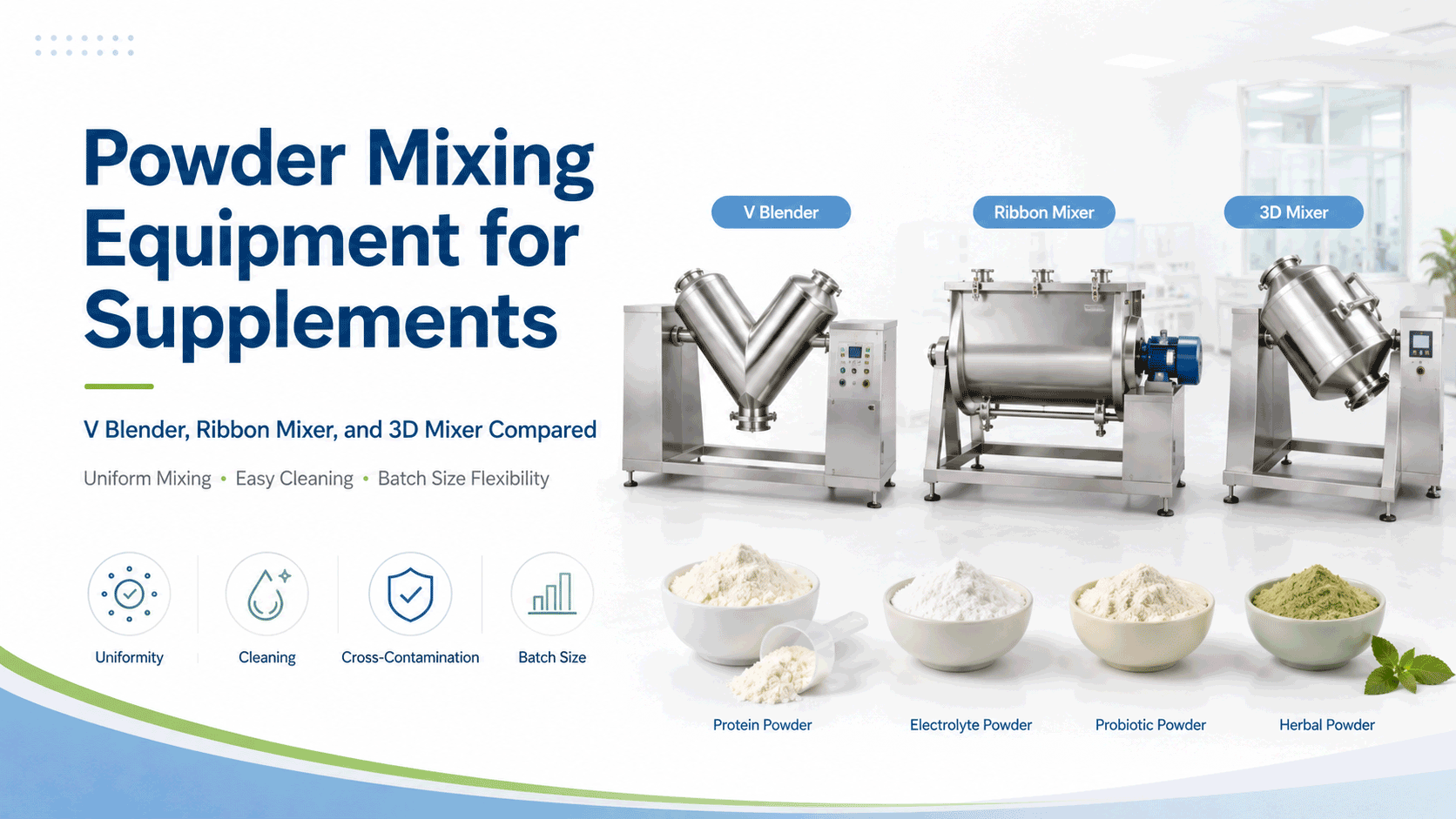
V blenders are widely used for dry powder blending in many industries. A V blender has a V-shaped tank that rotates, allowing powders to split, fall, and recombine repeatedly. This creates a gentle mixing action based mainly on gravity and diffusion. For free-flowing powders and granules, V blenders can produce a homogeneous mixture with relatively low shear.
In supplement manufacturing, V blenders are often suitable for formulas that do not require aggressive agitation. They can be useful for vitamins, simple herbal blends, dry ingredients with good flowability, and products where particle damage should be minimized. Because the mixing action is gentle, V blenders may help protect fragile particles or granules.
However, V blenders may not be the best choice for every powder. If the formulation contains cohesive powders, sticky ingredients, large density differences, or micro-ingredients that are difficult to disperse, the mixing process may take longer or require pre-blending. In some cases, an intensifier bar or additional mixing technology may be needed to improve distribution. Without proper process validation, a V blender may produce a mixture that looks uniform but still contains uneven ingredient distribution.
3D mixers are also used for gentle powder mixing. A 3D mixer moves the container in multiple directions, creating a more complex motion than simple rotation. This multi-directional movement can improve powder flow inside the tank and help achieve homogeneous mixing without using high shear. For small batches, flexible production, and formulas that require careful handling, 3D mixers can be a suitable solution.
Both V blenders and 3D mixers are often valued for their simplicity, gentle operation, and suitability for dry powder. They can be useful when a factory produces many small batches or needs frequent formula changes. Their lower shear action can protect certain materials, but they may have limitations when handling cohesive powders or high-volume production.
For factories producing protein powder, electrolyte powder, or herbal powder at larger volumes, V blenders and 3D mixers may not always provide the desired output or efficiency. In such cases, ribbon mixers, paddle mixers, or other industrial powder mixing machines may be more practical.
Ribbon Mixers, Ribbon Blenders, and Paddle Mixers for Higher-Capacity Blending
Ribbon mixers and ribbon blenders are among the most common industrial mixers used for powder blending. A ribbon mixer usually has a horizontal tank with inner and outer ribbon blades. These blades move powders in opposite directions, creating a convective mixing pattern. This helps move materials from side to side, top to bottom, and center to edge.
For supplement factories, ribbon mixers are often suitable for larger batch sizes and higher production volume. They can handle protein powders, meal replacement powders, electrolyte powders, herbal blends, food powders, and other powdered products. Compared with V blenders, ribbon mixers usually provide stronger mechanical movement and can achieve efficient mixing in a shorter time for many dry powder formulations.
Ribbon mixers are versatile and can be used in food processing, pharmaceutical industries, chemicals, pigments, fertilizers, and many other industries. For supplement production, stainless steel construction and hygienic design are important because the equipment must support food-grade and GMP-style requirements. A suitable ribbon mixer should be easy to clean, easy to inspect, and capable of maintaining product quality across repeated batches.
Paddle mixers are another option for industrial powder mixing. Unlike ribbon mixers, paddle mixers use paddles to move and lift materials. This can create a more fluidized particle movement and may be useful for certain powders that need faster blending or more active agitation. Paddle mixers can be suitable for formulations that require more intense mixing, but the shear level must be matched carefully to the material.
For fragile ingredients, too much mechanical force may damage particles or affect product performance. For cohesive powders, stronger action may be necessary to break clumps and improve distribution. This is why machine selection should always consider the specific requirements of the formula.
Ribbon mixers and paddle mixers usually offer better capacity and higher efficiency for large batch production. However, they may also require more attention to cleaning, shaft seals, discharge valves, residue points, and maintenance. Because they contain internal moving parts, the cleaning process must be well designed to prevent cross-contamination between batches.
The right choice depends on the balance between volume, performance, cleaning, and product protection. A ribbon mixer may be suitable for high-volume supplement powder production, while a paddle mixer may be better for certain formulations that need more active movement. A V blender or 3D mixer may be better for gentle blending and small batches. Each machine has its place in the production line.
How to Choose the Right Dry Powder Mixer for Supplement Factories
Match Mixing Machine Selection to Batch Sizes, Desired Output, and Energy Efficiency
Batch size is one of the most important factors when choosing powder mixing equipment. A factory producing small batches for custom supplement formulations may need flexible powder mixers that are easy to clean and quick to change over. A factory producing large volumes of protein powder or electrolyte powder may need industrial powder mixing machines with larger tank volume, higher output, and stronger production efficiency.
The working volume of the mixer is just as important as the total tank volume. Most mixers cannot operate effectively when they are too full or too empty. If the batch is too small, the powder may not move properly inside the tank. If the batch is too large, the mixer may not produce a homogeneous mixture or may overload the motor. The equipment should be sized according to real batch sizes, not only future ambitions.
Desired output should also include more than mixing time. A factory should calculate the full cycle time, including loading raw materials, mixing, sampling, discharge, cleaning, drying, inspection, and transfer to the filling line. A mixer that blends quickly but takes a long time to clean may not improve overall efficiency. A machine that discharges poorly may create waste and reduce yield. A mixer that is difficult to connect to the filling line may slow down production.
Energy efficiency should be considered as part of the total cost of ownership. A more efficient mixer does not simply use less power. It produces the required homogeneous mixture with less time, less waste, less rework, lower maintenance needs, and better batch consistency. For industrial powder production, energy efficiency and operational efficiency are closely connected.
Continuous mixers may be suitable for factories with stable formulas and high-volume production. They allow materials to move through the mixing process continuously instead of in separate batches. This can improve efficiency when the product and process are stable. However, batch mixers are often better for supplement factories that produce many different products, small batches, or custom formulations. Batch mixing also makes it easier to separate and document each production run.
The best dry powder mixer should match the factory’s current production needs while allowing some room for future growth. Buying equipment that is too small can limit business development. Buying equipment that is too large can reduce mixing performance for small batches and increase cleaning time, waste, and cost.
Cleaning, Cross-Contamination Control, and Production Line Integration
Cleaning is a critical factor for powder mixing equipment used in supplements. Many supplement factories produce multiple formulations on the same machine. If the mixer is not easy to clean, residues from one batch may contaminate the next batch. This can affect taste, color, potency, allergen control, microbial quality, and customer trust.
Powders can remain in many places inside a mixer. Residue may collect around seals, shafts, paddles, ribbon blades, discharge valves, tank corners, inspection ports, and internal surfaces. A good mixing machine should be designed for easy cleaning and easy inspection. Stainless steel contact surfaces, smooth welds, accessible openings, and hygienic discharge designs can help reduce cleaning difficulty.
For food and pharmaceutical industries, cleaning expectations are higher. The equipment should support industry standards and help the factory maintain hygiene. Some applications may require wet cleaning, dry cleaning, manual cleaning, or clean-in-place functionality. The right cleaning method depends on the product, material risk, equipment design, and production environment.
Cross-contamination prevention is especially important when producing supplements with strong colors, strong flavors, allergens, probiotics, botanical extracts, or mineral ingredients. The factory should define cleaning procedures and verify that residues are removed before the next batch. Easy cleaning is not only a convenience. It is a quality requirement.
Dust control is another important issue. During powder mixing, loading, discharge, and transfer, dust may escape into the production area. This can create worker safety concerns, cleaning problems, material loss, and contamination risk. A well-designed powder blending equipment system may include closed feeding, dust collection, sealed discharge, and proper material transfer methods.
Production line integration should also be considered before purchase. The mixer must connect smoothly with upstream and downstream processes. Raw materials may come from bags, drums, bins, or vacuum transfer systems. After mixing, the powder may go to a powder filling machine, jar filling line, sachet machine, stick pack line, or other packaging equipment. If the mixer does not discharge efficiently into the next process, the entire line may slow down.
For supplement factories, the right powder mixing equipment should support uniform mixing, easy cleaning, low waste, energy efficiency, and stable production flow. It should be suitable for the specific needs of the formulation, the desired output, and the factory’s quality system.
Choosing between V blenders, 3D mixers, ribbon mixers, ribbon blenders, paddle mixers, and continuous mixers is not only a technical decision. It is a product quality and process control decision. The right machine helps ensure homogeneous mixing, protect raw materials, reduce waste, maintain product quality, and produce final products that meet customer expectations.
For small batches, flexible production, and gentle dry powder blending, V blenders and 3D mixers may be suitable. For larger batch sizes, higher output, and industrial powder production, ribbon mixers and paddle mixers may offer better efficiency. For stable high-volume production, continuous mixers may be considered when the formula and process are consistent.
The best mixer is the one that fits the real powder, the real batch, the real cleaning requirement, and the real production line. In supplement manufacturing, successful powder mixing starts with understanding the product before choosing the equipment.


