19 Oct Turnkey Supplement Production Line: From Mixing and Formulation to Filling and Packaging
The nutraceutical industry is expanding beyond traditional vitamins and minerals. Today’s market includes sports nutrition powders, botanical capsules, functional foods, liquids, softgels, gummy vitamins, effervescent tablets, and many other nutraceutical supplements. As consumer demand becomes more diverse, brands and supplement manufacturers need production systems that can handle multiple formulas, packaging formats, and batch sizes without sacrificing quality or efficiency.
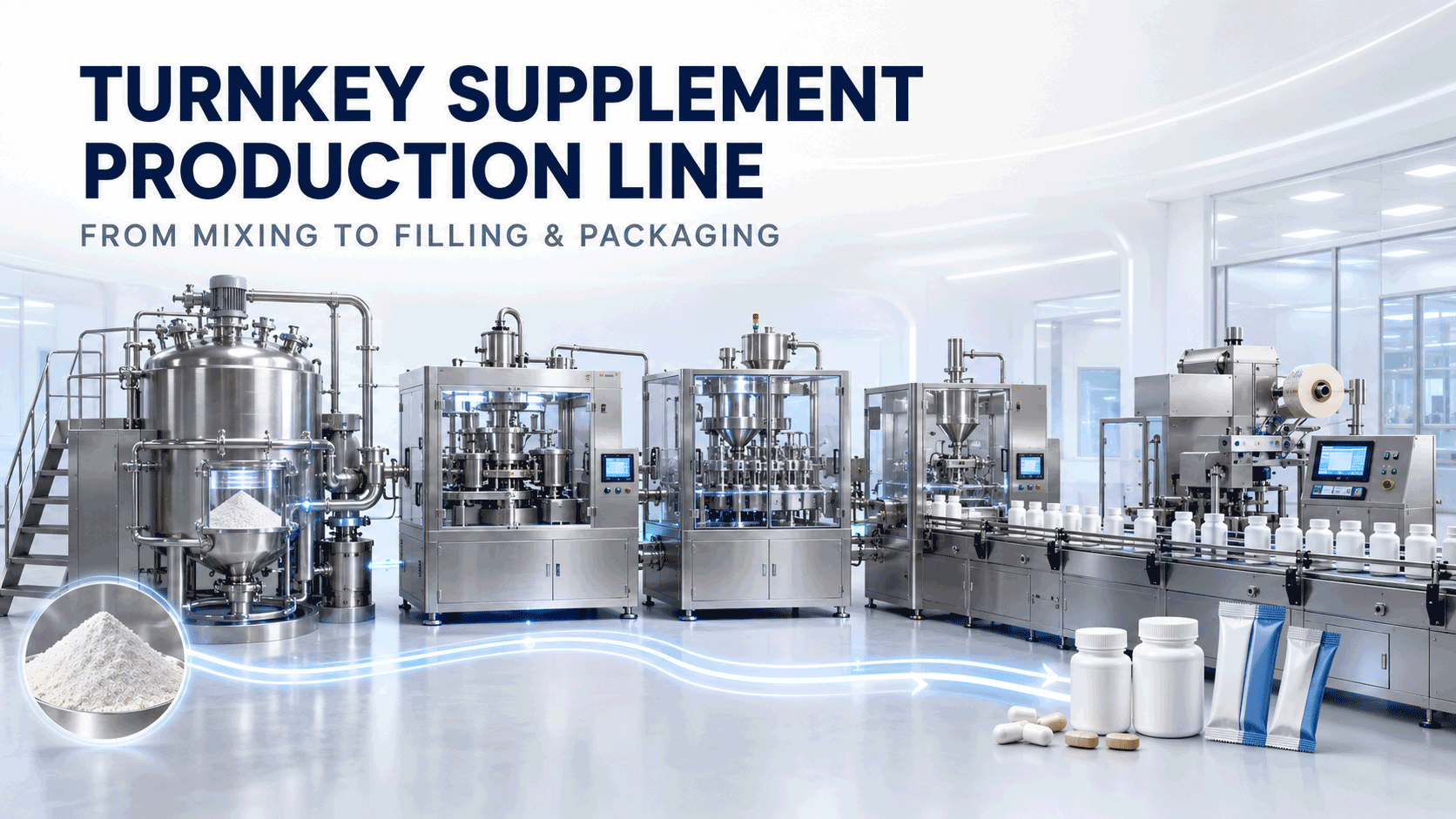
A turnkey supplement production line brings the major stages of supplement manufacturing into one coordinated solution. Depending on the project, the line can integrate raw material handling, screening, weighing, mixing, granulation, tablet compression, capsule filling, powder dosing, liquid filling, testing, packaging, labeling, and secondary cartoning. It may also include utilities, dust control, material transfer, cleaning systems, production records, and line management software.
The main value of a turnkey approach is integration. Purchasing individual machines without considering material flow, production capacity, room layout, cleaning requirements, and upstream or downstream compatibility can create bottlenecks. A high-speed tablet press, for example, provides little benefit when the mixer cannot supply enough material or the packaging machine cannot handle the resulting output.
A properly designed turnkey supplement production line treats supplement manufacturing as one connected process rather than a collection of unrelated machines.
1. Planning a Turnkey Supplement Production Line Around Your Supplement Manufacturing Needs
1.1 From Supplement Ideas and Custom Formulation to a Scalable Manufacturing Process
Every successful project begins with a clear understanding of the product rather than a list of equipment. Before choosing machinery, a company should define what it intends to produce, who the customers are, how the supplement will be consumed, and where it will be sold.
A custom formulation determines much of the manufacturing process. The properties of the active ingredients influence mixing time, environmental controls, dosing technology, granulation requirements, and equipment contact materials. A formula containing low-dose vitamins requires careful distribution throughout the blend, while a pre workout powder containing creatine, amino acids, flavors, and sweeteners may require a different mixing sequence and dust-control strategy.
The development team must also consider whether the product will take the form of powders, tablets, capsules, liquids, softgels, or gummy vitamins. Powders are popular for their versatility, scalable serving size, and easy mixing with water or other beverages. Hard capsules can contain powders, granules, pellets, or certain liquid fills and may use gelatin or vegetarian shell materials. Tablets can be compressed into a wide range of shapes, sizes, weights, and hardness levels.
Softgels are a popular form for oils and lipid-soluble active ingredients because they are easy to swallow, provide a sealed dosage form, and can support a long shelf life when the formulation and packaging are properly designed. Gummy vitamins are favored by many consumers for their taste and chewable format, although their manufacturing process requires specific expertise in cooking, depositing, drying, and controlling moisture.
An experienced engineering and formulation team should assess ingredient compatibility, dose, bulk density, particle size, flowability, moisture sensitivity, and heat sensitivity. These factors determine whether a formula can move efficiently through the selected machines.
The team must then translate the formula into target batch sizes and production capacity. A startup testing supplement ideas through online marketplaces may require frequent product changeovers and relatively small batches. An established company supplying national retailers may prioritize continuous output and automated packaging. A scalable line should allow brands to adjust production sizes as market demand changes.
Custom formulas also need to be evaluated against the regulatory requirements of the intended market. Ingredient legality, maximum or recommended usage levels, claims, label content, allergen declarations, and required records may differ across countries. Regulatory compliance cannot simply be added after manufacturing begins; it must be considered during formulation, equipment design, facility planning, and quality control.
1.2 Selecting Supplement Manufacturing Equipment for Powders, Tablets, Hard Capsules, Softgels and Gummy Vitamins
The required supplement manufacturing equipment depends on the product form and process. Most solid-dose lines begin with raw material reception, quarantine, sampling, weighing, screening, and dispensing. Stainless-steel sieving machines help remove foreign material and break up agglomerates before mixing. Vacuum conveying or closed transfer systems can reduce dust and limit manual handling.
Mixers are crucial because inconsistent blending can result in unequal distribution of active ingredients. V-blenders, bin blenders, ribbon blenders, double-cone mixers, and high-shear mixers each serve different supplement manufacturing needs. The correct selection depends on the properties of the powders, batch capacity, required mixing intensity, and cleaning method.
Some formulas can move directly from blending into capsule filling, tablet compression, or powder packaging. Others need granulation to improve flow, reduce dust, prevent ingredient separation, or enhance compressibility. Wet granulation typically requires a high-shear granulator, fluid-bed dryer, mill, and final blender. Dry granulation may use roller compaction followed by milling and lubrication.
Tablet production requires a tablet press with suitable tooling, compression force, output capacity, and control functions. Tablets can be produced in various shapes and sizes, but the formula must have adequate flow and compression properties. Depending on the product, downstream equipment may include a deduster, metal detector, tablet counter, coater, inspection system, and blister or bottle packaging line.
Hard capsule manufacturing usually requires a capsule filling machine, capsule polishing equipment, metal detection, and inspection. Semi-automatic machines can be cost effective for moderate output or frequent product changes, while fully automatic machines support higher production efficiency. Accurate dosing and reliable capsule separation, filling, closing, and rejection are essential for consistent quality.
Softgel production is technically different from filling preformed hard capsules. It generally involves preparation of the gelatin or vegetarian shell mass, fill-material preparation, encapsulation using rotary-die equipment, tumble drying, controlled final drying, inspection, sorting, and packaging. A turnkey softgel project therefore requires dedicated processing rooms and environmental controls.
Powder lines may use auger fillers, volumetric dosing machines, linear weighers, or other precision systems. The selection depends on powder flow, serving weight, accuracy requirements, and the intended packaging. A pre workout powder may be filled into tubs, jars, pouches, sachets, or stick packs. Each form creates different demands for precise dosing, dust extraction, sealing, and cleaning.
Liquid production may include purified-water preparation, mixing tanks, homogenizers, filtration, holding tanks, pumps, and volumetric or flow-meter filling machines. Gummy vitamins require another specialized group of machines, typically including cooking, mixing, flavor and color addition, depositing, cooling or drying, demolding, oiling or sanding, inspection, and packaging.
No single machine configuration is ideal for every supplement. The line must be engineered around the formula, dosage form, production environment, cleaning strategy, expected demand, and future product range.
2. How Supplement Manufacturing Moves from Mixing to Forming and Filling
2.1 Mixing, Granulation and Precise Dosing for Consistent Dietary Supplement Production
After approved raw materials enter the production area, each ingredient must be identified, weighed, and documented. Proper dispensing is critical because even advanced technology cannot correct an incorrect quantity introduced at the beginning of a batch.
Materials are typically screened before blending. The manufacturing team may use staged addition or premixing when a low-dose active ingredient must be distributed through a much larger quantity of carrier material. This process helps reduce the risk of concentration differences within the final blend.
Mixing parameters should be established for each formula. Blender speed, fill level, loading sequence, and mixing time can all affect uniformity. Excessive mixing may also be undesirable because differences in particle size and density can cause segregation after an apparently uniform blend has been produced.
Granulation may be introduced when the blended powder does not flow or compress efficiently. In wet granulation, a binding liquid is added to form granules, which are then dried and milled to a controlled size. In dry granulation, powder is compacted without adding liquid. The method must suit the stability of the vitamins, botanical extracts, minerals, and other active ingredients in the formula.
In-process quality control may include particle-size checks, moisture measurements, blend uniformity testing, bulk-density measurement, and verification of flow properties. The results provide evidence that the material is ready for the next stage.
Equipment construction also affects safety and efficiency. Product-contact parts should use appropriate materials and finishes, while machines should minimize inaccessible spaces where powder can accumulate. Easy cleaning and tool-free changeovers can shorten downtime between batches, but cleaning procedures must still be validated or appropriately verified according to the facility’s quality system.
Dust management is another essential consideration. Powders can escape during weighing, transfer, mixing, compression, and filling. A well-designed line may use contained transfer, local extraction, vacuum conveying, and enclosed machinery to protect operators, reduce cross-contamination, and improve material recovery.
The purpose of automation is not simply to make the machines run faster. Automated systems can improve production efficiency and quality consistency by controlling recipes, monitoring machine settings, detecting deviations, and rejecting nonconforming units. However, trained personnel must still review the process and respond to alarms or unexpected results.
2.2 Producing Powders, Tablets, Hard Capsules, Softgels, Liquids and Gummy Vitamins
Once the intermediate blend or granules meet specifications, production follows the path required by the dosage form.
For powders, the material may move directly to an auger filler, sachet machine, stick-pack machine, pouch filler, or container-filling system. Powders that contain creatine, proteins, minerals, or botanical extracts can vary significantly in density and flow. The dosing system must therefore be tested with the actual formula rather than selected only from a theoretical output figure.
A powder packaging machine forms or receives the package, measures the product, fills it, and creates the final seal. Checkweighing, metal detection, code printing, and seal inspection may be integrated downstream. Because powder can contaminate the sealing area, efficient dust extraction and package cleaning are critical to seal quality.
For tablets, granules enter the tablet press and flow into dies before being compressed between punches. Tooling determines the tablet’s shape and size, while fill depth and compression settings influence weight, thickness, hardness, and disintegration. The line should detect abnormal pressure or weight conditions and stop or reject affected output.
Tablets may then be coated to improve appearance, mask taste, protect sensitive ingredients, or modify product performance. After coating, they can be counted into bottles or packed into blisters. Effervescent tablets usually need additional moisture control and packaging with strong barrier properties.
For hard capsules, empty shells are oriented, separated, filled, closed, and discharged. Capsule shells can be made from gelatin or vegetarian materials. Fill weight depends on the dosing system, capsule size, powder density, and formula behavior. In-process weight checks and capsule inspection help identify incomplete filling, damaged shells, or improperly closed capsules.
Softgels require the simultaneous formation of the shell and encapsulation of the liquid or semi-solid fill material. Precise control of temperature, viscosity, ribbon thickness, and fill volume is essential. After encapsulation, the softgels pass through drying and inspection before packaging. Their long-term stability depends on the interaction among the shell, fill formula, drying conditions, and package barrier.
Liquids are mixed and, where required, homogenized or filtered before filling. Filling machines must handle the product’s viscosity, foaming tendency, and required dose. Containers then move through cap placement, capping, induction sealing, labeling, and inspection.
Gummy production adds heat and moisture considerations. Active ingredients may be introduced at a stage that limits unnecessary thermal exposure. Deposit weight, texture, water activity, drying conditions, and coating must be controlled to maintain product quality over its intended shelf life.
Each dosage form has distinct manufacturing requirements, but all production routes depend on precision, repeatable controls, hygienic equipment, qualified personnel, and documented quality decisions.
3. Packaging, Quality Control and One Stop Shop Turnkey Solutions
3.1 Packaging and Strict Quality Control for Product Integrity and Regulatory Compliance
Packaging is more than the final visual stage of manufacturing. Packaging machines protect dietary supplements against moisture, oxygen, light, physical damage, and contamination. The selected bottle, pouch, blister, stick pack, cap, liner, and seal must be compatible with the formula and intended shelf life.
Tablets and capsules may be counted into bottles, capped, induction sealed, labeled, coded, and packed into cartons. Sensitive products may require desiccants or oxygen-control components. Blister packaging separates individual units and can provide a strong barrier when appropriate materials are selected.
Powders may be filled into tubs, bags, pouches, sachets, or sticks. Liquids may use bottles, ampoules, sachets, or single-dose containers. Packaging equipment must consistently deliver the correct quantity while producing secure, clean seals.
Secondary packaging can include cartoning, leaflet insertion, case packing, serialization or coding where applicable, and pallet preparation. Integrated rejection systems help remove underweight packs, missing caps, unreadable codes, incorrect labels, or defective seals.
Strict quality control begins before production and continues through release. Quality control personnel oversee specifications, testing, documentation, manufacturing controls, and the disposition of materials and finished products. Incoming ingredients may require identity verification and other testing based on established specifications and qualified supplier controls.
In-process testing can cover blend uniformity, tablet weight, hardness, capsule fill weight, liquid volume, gummy weight, package integrity, and coding accuracy. Finished-product testing may include identity, strength, composition, purity, microbiological quality, contaminants, and other formula-specific requirements.
For products manufactured or offered for import in the United States, the dietary supplement CGMP requirements under 21 CFR Part 111 apply to relevant manufacturing, packaging, labeling, and holding operations. The rules require master manufacturing records, batch production records, quality control operations, and supporting documentation. A batch production record must be prepared for every manufactured batch and contain complete information related to its production and control. FDA dietary supplement CGMP guidance and 21 CFR Part 111.
Built-in monitoring, electronic records, recipe controls, and rejection systems can support regulatory compliance, but machinery alone does not guarantee compliance. A compliant operation also requires qualified personnel, approved procedures, validated or verified processes where appropriate, calibration, maintenance, sanitation, investigation of deviations, testing, and independent quality oversight.
3.2 Building a Cost-Effective One Stop Shop for Brands and Online Marketplaces
The advantage of a one stop shop is not merely purchasing every machine from one company. The real value comes from having one engineering team evaluate the complete process, connect the machines, balance their capacities, and accept responsibility for line performance.
A turnkey project should begin with a user requirement specification covering products, formula characteristics, batch sizes, output targets, packaging formats, room conditions, utilities, operator requirements, and future expansion. The equipment supplier can then create a process flow, line layout, machine list, control concept, and project schedule.
Capacity matching is crucial. Every stage must be evaluated in relation to the rest of the line. Oversizing one machine while ignoring a slow filling or packaging stage increases capital costs without necessarily increasing total output. A cost-effective design focuses on balanced production efficiency and realistic market demand.
Turnkey production lines can reduce scheduling bottlenecks and logistical delays by coordinating equipment design, factory testing, shipment, installation, commissioning, and operator training. They can also make maintenance easier when spare-parts planning, technical documentation, and service responsibilities are clearly defined.
However, purchasing a turnkey supplement production line does not eliminate upfront capital investment. It consolidates and controls that investment. Brands that want to avoid purchasing machinery and building an in-house facility may instead use contract supplement manufacturers. In that model, the manufacturer may provide formulation, sourcing, production, packaging, and fulfillment services.
The broader commercial solution may also cover packaging development, labeling support, graphic design, and brand identity. These services are especially relevant for products sold through online marketplaces, where packaging must protect the product during fulfillment while communicating its form, serving format, and positioning clearly to the consumer.
Graphic design should still be connected to regulatory review. An attractive label cannot compensate for missing mandatory information, unsupported claims, poor readability, or incorrect ingredient declarations. Artwork approval, label reconciliation, version control, and packaging-line verification should therefore form part of the quality process.
When evaluating supplement manufacturing equipment or a complete turnkey solution, customers should examine more than machine speed. They should consider product compatibility, precise dosing, easy cleaning, changeover time, control functions, line integration, documentation, maintenance access, technical support, spare-parts availability, and the supplier’s process expertise.
The best turnkey supplement production line is ultimately the one designed around real supplement manufacturing needs. It should protect product integrity, enhance production efficiency, support regulatory compliance, accommodate innovation, and give brands room to create new supplements as the nutraceutical industry evolves.
From formulation and raw material handling to mixing, forming, filling, labeling, and packaging, every stage contributes to the safety and quality of the finished dietary supplement. Treating those stages as one integrated system helps manufacturers produce more efficiently, maintain consistency, and respond confidently to increasing demand.


