19 May Designing a GMP‑Compliant Supplement Manufacturing Facility Best Practices for Safe and Efficient Production
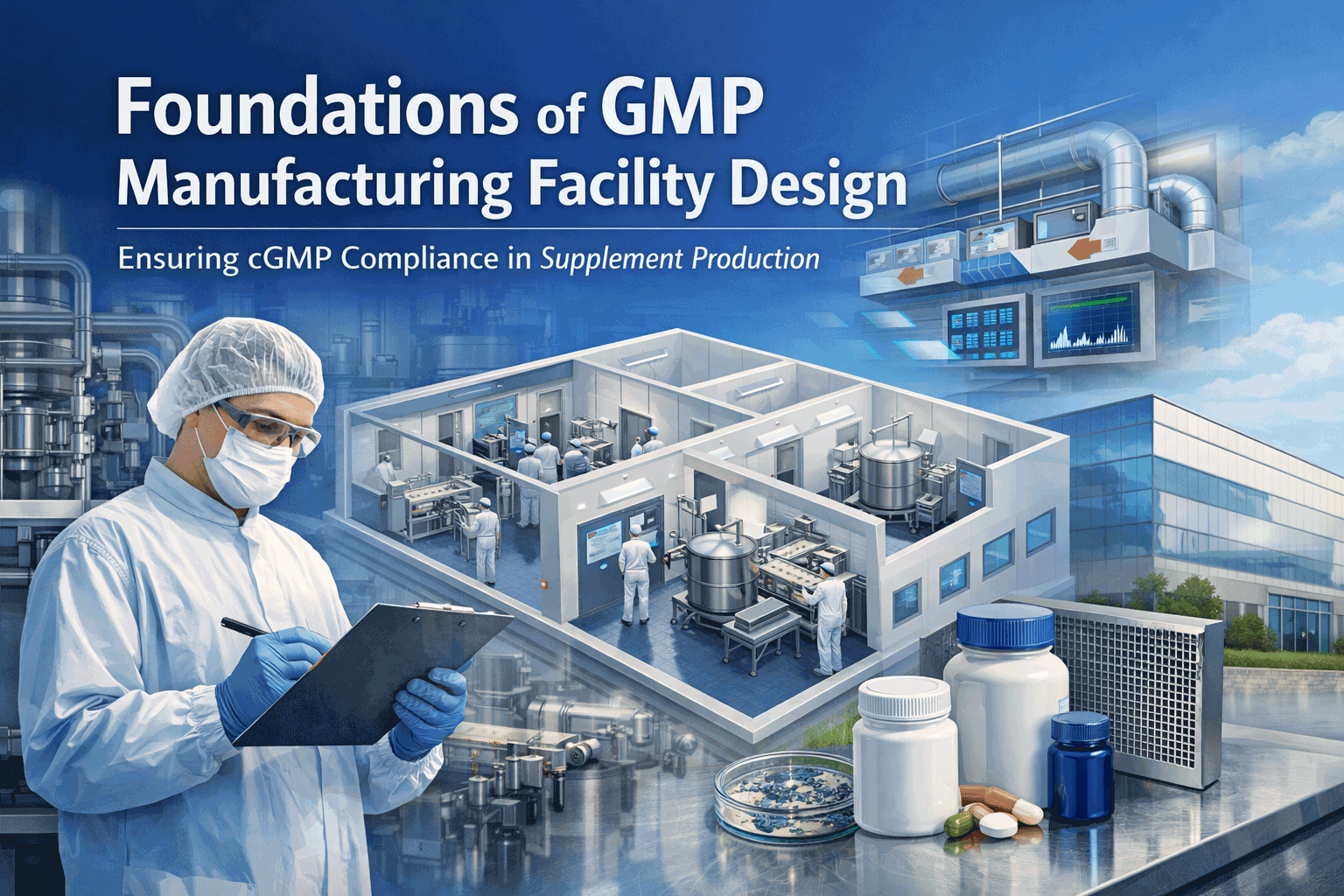
Foundations of GMP Manufacturing Facility Design
What Is Current Good Manufacturing Practice (cGMP)?
Current Good Manufacturing Practice, abbreviated as cGMP, refers to a set of guidelines enforced by regulatory bodies such as the Food and Drug Administration (FDA) to ensure the quality and safety of pharmaceutical products, including dietary supplements and medical devices. These practices are enshrined under the Federal Food, Drug, and Cosmetic Act and serve as a fundamental component of public health protection. cGMP regulations address all aspects of production and process controls, ranging from facility design and maintenance to equipment operation, staff hygiene, and material handling.
In the context of dietary supplements, cGMP compliance is non-negotiable. It is essential to safeguard consumer health and protect the integrity of the manufacturing process. Pharmaceutical manufacturers must align every stage of their operation with established cGMP standards, as outlined in the relevant FDA guidance documents. This ensures that supplements are manufactured under conditions that minimize contamination risks and errors, ultimately producing consistent, high-quality products.
Regulatory Framework for Dietary Supplements
The regulatory expectations for dietary supplements are codified in 21 CFR Part 111. These regulations include criteria for personnel qualifications, sanitary conditions, and robust documentation practices. In terms of facility infrastructure, manufacturers must ensure that their GMP facility is properly designed and maintained to comply with cGMP regulations. Design aspects include everything from air handling and cleanliness to segregation of product types and process flows.
By incorporating facility design as a critical element of regulatory compliance, manufacturers can build preventive systems to avoid costly remediation. The FDA assesses gmp manufacturing facility design during inspections, emphasizing whether a manufacturer has taken appropriate steps to prevent contamination and mix-ups through facility layout, room construction, and materials used.
Why Facility Design Impacts Regulatory Inspections
Improper facility design is a red flag during FDA inspections. Inspectors look for signs of potential cross-contamination, insufficient process controls, and improper material flow, all of which can compromise product integrity. A poorly executed layout may lead to product mix-ups, microbial contamination, or inefficient cleaning, which are violations of gmp standards.
An inspection-ready infrastructure must facilitate visual cleanliness, provide defined spaces for each stage of the manufacturing process, and minimize opportunities for contamination. The agency assesses cleanliness, maintenance, monitoring systems, and physical barriers between adjacent spaces to determine compliance. Hence, proper design from the outset is not merely architectural but a critical compliance and risk-mitigation strategy.
GMP Facility Layout and Flow Planning
Designing a GMP Facility to Prevent Contamination
Preventing contamination is central to facility layout design in gmp manufacturing facilities. This objective is achieved through the zoning of manufacturing areas and implementing linear workflows that keep materials, personnel, and products moving in unidirectional paths. By organizing plant grounds to separate high-risk operations from low-risk ones, manufacturers minimize the risk of airborne particles and microbial contaminants entering critical spaces.
Production areas must be designed to manage controlled environments, particularly in zones dealing with raw materials or finished products. Adherence to iso standard classifications further guides the construction of rooms that align with cleanliness and contamination control requirements. The use of smooth, non-porous walls and sealed floors supports sanitary operations. Additionally, the strategic location of washing areas and equipment storage ensures that cleaning activities do not interfere with production.
Material Flow and Personnel Flow Control
Maintaining appropriate material and personnel flow is essential in avoiding contamination and maintaining cGMP compliance. Manufacturers must define separate entries and exits for staff and materials. Raw material ingress should not intersect with finished product egress. This design consideration helps mitigate contamination risks and maintains the integrity of the production process.
In GMP facilities, cross-functional areas must be clearly separated to prevent mix-ups and microbial contamination. Adjacent spaces with different classifications should be equipped with airlocks and pressure differentials to prevent backflow of air or contaminants. Furthermore, facilities should implement restricted access to critical zones and provide sanitation rooms for personnel to change into cleanroom garments before entry.
Hygienic Facility Design for Easy Cleaning
Facility surfaces, equipment positioning, and drainage systems must be designed to facilitate efficient and effective cleaning procedures. All walls, ceilings, and floors must be constructed of materials that can withstand repeated sanitization without degradation. Equipment must be installed to allow sufficient space for cleaning around and beneath machinery.
Designing with cleanability in mind also includes minimizing ledges, crevices, and exposed hardware that can harbor dust or microbes. Equipment used in the manufacturing process should be made from corrosion-resistant materials and positioned to allow maintenance personnel to perform routine inspections and cleanings without interrupting operations. Drainage should slope correctly to prevent water pooling, and floor designs should support safe cleaning processes.
Cleanroom Classification and Environmental Control
Cleanroom Classification for Supplement Manufacturing
Cleanroom classification plays a critical role in supplement manufacturing where airborne particulate control and microbial contamination prevention are essential. Cleanrooms are typically classified according to iso standard guidelines, based on the number of particles per cubic meter or cubic foot of air. Depending on the risk level of the operation, manufacturers may implement ISO Class 7 or Class 8 cleanrooms to maintain proper environmental control.
For dietary supplements, classification helps establish zones where contamination risks must be tightly controlled. Each class defines allowable particulate levels and guides HVAC system design and cleaning protocols. Classifications serve as benchmarks for compliance and are integral to facility qualification processes. Cleanroom project planning must also consider product types and operations, ensuring that classification levels are aligned with specific processing needs.
Controlling Microbial Contamination
Microbial contamination is a significant risk in any pharmaceutical or dietary supplement operation. Effective facility design, supported by strict process controls, is crucial in reducing this risk. Facilities must employ validated cleaning and sanitization protocols, use HEPA filters in air handling systems, and establish room pressure hierarchies to prevent backflow of unfiltered air.
Regular monitoring programs must be established to test surfaces, air, and equipment for microbial presence. Environmental sampling and trend analysis allow early identification of deviations from cleanliness standards. In high-risk areas, positive air pressure should be maintained relative to adjacent spaces to prevent microbial ingress. Decontamination procedures and validated disinfection agents are necessary to uphold microbial control.
HVAC Systems, Air Changes, and Pressure Control
Heating, ventilation, and air conditioning (HVAC) systems form the backbone of environmental control in a gmp facility. These systems regulate temperature, humidity, and air cleanliness while managing airflow patterns and pressure zones. The design must ensure a specific number of air changes per hour depending on the cleanroom classification, which ensures continuous filtration and removal of particles.
HEPA filters should be installed to deliver filtered air into cleanrooms, maintaining the required air quality. The direction of airflow, especially from cleaner to less clean areas, must be controlled using differential air pressure. The ability of HVAC systems to maintain consistent temperature and humidity is vital for sensitive materials and stable production environments. Properly maintained air handling units minimize risks associated with microbial contamination and ensure compliance with cgmp regulations.
Facility Systems That Support GMP Compliance
Water, Utilities, and Supporting Infrastructure
Water is a critical utility in supplement manufacturing. Potable and purified water must meet established microbial and chemical specifications. Water systems should be designed to minimize stagnation, allow for easy sanitization, and be constructed from materials resistant to microbial proliferation. Utility piping and delivery systems should be isolated to prevent contamination.
Other utilities, such as steam and compressed air, must be clean, dry, and appropriately filtered before coming into contact with the product or equipment. Utility panels should be integrated into facility walls to minimize protrusions and allow easy cleaning. Ensuring redundancy in these systems minimizes downtime and supports uninterrupted production.
Equipment Placement and Production Area Design
Equipment layout directly affects the ease of cleaning, the risk of cross-contamination, and operational efficiency. Equipment should be arranged in logical process sequences to prevent backtracking and crossover between clean and dirty areas. Where feasible, rooms should be dedicated to specific product types or processes.
Selecting appropriate construction materials for equipment is also crucial. Stainless steel is commonly used for its durability and ease of cleaning. Equipment should include features that minimize contamination risks such as closed transfer systems, enclosed conveyors, and smooth, weld-free seams. Accessibility for maintenance and calibration is also a critical aspect of placement planning.
Documentation, Monitoring, and Quality Control Integration
The facility must be designed to support robust documentation and monitoring systems. Digital and paper records must be readily accessible, secure, and retained in compliance with FDA guidelines. Areas dedicated to quality assurance and control should be integrated into the production space to allow real-time decision-making.
Monitoring systems should track environmental parameters, equipment performance, and batch progress. Alarm systems and audit trails help detect anomalies, while integration with Manufacturing Execution Systems (MES) ensures traceability. Effective documentation and control procedures are essential for maintaining cgmp compliance and protecting product integrity.
Building a Future-Ready GMP Facility for Dietary Supplements
Scalability and Flexibility in GMP Facility Design
Designing for scalability means preparing a facility for future growth. This involves planning for modular expansions, utility scaling, and adaptable layouts. Facilities should be able to accommodate additional product lines or equipment without compromising gmp compliance.
Flexible facility design allows manufacturers to adapt to changing regulations and market demands. This includes modular cleanroom construction, mobile equipment platforms, and interchangeable HVAC systems. By building flexibility into the original design, manufacturers can avoid costly renovations and operational downtime in the future.
Risk-Based Design to Maintain Long-Term GMP Compliance
A risk-based approach to facility design identifies potential failure points and implements preventive controls. This means evaluating airflow patterns, room pressurization, contamination pathways, and human factors during the design phase. GMP facility designers must anticipate evolving cgmp regulations and implement features that meet not only current but future compliance needs.
Regular audits, maintenance schedules, and change control procedures ensure the facility remains inspection-ready. Training programs and SOPs must evolve alongside facility updates to maintain operational consistency. This proactive approach reduces long-term compliance risks and enhances overall operational resilience.
Strategic Benefits of a Well-Designed GMP Facility
A well-executed gmp manufacturing facility design enhances product quality, employee safety, and operational efficiency. It minimizes contamination risks, reduces waste, and supports the consistent production of high-quality supplements.
Beyond compliance, a strategically designed facility strengthens brand credibility and opens access to global markets that demand stringent regulatory adherence. Manufacturers who invest in superior facility design position themselves as leaders in quality and innovation in the competitive dietary supplement landscape.
A future-ready GMP facility is not merely a legal requirement—it is a foundation for excellence in manufacturing, ensuring that products are made safely, consistently, and efficiently, meeting the expectations of regulators and customers alike.
