17 Jul Flexible Manufacturing for Personalization and Small Batches Building Agile Packaging Lines for High‑Mix Production
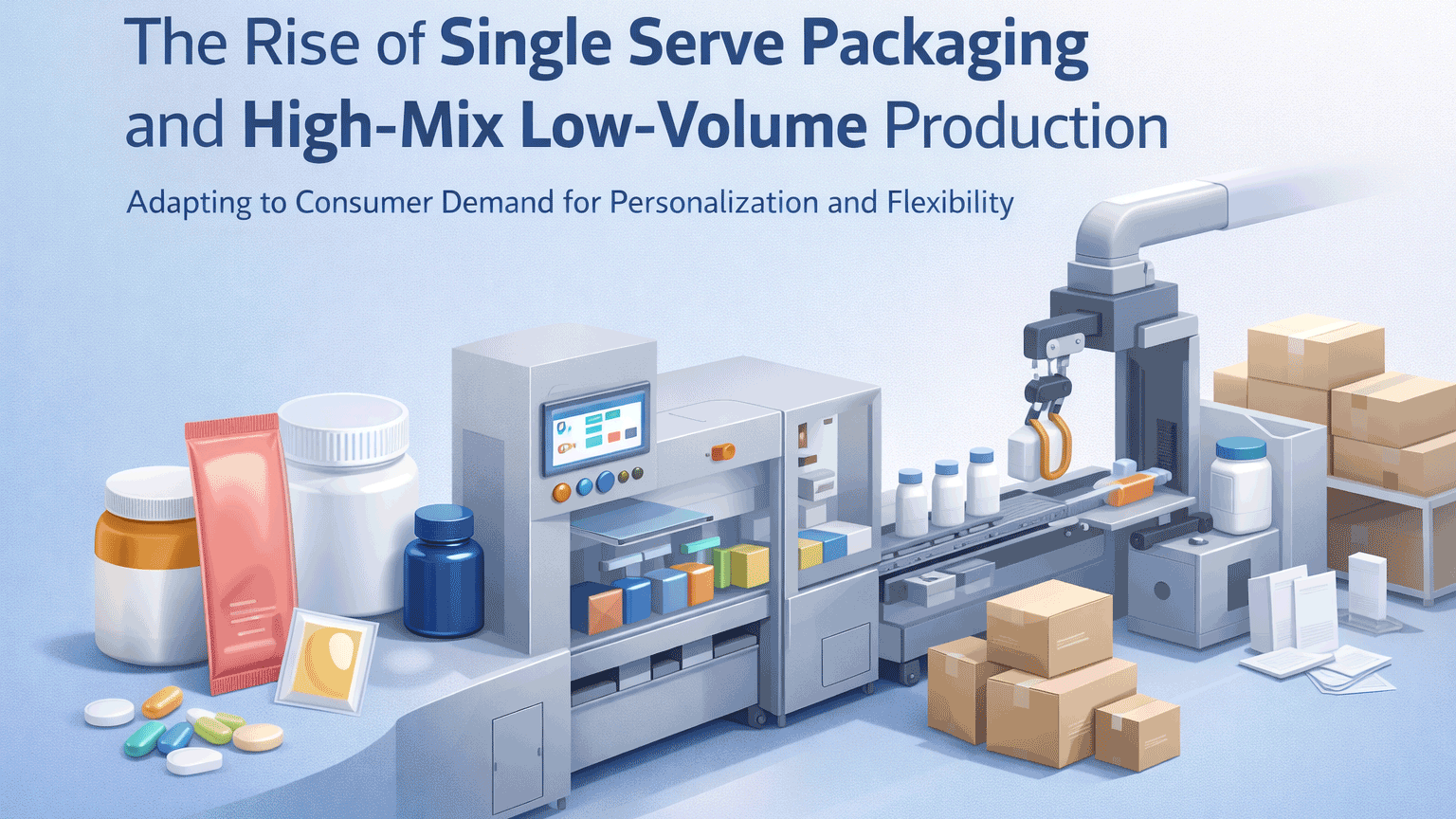
The Rise of Single Serve Packaging and High-Mix Low-Volume Production
Consumer Demand Driving Single Serve Packaging and Product Personalization
Modern consumers expect brands to cater to their personal needs and preferences. This shift toward personalization is reshaping the packaging landscape, especially in sectors like health supplements, food, and personal care. As consumers embrace unique flavor options, portion-controlled servings, and personalized formulations, manufacturers must evolve to support smaller production volumes and more frequent product changes. Single serve packaging has become a key solution in this environment. It not only enhances convenience and portion accuracy but also aligns with current health and lifestyle trends. Meeting these expectations means rethinking production processes to allow for high-mix, low-volume runs while maintaining product quality and delivery timelines.
Supply Chain Complexity and Inventory Turnover in High-Mix Manufacturing
The rise in SKUs has introduced a new layer of complexity to the supply chain. With multiple product variations in circulation, inventory turnover becomes more critical than ever. Traditional bulk production models are no longer sufficient to meet fluctuating demand. In high-mix low-volume manufacturing, companies must adopt agile operations that support quick changeovers and reduce inventory holding costs. Flexible manufacturing systems improve the flow of materials and simplify the changeover process between SKUs. This agility not only boosts supply chain efficiency but also enhances responsiveness to market shifts, minimizing the risk of obsolete stock and enabling faster time-to-market.
Production Capacity Challenges in High-Mix Low-Volume Environments
Balancing production capacity with variable demand is one of the biggest challenges in high-mix environments. Unlike traditional mass production, small-batch operations often face difficulties in justifying equipment investment due to lower unit volumes. However, the ability to scale production up or down with minimal effort is essential for staying competitive. Manufacturers must consider flexible packaging machines that can handle multiple formats and package sizes efficiently. Equipment designed for modular use or multiple shifts allows operations to maintain throughput, reduce production delays, and stay agile in an ever-evolving marketplace. It also supports reduced inventory costs and optimized use of resources.
Flexible Packaging Lines Powered by Modular Systems and Additive Manufacturing
Modular Packaging Lines as Key Components of Flexible Manufacturing
Modular packaging lines play a crucial role in allowing quick adjustments to production processes. These systems are designed with flexibility in mind, enabling manufacturers to switch between different packaging types, sizes, and product categories with minimal downtime. By using modular stations and interchangeable components, companies can build systems that adapt to current demand and scale according to future demand. This modularity significantly reduces lead times during product transitions and ensures that even small batches can be processed efficiently. As market demands continue to shift, modular packaging lines allow companies to stay agile and cost-effective.
Additive Manufacturing and Rapid Prototyping for Custom Packaging Formats
The adoption of additive manufacturing technologies such as 3D printing has further enhanced flexibility in packaging design and production. These technologies allow for rapid prototyping of machine components and tooling, which is especially useful when developing new packaging formats or testing limited-run products. Custom parts can be created on demand, reducing the time-consuming aspects of traditional fabrication. This approach not only supports innovation but also lowers initial investment and shortens development cycles. It gives manufacturers the ability to respond quickly to customer requests and produce packaging that aligns with branding and product positioning without delaying production timelines.
Multi-Format Equipment Design to Support Production Capacity Scaling
Today’s packaging machines are increasingly built to handle a wide range of product formats. Whether producing sachets, bottles, boxes, or single serve packs, multi-format equipment is essential for businesses managing varied product lines. These machines are engineered for ease of use, with intuitive changeover processes and built-in systems that allow for automatic adjustments. This versatility enables businesses to expand or contract production volume as needed without overhauling entire systems. It enhances productivity, reduces operational inefficiencies, and makes it easier to serve niche markets and mainstream customers alike. By investing in such flexible systems, companies can future-proof their manufacturing processes.
Quality Control, Data Collection, and Continuous Improvement in Agile Production Lines
Quality Control Systems for High-Mix Packaging Operations
Maintaining quality in high-mix, low-volume operations is critical but challenging. The need to switch frequently between SKUs introduces potential inconsistencies. Advanced quality control systems are essential to ensure each unit meets predefined standards. Automated inspection using machine vision technology helps detect defects in real time, maintaining high product quality across batches. Quality assurance processes must be robust yet flexible to accommodate varying packaging materials and formats. By focusing on consistent quality control, companies can avoid costly rework and enhance customer satisfaction even in small-scale personalized runs.
Data Collection and Performance Tracking to Reduce Downtime
In flexible manufacturing, data collection plays a vital role in operational efficiency. Real-time tracking of performance metrics, changeover durations, machine downtime, and production throughput offers valuable insights into areas for improvement. By analyzing this data, companies can implement strategies to reduce downtime and fine-tune the production process. Integrated software systems help ensure that every unit produced meets quality and performance expectations. These insights are also crucial for predictive maintenance, reducing the likelihood of unplanned stoppages and extending the life of machinery. The combination of automation and analytics is instrumental in supporting long term success in flexible production.
Continuous Improvement Strategies for Flexible Manufacturing and Inventory Optimization
Sustainable success in flexible manufacturing requires a commitment to continuous improvement. Lean manufacturing principles, when applied to high-mix environments, help streamline workflows, eliminate waste, and improve material handling processes. Manufacturers can use performance data to identify bottlenecks, enhance training for operators, and make informed decisions on resource allocation. This approach supports both short-term efficiency gains and long-term growth. As product portfolios grow and customer expectations evolve, companies must continuously refine their operations to reduce lead times, improve inventory turnover, and stay competitive. The ability to adapt through continuous improvement is not just beneficial—it is essential in today’s dynamic manufacturing landscape.
In conclusion, flexible manufacturing has become an essential strategy for companies navigating a world of increased personalization, varied product offerings, and shorter product life cycles. By leveraging modular systems, advanced data analytics, and agile quality control frameworks, manufacturers can meet current market demands while preparing for future opportunities. This integrated approach ensures that businesses not only maintain competitiveness but also lead innovation in the packaging industry.
