
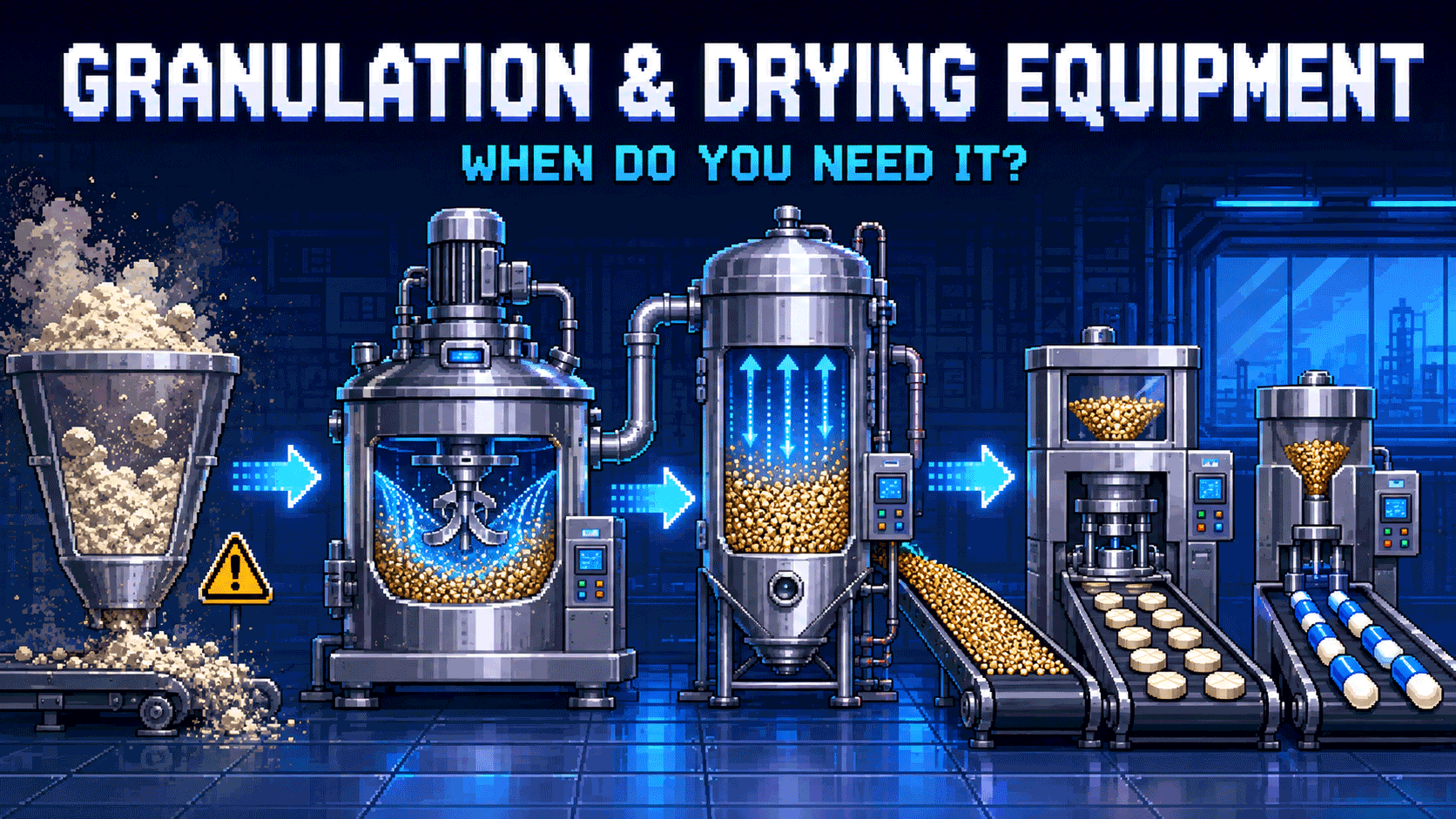
05 Nov Granulation and Drying Equipment for Tablets and Capsules: When Do You Need It?
A powder may look uniform in a laboratory container but behave very differently when it enters a tablet press or capsule filling machine. Fine powders can create dust, separate during transfer, form bridges inside a hopper, or flow into dies and dosing chambers at an inconsistent rate. These problems may result in variable tablet weight, capsule fill-weight variation, tablet capping, lamination, sticking, low hardness, and unstable production throughput.
Granulation is one of the main technologies used to correct these problems. The process converts fine powders into larger, more manageable agglomerates called granules. Pharmaceutical granulation can improve powder flow, increase bulk density, reduce segregation, enhance compressibility, and support more consistent dosing during tablet and capsule production.
However, not every formulation needs granulation. Materials with excellent flow properties and compressibility may be suitable for direct compression or direct capsule filling. Adding unnecessary granulation equipment increases processing time, equipment investment, cleaning requirements, validation work, and potential product loss.
Manufacturers must therefore answer two questions before purchasing a granulator machine: does the formula genuinely require granulation, and which granulation technology is appropriate for its physical and chemical properties?
1. When Granulation Equipment Is Needed in Tablet and Capsule Production
1.1 How Poor Powder Flow, Segregation and Low Bulk Density Affect Production
The first reason to consider granulation equipment is poor powder flow. Flowability describes how efficiently powdered material moves through a hopper, transfer system, feeder, die, or capsule dosing chamber. It is influenced by particle size, particle shape, surface texture, moisture, electrostatic charge, density, and the interaction among ingredients.
Fine powders have a large surface area in relation to their mass. This can increase cohesive forces between powder particles and make the material resistant to movement. Instead of flowing evenly, the powder may form arches over a hopper outlet, create channels inside the material bed, or suddenly collapse into the feeder.
Poor flow creates serious problems during tablet manufacturing. A rotary tablet press depends on the consistent filling of each die cavity. When the powder bed does not move uniformly, some dies may receive too much material while others receive too little. The result can be tablet weight variation and inconsistent active ingredient content.
The same issue appears in capsule production. Many capsule filling systems use volumetric dosing principles. If the powder mixture has unstable bulk density or does not refill the dosing zone consistently, capsule fill weight can vary even when the machine settings remain unchanged.
Increasing the speed of the tablet press or capsule filler may make the problem worse. At low speed, the powder has more time to enter the dosing area. At high speed, the available filling time becomes shorter, making reliable flow properties increasingly important. A formula that performs adequately during a laboratory trial may therefore fail when transferred to high-output pharmaceutical production.
Segregation is another reason to evaluate granulation. A powder mixture may contain ingredients with very different particle sizes and densities. Vibration, transfer, discharge, and transportation can cause larger or denser particles to move differently from smaller or lighter particles. Even if the original blend is uniform, it can separate before or during tablet compression or capsule filling.
Granulation helps bind primary powder particles into larger composite units. If each granule contains a representative distribution of the formula, the risk of ingredient separation during further processing may be reduced. This is especially important for products containing a relatively small quantity of an active ingredient.
Low bulk density can also cause operational difficulties. A lightweight powder occupies more volume for the same weight and may require a larger blender, hopper, container, or capsule size. Granulation can increase bulk density, allowing the material to occupy less space and move more consistently through the production processes.
Compressibility must be considered separately from flow. Some powders flow well but do not form strong tablets. Others may form tablets at laboratory scale but exhibit capping, lamination, cracking, or excessive friability during continuous production.
Capping occurs when the top or bottom section separates from the main body of a tablet. Lamination describes separation into horizontal layers. These defects can be connected to trapped air, inadequate bonding, incorrect moisture, poor particle size distribution, excessive compression speed, inappropriate tooling, or an unsuitable formulation. Granulation can improve bonding and reduce some of these problems, but it is not an automatic solution for every tablet defect.
Before adding a granulation stage, the manufacturing team should investigate the complete process. Tablet cracking may come from excessive compression, worn tooling, an unsuitable tablet shape, inadequate dwell time, or poor formulation design. Capsule weight variation may result from incorrect machine settings, inconsistent powder level, or worn dosing components rather than the absence of granulation.
Direct compression or direct capsule filling should generally be considered first when the powder mixture already provides adequate flow, content uniformity, bulk density, compressibility, and physical stability. These direct production methods require fewer processing stages and may reduce cost, cleaning, material handling, and production time.
Granulation becomes valuable when those properties cannot be achieved reliably through formulation adjustments, controlled blending, suitable excipients, or equipment optimization alone.
1.2 How Granulation Processes Improve Tablet Compression and Capsule Filling
Granulation is a particle-enlargement process in which small powder particles are combined to form granules. In pharmaceutical manufacturing, the granules are usually an intermediate material rather than the final dosage form. They may be mixed with external-phase excipients before tablet compression or transferred to a capsule filling machine.
The published review supplied as a reference describes pharmaceutical granulation as a significant unit operation for tablets and capsules. It explains that granulation transforms fine powders into more free-flowing and compressible material while also affecting particle size, bulk density, porosity, hardness, moisture, and physicochemical stability. Granulation techniques and technologies: recent progresses.
The principal benefit is improved powder flow. Larger granules usually have a lower surface-area-to-mass ratio than fine powders and may exhibit weaker cohesive behavior. Properly designed granules can move more evenly through hoppers and feeders, supporting stable filling of tablet dies and capsule dosing chambers.
Granulation can also produce a more consistent particle size distribution. A narrow or controlled particle size distribution reduces extreme differences between fine and coarse material. This can improve flow, reduce segregation, and support more consistent volumetric dosing.
The word “consistent” does not mean that every granule must be identical. A useful formulation often contains a planned range of granule sizes. Some fines may help fill the spaces between larger granules and contribute to tablet compression. Excessive fines, however, can recreate the dust, flow, and segregation problems that granulation was intended to solve.
Granules used in pharmaceutical applications can vary widely in size. The reference review notes a broad range of approximately 0.2 to 4.0 mm in pharmaceutical applications, while intermediate granules for tablet compression or capsule filling are often found in a narrower part of that range. This should not be treated as a universal specification. The desired granule size depends on the dosage form, formulation, equipment, dose, and required performance.
Granulation can improve compressibility by bringing binder and other functional excipients into closer contact with the powder particles. During tablet compression, the granules deform, fracture, or rearrange to create bonds. A properly developed process can support consistent hardness at a suitable compression force while controlling friability and disintegration.
The process can also reduce dust generation during powder handling. Lower dust levels may improve material recovery, operator conditions, housekeeping, and containment. Nevertheless, granulation is not a substitute for a formal combustible-dust or occupational-exposure control strategy. Appropriate extraction, containment, grounding, equipment design, and risk assessment remain essential.
Improved bulk density may enhance capsule production by placing more material into a given capsule volume. It can also reduce the storage and transfer volume required for a batch. However, excessive densification may affect tablet compressibility or product performance, so bulk density must be treated as a controlled quality characteristic rather than simply maximized.
Granulation may additionally improve wetting or dispersibility in certain food, beverage, and supplement powders. Agglomerated products can sometimes disperse more readily in liquid and form fewer surface clumps. This benefit depends on granule porosity, composition, surface properties, and the liquid in which the product will be mixed.
Ultimately, granulation is an essential process only when it creates measurable manufacturing or product-quality benefits. The decision should be supported by powder characterization, formulation trials, compression or capsule-filling studies, and an understanding of the intended drug delivery system or supplement dosage form.
2. Choosing Wet Granulation, Dry Granulation or Other Granulation Methods
2.1 Wet Granulation, High Shear Granulation and Fluid Bed Granulation
Wet granulation uses a granulation liquid to agglomerate powder particles. The liquid may contain a dissolved or dispersed binder, or the binder may be included in the dry powder mixture and activated when the liquid is added.
A conventional wet granulation process begins with weighing, screening, and dry mixing. The granulation liquid or binder solution is then introduced while the powder mixture is agitated. The liquid creates bridges between particles, producing nuclei that grow into wet granules.
As more liquid and mechanical energy are applied, the wet mass progresses through nucleation, growth, consolidation, and possible breakage. The process must stop within an acceptable endpoint range. Insufficient liquid or mixing may leave too many fine powders and weak granules. Excessive liquid or mechanical work may produce dense oversized lumps, an overwet mass, or granules that are difficult to dry and mill.
High shear granulation is one of the most common wet granulation methods. A high shear mixer normally contains an impeller that moves the powder mixture and a chopper that helps break large agglomerates and distribute the granulation liquid. The combination of liquid addition and mechanical energy can produce granules quickly.
High shear granulators are useful when a formulation needs intensive mixing, rapid agglomeration, or relatively dense granules. The equipment can integrate dry mixing and wet mass formation in a closed vessel. Depending on the system design, the wet mass may then be discharged into a wet mill before entering the drying process.
Impeller speed, chopper speed, granulation time, liquid addition rate, binder concentration, spray pattern, and product load all affect granule quality. Although some high shear granulators may operate within broad speed ranges such as 100 to 500 rpm, this is not a universal rule. A speed value cannot be transferred directly between machines of different sizes because impeller diameter, vessel geometry, tip speed, fill level, and power per unit mass also influence the process.
The binder solution is critical. Incorrect binder selection or concentration can create granules that are too weak, too hard, too dense, or difficult to compress. It may also affect tablet disintegration and dissolution. The granulation liquid must be compatible with the ingredients and should not create unacceptable degradation or stability risks.
After wet granulation, the wet granules must usually be dried. Drying removes the added liquid and brings the material to a defined moisture range. Inadequate drying may cause sticking, microbial risk, poor stability, or inconsistent compression. Overdrying may create brittle granules, additional fines, poor compaction, or slow binder activation during compression.
A fluid bed dryer suspends the granular material in a controlled stream of process air. The contact between the moving particles and conditioned air supports efficient heat and mass transfer. Compared with static tray drying, a properly designed fluid bed can reduce drying time and improve drying uniformity.
Airflow must be high enough to fluidize the powder bed without carrying unacceptable quantities of material into the filters. Inlet air temperature, air volume, humidity, product temperature, filter condition, and drying time influence the final moisture content.
The end of the drying process should be determined using a defined endpoint rather than time alone. Loss on drying or another appropriate moisture measurement may be used, depending on the formula and quality requirements. Two batches exposed to the same drying time can finish differently if their initial moisture, load, airflow, or environmental conditions differ.
After drying, the material is commonly milled or screened to achieve the desired granule size. Lubricants, glidants, disintegrants, or other external-phase ingredients may then be blended with the dried granules before tablet compression or capsule filling.
Fluid bed granulation combines aspects of granulation and drying in one system. Fine powder is fluidized by air while a binder solution is sprayed into the powder bed. Droplets wet the moving particles, causing them to adhere and produce granules. Continued airflow then supports drying.
This granulation technology can provide efficient processing with fewer material transfers than a conventional high shear granulation line. It can be useful when uniform application of granulation liquid and controlled drying are important.
However, fluid bed granulation requires precise control of spray rate, droplet size, atomization pressure, airflow, temperature, and product behavior. If the spray rate is too high relative to the drying capacity, the product may become overwet and defluidize. If drying occurs too quickly, the binder may dry before effective particle agglomeration develops.
High shear granulation and fluid bed granulation should not be treated as interchangeable simply because both are wet granulation processes. High shear systems apply intensive mechanical energy and often produce denser granules. Fluid bed granulators depend strongly on air movement and spray behavior and may produce more porous granules under suitable conditions.
The correct choice depends on the formulation, desired granule structure, batch size, facility layout, containment requirements, cleaning approach, and intended production throughput.
2.2 Dry Granulation, Roller Compaction and Melt Granulation
Dry granulation forms granules without adding a granulation liquid. It is usually selected for ingredients that are sensitive to water, another solvent, or the heat associated with a conventional wet granulation and drying process.
The dry granulation process uses mechanical pressure to compact dry powders into a larger solid mass. That compacted material is then milled into granules with a controlled particle size distribution. The dry granulation method eliminates liquid preparation, wet massing, and wet drying, potentially shortening the manufacturing process.
Traditional dry granulation can use slugging, in which a tablet press creates large compacts that are later milled. Modern large-scale production more commonly uses roller compaction because it can provide continuous feeding, compaction, milling, and granule collection.
A roller compactor feeds powdered material between two counter rotating rollers. Pressure applied by the counter rotating rollers forms a compacted ribbon or sheet. The ribbon then passes through a mill or granulator machine to produce granules.
Key process parameters include feed-screw speed, roll pressure, roll gap, roller speed, milling screen size, and mill speed. These parameters influence ribbon density, granule size, the amount of fines, flow properties, and compressibility.
Roller compaction can be an efficient option for moisture-sensitive and heat-sensitive formulations because it does not require a liquid binder or fluid bed drying. It can also support continuous production and reduce the number of major unit operations.
Dry granulation still has limitations. Excessive compaction pressure may reduce the ability of the granules to deform and bond during final tablet compression. This phenomenon can make it difficult to achieve consistent hardness without applying higher compression force. Multiple passes through the roller compactor may further change material properties.
The dry powders must also possess enough compactability to form a ribbon that can be handled and milled. A formula that does not form a stable compact under pressure may require additional binder, formulation changes, or an alternative granulation method.
Fine-particle recycling requires careful study. Recycling fines may improve material yield, but repeated processing can alter particle characteristics and create differences between fresh material and recycled material. The proportion and handling of recycled fines should therefore be defined and controlled.
Melt granulation is another option. In this process, a binder that softens or melts at a selected temperature agglomerates the powder particles. The binder solidifies during cooling and holds the particles together. Melt granulation can be performed in suitable high shear granulators or fluid bed granulators.
Because melt granulation does not necessarily require water or an organic liquid, it can remove the conventional solvent-drying stage. Nevertheless, it introduces thermal exposure. The formula must tolerate the processing temperature, and the binder must provide suitable melting, distribution, solidification, and product-performance characteristics.
Spray drying is related to particle engineering but differs from conventional wet mass granulation. A liquid feed, solution, suspension, or slurry is atomized into a heated drying chamber. Rapid solvent evaporation produces dry particles. Spray drying can create engineered powders with controlled properties, but it requires suitable feed preparation, thermal stability, dust collection, and careful control of atomization and drying conditions.
Low-shear and medium-shear granulation systems are also available for particular materials and production objectives. Granulation equipment can therefore be described broadly as low-, medium-, or high-shear, but these classifications do not by themselves predict granule quality. Vessel geometry, tool design, process energy, binder delivery, and formulation behavior must also be considered.
The main decision between wet granulation and dry granulation comes down to product properties and target performance. Wet granulation can provide strong agglomeration and effective binder distribution but requires liquid handling and drying. Dry granulation avoids liquids and wet drying but can introduce loss of compactability and may produce more fines. Melt granulation avoids conventional liquid addition but introduces heat.
No granulation method is universally superior. Each method must be tested using the actual powder mixture and assessed against flow, content uniformity, tablet compression, capsule filling, stability, and finished-product performance.
3. Selecting Granulation Systems and Controlling Granule Quality
3.1 Granulator Machine, Fluid Bed Dryer and Integrated Granulation Equipment
A complete granulation line contains more than one granulator machine. The required granulation equipment depends on whether the process is wet, dry, fluid-bed-based, batch-based, or continuous.
A conventional high shear wet granulation line may include a sifter, vacuum transfer system, dispensing station, high shear mixer, binder preparation tank, binder delivery system, wet mill, fluid bed dryer, dry mill, final blender, dust extraction system, and product containers.
Some granulation systems connect the high shear mixer directly to the wet mill and fluid bed dryer. Closed transfer reduces manual handling and may improve containment, cleanliness, and process efficiency. It can also reduce the exposure of the wet mass to uncontrolled conditions.
An integrated fluid bed system may perform granulation, drying, and sometimes coating within one processing container. This approach can reduce transfers and floor-space requirements, although the control strategy and cleaning procedure may become more complex.
Commercial equipment configurations include laboratory, pilot, and pharmaceutical production systems, as well as integrated high-shear and fluid-bed lines. Fluid bed technology can be used for drying, granulating, and coating by suspending particles in controlled airflow. Granulation, drying and fluid-bed equipment reference.
A dry granulation line typically includes powder feeding, a roller compactor, ribbon or flake milling, screening, fines management, blending, and contained transfer to the tablet press or capsule filler. The design must maintain a stable feed condition because inconsistent feeding can cause changes in ribbon density and granule quality.
Equipment capacity should be based on the complete production process. A large granulator does not automatically increase production throughput if the fluid bed dryer requires several cycles to dry one granulator batch. Manufacturers should compare granulator batch size, dryer loading capacity, drying time, milling capacity, final blending time, and downstream tablet or capsule output.
The relationship between wet mass quantity and dryer capacity is particularly important. If one high shear batch exceeds the practical capacity of the fluid bed, the material may need to wait or be divided. Holding wet granules for an uncontrolled period can affect granule growth, migration of dissolved ingredients, and drying behavior.
Containment is also crucial when powders present occupational exposure, cross-contamination, sensitization, or combustible-dust risks. Closed charging, vacuum transfer, split-valve connections, contained discharge, appropriate filtration, and suitable cleaning systems may be required.
Granulation reduces airborne fines during later processing, but the initial loading and mixing stages still handle dry powders. Dust-control engineering must therefore cover the entire production line.
Cleaning requirements should be considered before equipment purchase. A granulator with difficult-to-access product-contact surfaces can create long changeovers and cleaning risks. Removable components, wash-in-place functions, spray coverage, drainability, surface finish, gasket design, and verification access can all affect practical operation.
Manufacturers handling multiple products should evaluate how quickly the granulation system can be cleaned and changed over. High theoretical production capacity is less valuable if the machine remains unavailable for long periods between batches.
Automation can improve repeatability by controlling recipes, recording process parameters, generating alarms, and managing defined endpoints. Useful measurements may include motor power or torque, product temperature, inlet and outlet air conditions, pressure differential, airflow, liquid-addition quantity, spray rate, and moisture.
Automated control does not remove the need for trained operators and quality oversight. Sensors require calibration, process limits require scientific justification, and deviations must be investigated. The equipment provides data, but the manufacturing and quality teams remain responsible for interpreting that data.
A practical equipment selection process should begin with formulation trials. Laboratory granulation identifies whether the material can form granules and establishes a preliminary operating range. Pilot equipment then provides information about scale-up, drying, milling, compression, capsule filling, and material handling.
The manufacturer should avoid selecting production equipment solely from a brochure capacity. Usable capacity depends on powder density, vessel fill level, binder quantity, fluidization behavior, drying load, and required processing time.
3.2 Process Parameters for Consistent Granules and Large-Scale Production
Achieving consistent granules requires control of both material attributes and process parameters. The starting materials determine how the process responds, while the equipment parameters determine how energy, liquid, pressure, and heat are applied.
Important material attributes include the particle size and particle size distribution of the active and excipients, powder morphology, density, solubility, moisture content, hygroscopicity, surface properties, compactability, and sensitivity to temperature or granulation liquid.
In high shear granulation, critical process parameters may include dry-mixing time, impeller speed, chopper speed, binder concentration, liquid addition rate, spray position, nozzle characteristics, wet-massing time, batch load, and granulation endpoint.
The granulation endpoint is the condition at which the wet mass has developed the intended properties. Endpoint determination may use time, operator observation, motor power, torque, or other process measurements. A scientifically justified combination is more reliable than depending entirely on a fixed time.
Moisture control is critical. Too little granulation liquid may produce weak granules and excessive fines. Too much liquid can lead to overwetting, large agglomerates, prolonged drying, migration of soluble ingredients, or material loss on equipment surfaces.
During fluid bed drying, inlet air temperature alone does not define product exposure. Product temperature, airflow, humidity, load, filter condition, and evaporation rate must also be evaluated. Heat-sensitive ingredients may require lower product temperatures and carefully controlled drying conditions.
The target residual moisture should be based on processability and product stability. Granules that are too wet may stick to the tablet press or capsule machine. Granules that are too dry may become brittle, create fines, accumulate electrostatic charge, or lose compressibility.
Milling parameters influence the final granule size and the proportion of fines. Screen opening, impeller design, rotor speed, feed rate, and granule hardness all affect the particle size distribution. Aggressive milling can damage otherwise acceptable granules.
In roller compaction, feed consistency and precise control of the roll gap and roll pressure are essential. Variations can change ribbon density and produce inconsistent granules. The milling stage must then reduce the ribbon to the desired granule size without generating excessive fine powders.
Granule quality should be evaluated in relation to downstream performance. A visually uniform batch may still flow poorly, segregate, or produce weak tablets. Relevant tests can include particle size distribution, bulk and tapped density, flow rate, angle of repose, moisture, granule strength, compressibility, and blend or content uniformity.
Tablet trials should assess weight variation, hardness, thickness, friability, disintegration, ejection force, sticking, capping, and lamination. Capsule trials should evaluate fill weight, weight variation, machine speed, rejection rate, shell closure, and product loss.
Scale-up is one of the most challenging aspects of pharmaceutical granulation. Simply multiplying the laboratory mixing time or equipment speed is unlikely to reproduce the same process. Equipment geometry, tip speed, power per unit mass, spray coverage, bed depth, airflow, and heat-transfer conditions change with scale.
A successful scale-up strategy identifies which physical effects must remain comparable. In a high shear mixer, these may include fill level, impeller tip speed, power consumption, torque profile, and liquid distribution. In a fluid bed, they may include airflow per unit mass, fluidization behavior, spray flux, product temperature, and drying rate.
Continuous granulation may improve efficiency and consistency when the feeding, mixing, liquid addition, granulation, and drying stages remain in a controlled steady state. It can support efficient processing and reduce intermediate storage. However, continuous production introduces additional requirements for startup and shutdown material, residence-time distribution, diversion of nonconforming material, feeder accuracy, and real-time monitoring.
Consistent quality comes from linking the formulation, equipment, process parameters, and control strategy. The objective is not merely to produce granules that fall within a particle size range. The objective is to create granular material that performs predictably through further processing and results in tablets or capsules that meet their specifications.
Factories should therefore consider granulation equipment when poor flow, segregation, low bulk density, excessive dust, inadequate compressibility, unstable capsule filling, or tablet defects cannot be resolved reliably through a simpler process.
Wet granulation is often appropriate when the formula needs strong agglomeration and effective binder distribution. High shear granulation provides intensive, rapid wet mass formation, while fluid bed granulation combines controlled spraying with fluidization and drying. Dry granulation and roller compaction are valuable when liquid or thermal exposure must be limited. Melt granulation and spray drying provide additional particle-engineering options for suitable formulations.
The correct granulation system should be selected through formulation analysis, laboratory development, pilot trials, downstream testing, and realistic production planning. When properly designed and controlled, granulation becomes a vital process that transforms difficult fine powders into uniform granules with excellent flow properties, stable feeding behavior, and the strength required for tablet and capsule production.
