05 Aug How to Set Up a Supplement Manufacturing Factory: Equipment List, Layout, Manufacturing Process, and Budget Guide
Setting up a supplement manufacturing factory is a major decision for any supplement brand, supplement manufacturer, investor, or project owner entering the dietary supplement industry. It is not only about buying machines or renting a building. A real supplement manufacturing operation requires a complete system that connects supplement ideas, custom formulation, ingredient sourcing, supplement manufacturing equipment, quality control, packaging, regulatory compliance, and finished products release.
Many brand owners begin with a simple question: what equipment do I need to manufacture dietary supplements? However, the better question is: what kind of final product do I want to make, what regulatory requirements must I meet, and what manufacturing process will protect product quality from raw materials to finished dosage form? The answer will affect the entire process, including facility layout, blending equipment, tablet presses, capsule filling machines, soft gels equipment, packaging equipment, microbiological testing, heavy metal testing, shelf life study, and storage conditions.
A supplement manufacturing factory may produce capsules, tablets, powders, gummies, soft gels, liquids, sachets, stick packs, jars, or bottled supplements. Each finished dosage form has different supplement manufacturing needs. Capsules need accurate filling and polishing. Tablets need granulation, compression, coating, and dedusting. Powders need uniform distribution, dust control, and moisture protection. Soft gels and gummies need more complex temperature control, drying, and packaging process management. Because of these differences, a factory should never be designed only from a generic equipment list. It should be designed around the product vision, production process, regulatory standards, and consumer needs.
For a new brand, working with a contract manufacturer can be a practical way to validate the market before investing in a full supplement manufacturing factory. For an established supplement brand with stable demand, strong capital, and a long-term supplement vision, building a factory may provide more control over product quality, cost, lead time, and custom manufacture capability. In both cases, the goal should be the same: to produce high quality supplements that meet consumer expectations, comply with industry regulations, and protect product integrity throughout the entire process.
Planning a Supplement Manufacturing Factory Around Product, Market, and Budget
Define the Final Product Before Buying Supplement Manufacturing Equipment
The first step in setting up a supplement manufacturing factory is not purchasing supplement manufacturing equipment. The first step is defining the final product. In the supplement industry, the final product determines the manufacturing process, the equipment, the facility layout, the quality control plan, and the budget. A capsule product, a tablet product, a powder product, and a soft gels product may all be dietary supplements, but they require very different production process designs.
A supplement brand should begin by clarifying the finished dosage form, serving size, active ingredients, packaging format, expected shelf life, target market, and regulatory compliance requirements. If the brand wants to produce capsules, the factory may need weighing equipment, blending equipment, capsule filling equipment, capsule polishing equipment, metal detection, counting equipment, bottle filling equipment, capping equipment, labeling equipment, and tamper evidence packaging. If the brand wants to produce tablets, the facility may need granulation equipment, drying equipment, tablet presses, dedusters, coating equipment, and tablet inspection systems. If the brand wants to produce powder supplements, the production line may require sifting, milling, high capacity blending equipment, powder filling machines, sachet packing machines, stick pack machines, or jar filling lines.
The product formula also has a critical role. Some dietary supplements use simple ingredients, while others require evidence based ingredients, botanical extracts, minerals, amino acids, probiotics, flavors, sweeteners, or functional blends. Different raw materials have different particle sizes, flowability, density, moisture sensitivity, and storage conditions. These factors influence whether the production run can be handled smoothly on actual production equipment.
Before full production, many experienced teams use a pilot batch to confirm whether the custom formulation works in the real manufacturing process. A formula may look perfect on paper, but it still needs to perform during weighing, blending, filling, compression, packaging, and stability testing. This is why pilot batch testing is so important before a large purchase order or commercial production run.
Understand Supplement Manufacturing Needs in the Dietary Supplement Industry
The dietary supplement industry is highly competitive, and consumer expectations continue to rise. Consumers are no longer satisfied with products that only look attractive. They expect high quality products, clean labeling, clear product claims, better taste, convenient packaging, strong product integrity, and reliable quality. At the same time, regulatory requirements and industry regulations are becoming more demanding. A supplement manufacturing factory must be prepared to meet consumer expectations and regulatory standards at the same time.
Supplement manufacturing needs should be evaluated from several perspectives. The first is product category. A factory producing general multivitamins may need different equipment and quality control systems from a factory producing probiotics, sports nutrition powders, botanical supplements, soft gels, or mineral tablets. The second is production volume. A small factory serving a new brand may focus on flexible equipment and smaller batch sizes, while a facility designed for high speed production may require automated lines, larger blending capacity, continuous packaging equipment, and stronger material handling systems.
The third factor is market positioning. Some brand owners need basic private label products with standard formulas. Others need custom formulation, evidence based ingredients, unique taste, special packaging, or advanced technology to support differentiation. If the business model depends on custom manufacture, then the facility must be flexible enough to handle different ingredients, different batch sizes, and different finished products without increasing contamination or quality risks.
A supplement manufacturer must also consider lead time. The entire process from raw materials purchasing to finished products release may take several weeks or longer, especially when ingredient sourcing, testing, formulation adjustment, packaging material approval, pilot batch production, microbiological testing, heavy metal testing, and stability review are included. Good planning helps avoid delays and prevents the factory from accepting a purchase order that cannot be completed on time.
Compare Self-Building With Contract Manufacturing and a Contract Manufacturer Model
Not every supplement brand should build its own supplement manufacturing factory at the beginning. For many new brand owners, contract manufacturing is a safer starting point. A trusted manufacturing partner can provide custom formulation support, pilot batch testing, actual production equipment, quality control systems, packaging equipment, and regulatory compliance experience without requiring the brand to invest heavily in a facility.
A contract manufacturer may be especially useful when the brand is still testing supplement ideas. If the product has not yet proven demand, it may be risky to spend a large amount of capital on factory construction, supplement manufacturing equipment, hiring, certification, and laboratory setup. Contract manufacturing allows a new brand to test consumer preferences, adjust the formula, improve packaging, and evaluate market response before building its own facility.
However, self-building can make sense when the supplement brand already has stable demand, multiple supplement products, strong technical capability, and a clear supplement vision. A self-owned supplement manufacturing factory can provide better control over production scheduling, ingredient sourcing, quality control, finished products inventory, and confidential custom formulation. It may also support faster product development if the experienced team can manage formulation, production process design, quality assurance, and regulatory compliance internally.
The decision should not be based only on cost. It should be based on risk, scale, capability, and long-term strategy. A contract manufacturer can be a one stop shop for brands that need speed, flexibility, and lower upfront investment. A self-built factory may be better for companies that want deeper control, state of the art production capability, and a stronger manufacturing identity. Some companies use both models. They may start with a supplement contract for early products and later invest in their own facility once the product line, brand, and purchase order volume become more predictable.
Equipment List and Manufacturing Process for Dietary Supplements
Raw Materials, Ingredient Sourcing, Testing, and Blending Equipment
Raw materials are the foundation of high quality supplements. No supplement manufacturing factory can produce the highest quality final product if the raw materials are unstable, contaminated, incorrectly identified, or poorly handled. Ingredient sourcing should therefore be treated as a quality control activity, not only a purchasing activity.
A good supplement manufacturer should qualify suppliers, review raw material documentation, check Certificates of Analysis, verify ingredient identity, and assess risks related to heavy metals, microbiological contamination, allergens, adulteration, potency, and storage conditions. For many dietary supplements, raw materials may include vitamins, minerals, botanical extracts, amino acids, enzymes, probiotics, fibers, oils, flavors, sweeteners, and excipients. Each material needs its own specification, acceptance criteria, and handling requirement.
Once raw materials arrive at the supplement manufacturing factory, they should be received, labeled, quarantined, inspected, and tested before release to production. Quality control may include identity testing, potency testing, heavy metal testing, microbiological testing, moisture testing, particle size evaluation, and other checks depending on the ingredient and final product. United States Pharmacopeia standards may be used as one reference point for ingredient quality, testing methods, and product expectations where applicable.
After raw materials are approved, the manufacturing process usually moves into weighing, sifting, milling, and blending. Weighing equipment must be accurate and routinely verified because weighing errors can affect dosage, safety, and product quality. Sifting and milling equipment help control particle size and remove foreign matter or agglomerates. Blending equipment is especially important because it supports uniform distribution of active ingredients and excipients throughout the batch.
Uniform distribution is critical for capsules, tablets, powders, and many other finished dosage form types. If a blend is not uniform, one capsule may contain too much of an active ingredient while another may contain too little. Rigorous quality control measures during blending may include blend sampling, mixing time validation, flowability checks, and in-process testing. A consistent product begins long before the packaging process. It begins with controlled raw materials and a validated blend.
Capsule, Tablet, Powder, Soft Gels, and Other Supplement Manufacturing Equipment
Supplement manufacturing equipment should be selected according to the finished dosage form and production capacity. A capsule line usually includes blending equipment, capsule filling equipment, capsule polishing equipment, capsule sorting equipment, metal detection, checkweighing, counting, bottling, capping, labeling, and packaging equipment. Capsule filling machines must support accurate dosage, stable output, and clean operation. If the product uses hygroscopic powders or difficult-flowing ingredients, the formulation and equipment settings may need adjustment before the production run.
Tablet manufacturing usually requires more processing steps. The production process may include raw material weighing, blending, granulation, drying, milling, lubrication, compression using tablet presses, dedusting, metal detection, coating, inspection, and packaging. Tablet presses play a central role in producing tablets with consistent weight, hardness, thickness, and appearance. However, tablet quality is not created by the press alone. It depends on powder flow, particle size, binder selection, compression force, tooling, humidity control, and rigorous quality control throughout the process.
Powder supplement manufacturing often requires large capacity blending equipment and careful dust control. Powder products may be packed in jars, pouches, sachets, stick packs, or bulk containers. Because powders can segregate, absorb moisture, create dust, and vary in density, the supplement manufacturer must manage the entire process carefully. The final product should have consistent serving weight, acceptable taste, proper flowability, and stable shelf life.
Soft gels require specialized equipment and a more complex manufacturing process. The facility may need systems for oil preparation, gelatin preparation, encapsulation, drying, sorting, polishing, and packaging. Soft gels are often used for oils, fat-soluble nutrients, and liquid fills, but they require strong control over temperature, humidity, fill weight, shell quality, and drying conditions.
For a supplement manufacturing factory that aims to serve an extensive range of dietary supplements, equipment flexibility becomes important. The facility may need modular lines, changeover-friendly designs, and cleaning procedures that reduce downtime while protecting product integrity. High speed production may improve efficiency, but only if the equipment, people, quality system, and packaging process can maintain a consistent product at scale.
Packaging Equipment, Packaging Process, Tamper Evidence, and Finished Products
Packaging is often underestimated when planning a supplement manufacturing factory. Many project owners focus on mixing machines, capsule fillers, or tablet presses, but packaging equipment can be just as important for product quality, consumer trust, and regulatory compliance. The packaging process protects the final product from moisture, light, oxygen, contamination, leakage, breakage, and misuse.
Common packaging formats for dietary supplements include bottles, jars, pouches, stick packs, sachets, blister packs, cartons, and bulk containers. Each format has different equipment needs. Bottle packaging may require unscrambling, counting, filling, desiccant insertion, cotton insertion, capping, induction sealing, labeling, coding, and cartoning. Powder sachet or stick pack lines require film forming, dosing, sealing, cutting, printing, weighing, and inspection. Blister packaging requires forming, filling, sealing, coding, and secondary packaging.
Tamper evidence is an important part of packaging. Consumers expect sealed products that show whether the package has been opened or damaged. For many supplement products, tamper evidence may include induction seals, shrink bands, sealed pouches, blister packs, or other protective systems. The choice depends on the product category, packaging design, regulatory requirements, and consumer preferences.
Finished products must also be controlled after packaging. A proper supplement manufacturing factory should manage batch records, product release, storage conditions, shelf life, expiration date, reserve samples, and distribution records. The expiration date should be supported by stability data or a scientifically justified shelf life program. Storage conditions must be appropriate for the product, especially for probiotics, oils, soft gels, moisture-sensitive powders, and heat-sensitive ingredients.
Before finished products leave the facility, rigorous quality control should confirm that the product meets specifications. This may include appearance checks, weight checks, label review, packaging integrity, microbiological testing, heavy metal testing where applicable, and final quality release. Packaging is not the end of manufacturing. It is the final protective step before the product reaches consumers.
Factory Layout, Quality Control, Advanced Technology, and Regulatory Compliance
Supplement Manufacturing Factory Layout From Quarantine to Final Product Warehouse
The layout of a supplement manufacturing factory should support safety, efficiency, quality, and regulatory compliance. A poor layout can create cross-contamination risks, material confusion, cleaning problems, staff movement conflicts, and production delays. A good layout creates a logical flow from raw materials to finished products.
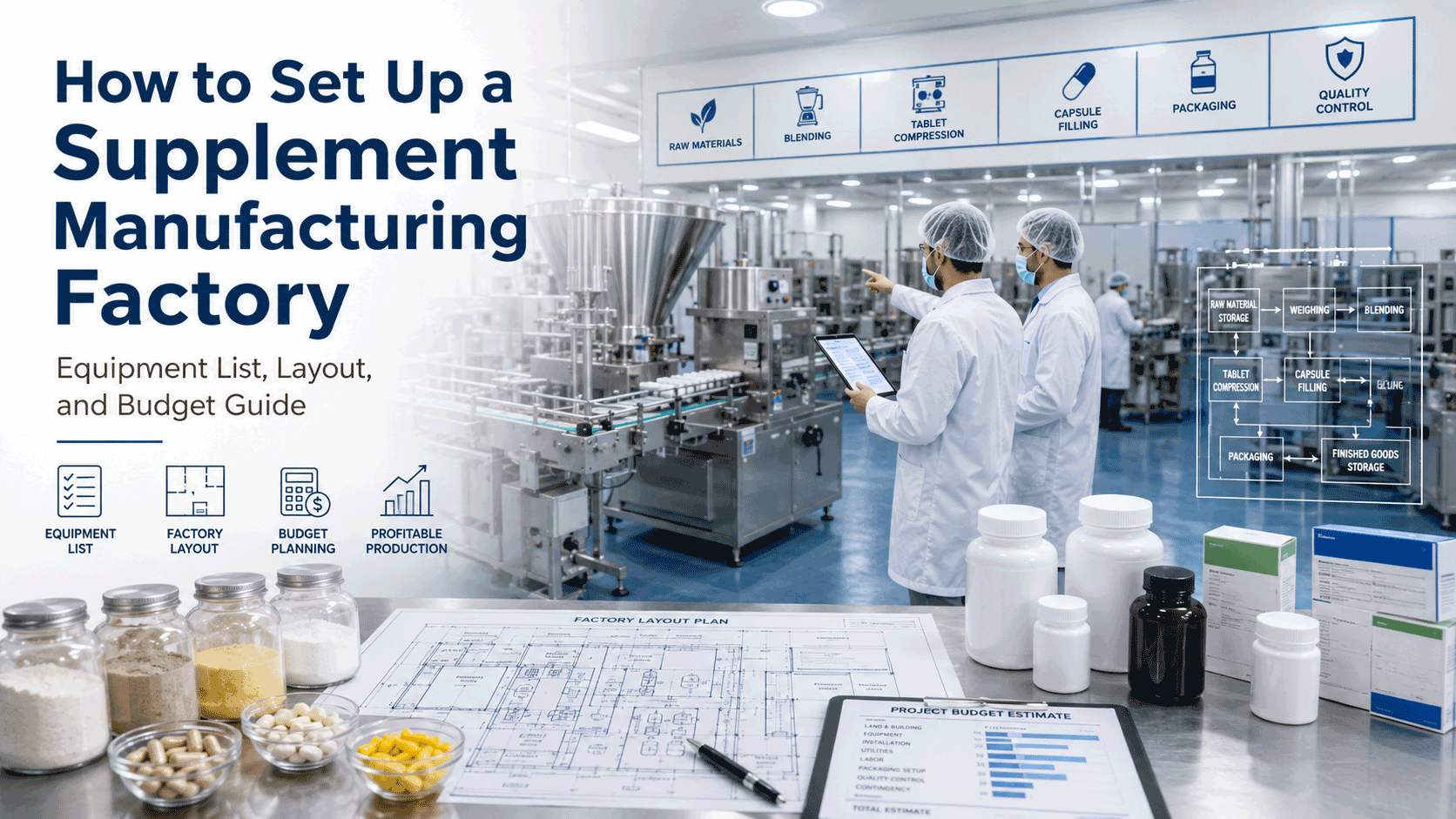
The factory should usually include a raw material receiving area, quarantine area, approved material warehouse, rejected material area, weighing room, sifting and milling area, blending room, production rooms, packaging room, quality control laboratory, finished products warehouse, cleaning area, document control area, and staff changing area. The exact layout depends on supplement manufacturing needs, dosage forms, production volume, and regulatory standards.
Material flow should be designed to reduce confusion and contamination. Raw materials should not move randomly through the facility. They should be received, identified, quarantined, tested, released, weighed, processed, packaged, and transferred to finished products storage in a controlled sequence. Personnel flow should also be controlled so that employees do not carry dust, allergens, microorganisms, or residues from one area to another.
For powder supplement manufacturing, dust control is especially important. A facility may need dust collection, air handling, pressure control, cleaning procedures, and dedicated equipment for certain high-risk materials. For soft gels, gummies, and other moisture-sensitive products, temperature and humidity control can have a major impact on quality. For products with allergens, strong flavors, colors, botanical extracts, or minerals, cleaning validation and line clearance become essential.
A supplement manufacturing factory layout should also support future expansion. Many companies start with one or two production lines, but later add more supplement products, higher speed lines, or additional packaging formats. A well-planned facility can reduce future renovation costs and help the brand grow more efficiently.
Rigorous Quality Control, Current Good Manufacturing Practices, and Testing
Quality control is not a single test at the end of the production process. It is a complete system that protects product quality throughout the entire process. A supplement manufacturer must apply rigorous quality control measures from ingredient sourcing to final product release. This includes supplier qualification, raw material testing, equipment verification, in-process checks, packaging inspection, finished products testing, documentation, deviation management, and product release.
Current good manufacturing practices and good manufacturing practices are essential for dietary supplement manufacturing. They help ensure that dietary supplements are consistently produced, packaged, labeled, and stored under controlled conditions. A factory should have written procedures for production, cleaning, calibration, equipment maintenance, personnel training, quality control, material handling, packaging, labeling, storage, returned goods, complaints, and records.
Heavy metal testing is especially important for certain raw materials and finished products. Botanical ingredients, mineral ingredients, marine ingredients, and some natural powders may carry risks related to heavy metals such as lead, arsenic, cadmium, and mercury. A responsible supplement manufacturer should understand ingredient risks and set appropriate testing plans. Microbiological testing is also important, especially for powders, botanicals, probiotics, gummies, and products that may be sensitive to moisture or contamination.
Rigorous quality control also includes verifying identity, purity, strength, composition, and limits on contamination. In-process checks may include blend uniformity, tablet weight, capsule fill weight, hardness, disintegration, moisture, appearance, and packaging accuracy. Final product testing may include potency, microbiological testing, heavy metal testing, label claim verification, and stability review depending on the product.
Quality is not only a regulatory requirement. It is a business advantage. A supplement brand that consistently delivers high quality products can build trust with consumers, distributors, retailers, and pharmaceutical companies that may be looking for reliable supplement products or a trusted manufacturing partner.
Advanced Technology, Cutting Edge Technology, and State of the Art Production Control
Advanced technology can improve supplement manufacturing when it is used for real control, not just appearance. A state of the art supplement manufacturing factory may use digital weighing systems, barcode scanning, automated material tracking, electronic batch records, production monitoring, environmental monitoring, automated checkweighers, metal detection, X-ray inspection, and ERP or MES systems. These tools help improve accuracy, traceability, efficiency, and regulatory compliance.
Cutting edge technology is especially useful when a factory manages many supplement products, many raw materials, and many custom formulation projects. Without digital control, it is easy for human errors to occur in weighing, material transfer, labeling, batch records, or packaging. Digital systems can help connect a purchase order, formula, batch number, raw material lot, production run, packaging material, finished product, expiration date, and quality release record.
Automation can also support high speed production. For example, automated counting lines, tablet presses with monitoring systems, powder filling lines with checkweighers, and packaging equipment with coding and inspection systems can increase output while maintaining consistent product quality. However, automation does not replace quality control. It supports quality control when combined with trained operators, validated procedures, equipment maintenance, and good manufacturing practices.
Advanced technology also helps brands meet consumer expectations. Modern consumers care about transparency, safety, consistency, and product integrity. A supplement brand that can demonstrate traceability, controlled manufacturing, strong testing, and stable shelf life has a stronger position in the supplement industry. For brand owners, this can be especially important when selling through retailers, online platforms, distributors, or international markets.
Technology should be selected according to actual supplement manufacturing needs. A small new brand may not need the most complex system at the beginning. A larger facility serving many brands or pharmaceutical companies may need more advanced systems from the start. The goal is to choose technology that supports the supplement vision, protects quality, improves efficiency, and prepares the factory for future growth.
Budget Guide for Building a Supplement Manufacturing Factory
Facility, Equipment, Laboratory, Packaging, and Working Capital
The budget for a supplement manufacturing factory should be built around the entire process, not just the equipment list. A common mistake is to calculate only the cost of supplement manufacturing equipment and ignore facility renovation, utilities, quality control laboratory, packaging equipment, certifications, raw materials, staff, testing, maintenance, and working capital.
Facility cost may include rent, construction, flooring, walls, ceilings, drainage, electricity, compressed air, HVAC, humidity control, water systems, dust control, changing rooms, warehouses, production rooms, and laboratory space. For dietary supplements, the facility must be cleanable, controlled, and suitable for the finished dosage form. A powder factory may need stronger dust collection and humidity control. A soft gels facility may need controlled drying space. A gummy facility may need cooking, depositing, drying, and packaging areas.
Equipment cost depends on the product category and production volume. A basic capsule or powder line may require less investment than a state of the art high speed production facility. Tablet manufacturing may require granulation, compression, coating, and inspection equipment. Soft gels and gummies may require larger investment because the production process is more complex.
Quality control cost should not be treated as optional. A factory needs testing plans, laboratory equipment or third-party laboratory partners, documentation systems, quality staff, stability programs, microbiological testing, heavy metal testing, identity testing, and finished products release procedures. Packaging cost also includes packaging equipment, packaging materials, label control, tamper evidence systems, coding, inspection, and storage.
Working capital is also necessary. Raw materials, packaging materials, staff salaries, testing fees, maintenance, utilities, rejected materials, pilot batch costs, and production run losses can all affect cash flow. A realistic budget helps the business survive the first several weeks and months before stable revenue is generated.
Build in Flexibility for Custom Formulation and Future Supplement Products
A supplement manufacturing factory should not be designed only for today’s product. Consumer preferences change, and the dietary supplement industry moves quickly. New supplement ideas, new delivery formats, evidence based ingredients, and new packaging trends may appear every year. A factory that is too rigid may become inefficient when the brand wants to launch new supplement products.
Custom formulation capability is valuable because it allows a supplement manufacturer to respond to different consumer needs. Brand owners may request capsules, tablets, powders, gummies, soft gels, stick packs, or other dosage forms. They may need vegan formulas, sugar-free formulas, clean label formulas, sports nutrition formulas, beauty supplements, digestive health products, or functional blends. A flexible facility can support a wider range of product development projects.
However, flexibility must be managed carefully. Custom manufacture can increase complexity because each formula may have different raw materials, testing needs, cleaning requirements, packaging process settings, and shelf life expectations. A factory that offers an extensive range of supplement products must have strong documentation, trained staff, validated cleaning procedures, controlled material flow, and rigorous quality control measures.
Pilot batch production is one way to manage risk. Before moving to a large production run, the experienced team can test whether the formula performs on actual production equipment. The pilot batch may reveal issues such as poor flowability, bad taste, tablet sticking, capsule filling variation, powder segregation, moisture sensitivity, or packaging instability. Fixing these issues before full production protects cost, time, and product quality.
A factory designed for future growth should also consider space for additional lines, more packaging equipment, larger warehouses, expanded quality control, and more advanced technology. The most successful supplement manufacturing factory is not only built for current orders. It is built for the next stage of the brand.
Choose the Right Manufacturing Partner Before You Build or Scale
Whether a company chooses to self-build, outsource, or combine both models, the right manufacturing partner has a critical role. A trusted manufacturing partner can support supplement ideas, custom formulation, supplement contract planning, production process design, ingredient sourcing, pilot batch testing, regulatory compliance, packaging, and finished products development.
For a new brand, a manufacturing partner can help avoid costly mistakes. Many brand owners understand marketing and consumer needs, but they may not fully understand supplement manufacturing, raw materials, quality control, packaging process design, or industry regulations. An experienced team can help translate the supplement vision into a realistic final product that can be manufactured consistently.
For companies planning to build their own supplement manufacturing factory, a technical partner can also support equipment selection, layout planning, process flow, packaging equipment configuration, and quality system design. This is especially important when the company wants to produce multiple dosage forms or serve different markets with different regulatory requirements.
The best partner is not simply the cheapest supplier. The best partner should understand product quality, regulatory standards, consumer expectations, production efficiency, and long-term brand growth. A reliable partner should communicate clearly, provide realistic timelines, support testing, respect product integrity, and help the brand make decisions based on both manufacturing reality and market demand.
In the supplement industry, a factory is more than a building with machines. It is a controlled system that turns raw materials into high quality supplements through a disciplined manufacturing process. Whether the goal is contract manufacturing, custom manufacture, or a self-owned supplement manufacturing factory, success depends on planning, quality, technology, and execution.
A strong supplement manufacturing factory starts with a clear final product, reliable ingredient sourcing, suitable supplement manufacturing equipment, rigorous quality control, compliant packaging, and a layout designed for efficiency and safety. It also requires current good manufacturing practices, good manufacturing practices, heavy metal testing, microbiological testing, shelf life management, expiration date control, and documentation across the entire process.
For brand owners, pharmaceutical companies, and supplement brands entering or expanding in the dietary supplement industry, the smartest approach is to begin with the product vision and work backward. Define the consumer needs, confirm the finished dosage form, develop the custom formulation, test the pilot batch, design the production process, select the equipment, plan the facility layout, and build a quality system that can meet consumer expectations.
A well-planned factory does more than manufacture supplements. It protects the brand, supports growth, improves consistency, and helps create products that consumers can trust.
