18 Aug Small Batch vs Large Scale Supplement Manufacturing Equipment: How to Choose the Right Line
Choosing supplement manufacturing equipment is not simply a decision between a small machine and a large machine. A manufacturer must decide how raw materials will move through every production stage, how operators will control the process, how equipment will be cleaned, and how the finished product will be tested and packaged.
This decision is particularly difficult for startup factories, regional supplement brands, new OEM facilities, and established manufacturers planning an expansion. A startup may want to preserve cash and produce small batches, while an expanding factory may be concerned that small equipment will quickly become a bottleneck. A new contract manufacturing facility may want a broad range of machines to serve different clients, even though its initial production demand remains uncertain.
Small batch supplement manufacturing equipment generally provides greater flexibility, lower initial investment, and easier adaptation to different formulations. Large-scale equipment can provide much higher production efficiency, lower direct labor per unit, and better integration between production stages. However, it usually requires larger rooms, stronger utilities, more technical support, and a reliable stream of orders.
The correct choice depends on the dosage form, formulation, production run, number of products, target market, packaging format, labor cost, cleaning requirements, and realistic sales demand. The objective is not to purchase the fastest machine available. It is to build a manufacturing process that can repeatedly produce dietary supplements at the required quality and cost.
1. Matching Equipment to Supplement Manufacturing Needs
1.1 Define the Product, Production Run and Supplement Manufacturing Needs
Equipment selection should begin with the product rather than a machinery catalogue. Capsules, tablets, powders, gummies, softgels, and liquids require different production processes, environments, utilities, and operator skills.
Even within one delivery format, formulations can behave very differently. A free-flowing powder may pass through a capsule filling machine efficiently, while a cohesive botanical blend may bridge in the powder hopper, create dust, and produce variable fill weights. A tablet formula with suitable compressibility may run reliably on a rotary press, while another formulation may require granulation before it can produce tablets with acceptable hardness and friability.
Manufacturers should first define the intended products, active ingredients, excipients, target serving size, dosage form, and finished product specifications. Capsule size, tablet weight, powder density, flow properties, moisture sensitivity, and the presence of oils or sticky materials all influence equipment requirements.
The expected production run is equally important. A brand may need only a few thousand capsules for initial product testing, but a regional retail order may require hundreds of thousands of units. A new OEM factory may process multiple small batches for different clients, whereas an established brand may manufacture one high-demand formula for extended campaigns.
Annual demand should be translated into practical daily and hourly requirements. The calculation should include the number of units per bottle, bottles per order, planned production days, shift length, expected machine utilization, changeovers, cleaning, maintenance, rejected units, and unplanned downtime.
For example, a customer requiring one million capsules per month does not necessarily need a machine rated for one million capsules in a single shift. The factory may spread production across several days. Conversely, a machine that appears adequate based on its nominal speed may be insufficient if frequent product changes leave little available running time.
Nominal production capacity describes what equipment may produce under defined conditions. It is not automatically the usable output for every formulation. The manufacturer must consider how machines work with actual filling material, capsule size, tooling, operator experience, and surrounding equipment.
The number of SKUs can be more important than total annual volume. A factory manufacturing one product can operate long production campaigns and minimize cleaning. A contract manufacturer producing twenty formulas may spend significant time on weighing, line clearance, cleaning, product testing, documentation, and changeovers.
Turnaround times must therefore be evaluated alongside machine speed. A smaller, accessible machine that can be cleaned and changed quickly may produce more saleable units per week than a large machine that remains unavailable for long periods between products.
Packaging format is another fundamental consideration. A capsule or tablet is not a finished retail product when it leaves the production machine. It may require polishing, dedusting, metal detection, inspection, counting, bottle filling, desiccant insertion, capping, induction sealing, labeling, coding, and cartoning.
If supplements will be packed into pouches, blister packs, stick packs, or sachets, the required equipment changes again. The production and packaging stages must be planned together.
Customers should also decide whether they intend to custom manufacture products internally or work with a manufacturing partner. Buying equipment can improve control over scheduling, production knowledge, and long-term capacity, but it creates responsibility for facilities, personnel, quality systems, raw materials, equipment maintenance, testing, and regulatory compliance.
Contract manufacturers may be appropriate when demand remains uncertain or when a product requires specialized equipment that would be underused in a new factory. Internal production becomes more attractive when volume is stable, intellectual property requires closer control, lead times are strategically important, or the manufacturer has sufficient technical and quality resources.
These decisions should be made using a realistic demand forecast rather than an optimistic sales target. Oversized equipment can tie up capital and increase the cost of cleaning, utilities, maintenance, and spare parts. Undersized equipment can create labor pressure, delayed orders, excessive handling, and repeated production runs.
1.2 Small Batch Supplement Manufacturing Equipment and Modular Production
Small batch supplement manufacturing equipment is typically selected for product development, pilot production, market testing, startup brands, regional sales, clinical or stability batches, and custom manufacture involving many formulations.
A small-scale solid-dose line may include precision scales, a dispensing booth, sifter, compact powder blender, mill where required, manual capsule filler or semi automatic capsule filler, capsule polisher, inspection table, metal detector, and semi-automatic packaging equipment.
Small powder blenders may handle batches from several kilograms to tens of kilograms, although usable capacity depends on bulk density, blender geometry, minimum and maximum fill level, and mixing behavior. The often-mentioned range of 5 to 50 kilograms is a practical example for certain compact machines, not a universal classification.
A blender must operate within an appropriate loading range. A vessel that is too empty may not generate effective material movement, while excessive filling may prevent ingredients from circulating properly. Purchasing a large blender for very small batches can therefore reduce, rather than improve, blend uniformity.
Small-scale equipment is often modular. The factory can begin with dispensing, blending, filling, and basic packaging, then add machines as demand develops. This reduces initial investment and allows the manufacturer to learn how the formulations behave before committing to a fully integrated production line.
Modular equipment can also be easier to disassemble and clean because components are smaller and more accessible. Nevertheless, “small” does not automatically mean easy to clean. Product-contact surfaces, seals, shafts, screens, powder hoppers, transfer containers, and tools still require a hygienic design and documented cleaning procedures.
Small-scale production relies more heavily on manual labor. Operators may move raw materials, load a blender, transfer the powder, separate empty capsules, fill molds, inspect the joined capsules, and load packaging materials manually.
This creates flexibility, but it also increases the importance of training and procedures. Manual handling can introduce weighing errors, incorrect components, inconsistent processing time, dust exposure, cross-contamination, and differences between operators.
A small batch operation must therefore apply good manufacturing practices appropriate to its products and market. The batch size does not reduce the need for correct labels, approved raw materials, calibrated equipment, production records, sanitation, line clearance, product testing, and release procedures.
Small-scale equipment is not always limited to a standard room or an ordinary electrical outlet. Certain machines may require three-phase electricity, compressed air, dust extraction, chilled water, vacuum, ventilation, or reinforced floors. Utility requirements must be verified from the technical specifications rather than assumed from the machine’s footprint.
For tablet production, development and small batches may use a single-punch press or a small rotary tablet press. A single-punch machine is useful for formulation trials and evaluating how a powder responds to compression. It can help developers study tablet weight, hardness, thickness, disintegration, and visual defects.
A small rotary press may be more suitable once production volume increases. It uses multiple tooling stations to produce tablets continuously as the turret rotates. The selected press must provide the required compression force, dwell time, tablet size, tooling format, and feeder design.
Tablet presses do not correct an unsuitable formulation. Powder must flow into the dies and form stable compacts. If the raw materials segregate, stick to the punches, cap, laminate, or fail to compress, the manufacturer may need formulation changes, granulation, improved lubrication, environmental control, or different tooling.
The same principle applies to capsule filling. A larger capsule filler does not solve poor powder flow. Reliable equipment should be supported by formulation development and material characterization.
2. Comparing Manual, Semi-Automatic and Fully Automated Machines
2.1 Manual Capsule Filler and Semi Automatic Capsule Filling
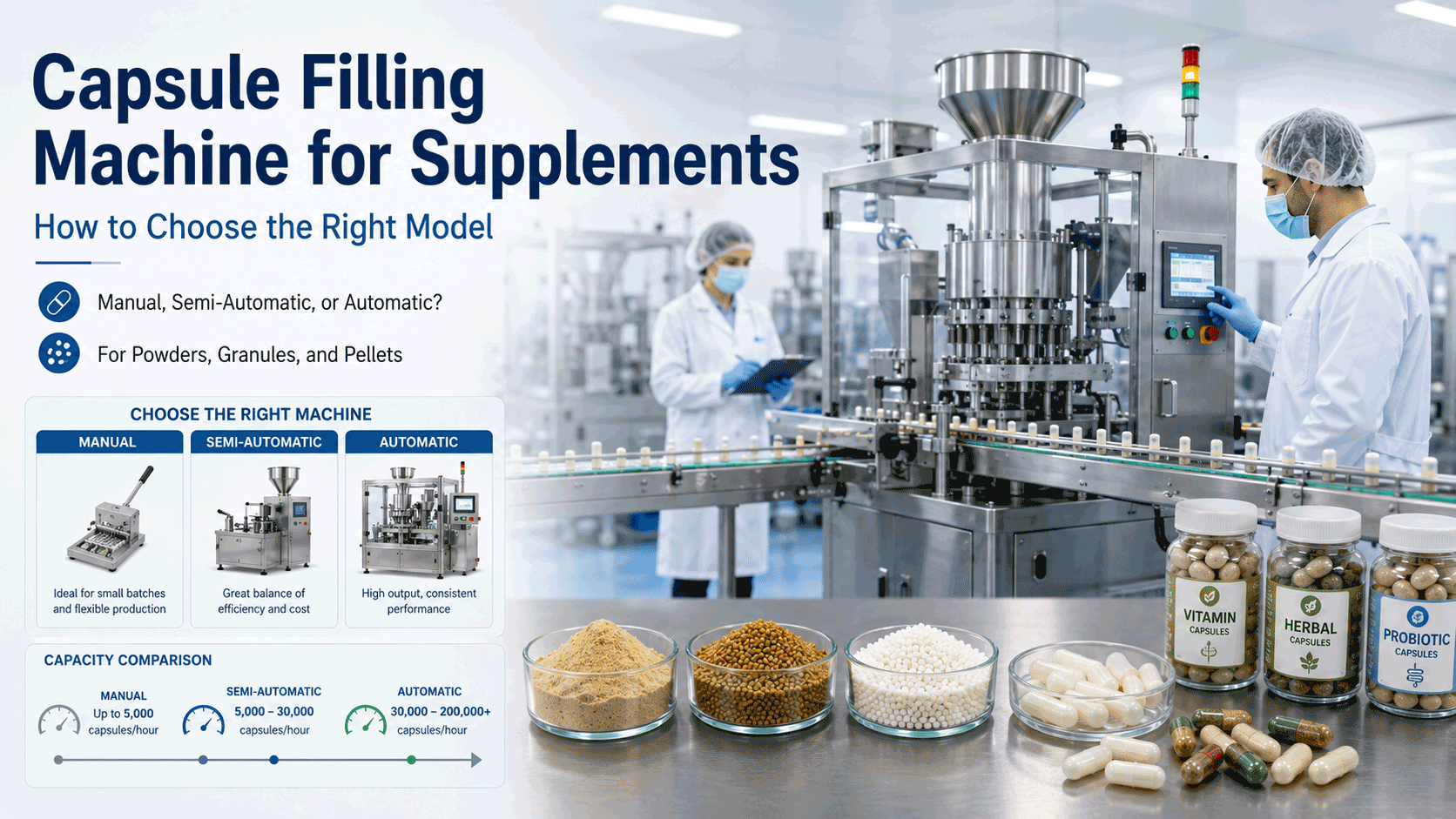
Capsule fillers can be classified broadly as manual, semi-automatic, and automatic equipment. The most suitable capsule filling machine depends on batch size, labor availability, filling material, required precision, capsule sizes, cleaning frequency, and available capital.
A manual capsule filler commonly uses trays or plates that hold a fixed number of empty capsules. Depending on the design, a plate may process dozens or several hundred capsules at a time. Claims such as 20 to 800 capsules should be understood as examples of equipment configurations rather than a guaranteed production rate.
The filling process begins by loading the empty capsules. Hard gelatin or HPMC capsules typically arrive as joined capsules with a capsule cap and body. The manual system separates the two components and holds the bodies in position.
Powder is spread across the open capsule bodies and encouraged into the cavities. Tamping tools may compress the filling material so that an additional quantity can be added. Once the desired amount has been introduced, the capsule caps are aligned with the bodies and pressed into place.
Capsule locking secures the cap and body. The completed capsules are released from the plate and inspected. Operators may then remove surface powder and verify capsule weight and closure.
A manual capsule filler is appropriate for development, samples, extremely small orders, or products with uncertain demand. It has a relatively low purchase cost and does not require complex automation. It also provides a simple way to evaluate whether a formulation can be placed into a particular capsule size.
The disadvantage is heavy dependence on one operator or a small team. Output varies according to operator skill, powder behavior, plate size, tamping method, and the exact amount required in each capsule.
Manual production may also create more open powder handling. Suitable local extraction, personal protection, material controls, and cleaning procedures are necessary, particularly for dusty, allergenic, sensitizing, or potent ingredients.
A semi automatic capsule filler combines manual and automated operations. The precise sequence varies by design, but such machines commonly automate capsule orientation, filling, or capsule locking while operators transfer components between stations.
A typical semi automatic capsule filling process begins when empty capsules are loaded into a hopper or orientation system. The machine positions the capsules and performs capsule separation so that the bodies and caps can be processed separately.
The capsule bodies move to the filling station. Powder is supplied through a powder hopper and metered into the bodies. The method may involve augers, dosing discs, tamping, vibration, or another mechanism depending on the machine.
The operator then transfers the filled capsule bodies and caps to a locking station. The machine joins and locks the capsules before discharging them for polishing and inspection.
Semi-automatic machines can reduce repetitive manual work and improve consistent output compared with manual plates. They may also provide better control of filling parameters and can process substantially more capsules per hour.
Figures such as 10,000 to 20,000 capsules per hour are common examples for some semi-automatic models, but they are not universal. Actual output depends on the equipment design, operator, capsule size, powder characteristics, fill weight, and transfer time between stations.
Semi-automatic does not mean operator-independent. The operator may still load material, move rings or trays, monitor powder level, transfer capsules, make adjustments, collect product, and perform in-process checks.
For certain factories, this is an advantage. A semi automatic capsule filler provides a balance between labor, investment, flexibility, and production capacity. It may be appropriate for regional brands, new OEM plants, and facilities producing multiple units or formulations in small to medium production runs.
Compared with a manual capsule filler, a well-designed semi-automatic machine can support more repeatable dosing. However, it should not automatically be described as more precise without specifying the formula, capsule, test method, and equipment condition.
Powder flow remains crucial. Cohesive or low-density material may fill inconsistently even when the machine operates correctly. The formulation may require glidants, granulation, density adjustment, controlled vibration, or other process development.
Cleaning and changeover must be evaluated carefully. The powder hopper, filling components, capsule orientation parts, locking station, guards, and collection surfaces must be accessible. A machine described as low maintenance can still require regular lubrication, inspection, replacement of wear parts, and calibration.
The manufacturer should also confirm the range of capsule sizes, required change parts, capsule material compatibility, fill-weight range, and whether the equipment can handle powders, pellets, granules, tablets, or combinations. A standard semi-automatic powder filler may not be suitable for every filling material.
2.2 Automatic Capsule Filling Machines, Tablet Presses and Automated Production Lines
Automatic capsule filling machines integrate capsule feeding, orientation, separation, dosing, rejection, capsule closing, and discharge within one coordinated cycle.
Empty capsules enter the capsule hopper and move through an orientation system. The machine places each capsule into a segment or carrier and uses vacuum or mechanical action for capsule separation.
The capsule bodies move through the dosing station while the caps remain controlled separately. Powder, granules, pellets, mini-tablets, or other materials may be filled using equipment designed for that application.
For powder filling, automatic machines commonly use a tamping-pin or dosator principle. In a tamping system, powder enters bores in a dosing disc and is compressed in stages before the plug is transferred into the capsule body. In a dosator system, a tube forms and transfers a measured powder plug.
After filling, the machine may reject capsules that failed to separate or fill correctly. The capsule body and capsule cap are then aligned at the closing station. Controlled pressure creates locked capsules, which are discharged for polishing, metal detection, inspection, or checkweighing.
Automatic capsule filling machines cover a broad range of outputs. Some compact machines may produce tens of thousands of capsules per hour, while high-speed systems can produce hundreds of thousands under suitable conditions.
The often-quoted range of approximately 13,000 to 460,000 capsules per hour represents a broad collection of possible equipment, not a performance standard. Some specialized machines operate outside that range, and usable output may be significantly lower than the maximum stated speed.
A high-speed capsule filling machine requires stable upstream and downstream processes. Powder must arrive in a controlled condition. Empty capsules must meet dimensional and separation requirements. Dust extraction, compressed air, vacuum, utilities, polishing, inspection, and packaging must support continuous operation.
If an automatic filler produces more capsules than the bottle line can package, the factory needs controlled intermediate storage or additional packaging capacity. If the blender cannot supply enough uniform powder, the capsule filler will remain idle.
Large-scale tablet production presents the same integration challenge. Rotary tablet presses may range from compact machines for development and medium batches to high-speed, double-sided presses designed for high volume production.
A rotary tablet press contains multiple punch-and-die stations. Powder enters the dies through a feeder, the punches apply pre-compression and main compression, and the finished tablets are ejected. Increasing the number of stations and turret speed can increase output, but product behavior and quality limits remain critical.
High machine speed can reduce the time available for die filling, air release, particle rearrangement, and compression. A formulation that performs well on a slow press may show weight variation, capping, sticking, or lamination when transferred directly to a faster machine.
Scale-up must therefore consider feeder configuration, turret speed, dwell time, compression force, tooling, powder flow, and tablet ejection. A faster press is not simply a larger version of a laboratory machine.
An automated production line may connect raw-material handling, sifting, milling, granulation, blending, capsule filling or tablet compression, polishing or dedusting, metal detection, inspection, and packaging.
Vacuum transfer can move powder between production stages and reduce manual handling. Closed containers, lifters, and contained connections may improve cleanliness and control dust. Automated recipe systems can guide operators and record selected process parameters.
Large-scale bottle packaging may include an unscrambler, electronic counter, desiccant inserter, cotton inserter if required, cap feeder, capper, induction sealer, labeler, coder, checkweigher, and cartoner.
A fully automated line can increase production efficiency and reduce repeated manual handling. Nevertheless, automation does not remove the need for operators. Personnel must monitor the process, replenish materials, perform in-process checks, respond to alarms, investigate deviations, clean equipment, and maintain the machines.
The decision to automate should consider utilization. An expensive high-speed line that operates only a few hours each month may have a poor return on investment. A slower modular line operating consistently may be more economical.
3. Building the Right Supplement Production Line for Growth
3.1 Quality, Regulatory Compliance and Total Manufacturing Cost
Small batches and large batches must both meet applicable product quality and safety requirements. Production scale changes the equipment and operational complexity, but it does not eliminate regulatory responsibility.
In the United States, manufacturers of dietary supplements must establish appropriate controls over components, manufacturing, packaging, labeling, holding, testing, and records. Other markets impose their own requirements for food supplements, natural health products, complementary medicines, or pharmaceutical products.
Good manufacturing practices are implemented through the facility, personnel, procedures, equipment, documentation, and quality unit. Buying a machine described as GMP-compatible does not make the finished operation compliant.
Equipment should be constructed from materials suitable for the intended product. Product-contact surfaces must be cleanable, non-reactive, and maintained in an appropriate condition. Welds, seals, gaskets, corners, shafts, screens, and connections should not create uncontrolled product traps.
Cleaning procedures must identify what is cleaned, how it is disassembled, which cleaning agents are used, the required contact time, rinsing method, drying method, reassembly process, and acceptance criteria.
When multiple products share equipment, the manufacturer should assess cross-contamination and allergen risks. Cleaning validation or scientifically justified verification may be required depending on the product, equipment, and regulatory framework.
Dust extraction is critical for powder handling. Capsule fillers and tablet presses can release fine material during filling, compression, transfer, and cleaning. Dust can create operator exposure, cross-contamination, housekeeping, product-loss, and combustible-dust hazards.
Automated systems may reduce open handling, but they do not automatically provide effective containment. Equipment configuration, connections, extraction airflow, filters, pressure relationships, and operator practices must be assessed together.
Product testing should be established according to the dosage form and specification. Capsule and tablet controls may include identity, assay, fill or tablet weight, content uniformity, disintegration, dissolution where relevant, moisture, microbiological quality, and contaminants.
In-process checks can detect problems before an entire production run is completed. Capsule operations may monitor fill weight, capsule closure, appearance, rejection rate, and machine performance. Tablet production may monitor weight, hardness, thickness, friability, and compression force.
Professional equipment can support precision and traceability, but it does not ensure them independently. Traceability also requires controlled material codes, batch records, equipment identification, calibration, process data, sampling, reconciliation, and quality review.
Certifications must be described accurately. FSSC 22000 certification indicates that a food-safety management system has been audited against the relevant scheme. It does not guarantee that every product or batch is safe. Similarly, a GMP certificate does not guarantee that every manufacturing activity will always comply with the highest standards.
The total cost of equipment extends well beyond its purchase price. Manufacturers should consider installation, freight, duties, room construction, HVAC, compressed air, vacuum, chilled water, electrical work, extraction, tooling, change parts, spare parts, validation, training, maintenance, cleaning, and future upgrades.
Labor cost must be calculated across the complete manufacturing process. Manual machines may have a low purchase price but require more staff for material handling, capsule separation, filling, capsule locking, inspection, and packaging.
Large automated machines can reduce direct labor per unit, but they require trained technicians and maintenance support. When such machines stop, a large part of the production line may stop with them.
Material yield also affects cost. Powder can remain in a blender, transfer pipe, powder hopper, dosing system, or dust collector. Small production runs may suffer a higher percentage loss because equipment hold-up represents a greater proportion of the batch.
Cleaning and turnaround times are especially important for contract manufacturers. A machine that fills capsules quickly but takes many hours to disassemble and clean may not provide good production efficiency for multiple small orders.
Manufacturers should evaluate cost per saleable unit under realistic operating conditions rather than maximum machine speed. The calculation should include utilization, yield, rejected product, labor, quality control, cleaning, maintenance, packaging, and downtime.
3.2 Choosing Individual Machines, a Modular Line or a Turnkey Automated Production Line
A startup factory developing supplement ideas usually benefits from flexible, modular equipment. Precision weighing, compact blending, manual or semi-automatic filling, inspection, and semi-automatic packaging can support product development and early commercial demand without excessive capital investment.
This approach is appropriate when formulas change frequently, production runs are small, and the manufacturer is still learning which products will gain market demand. The main risk is buying equipment that is too small to support a successful launch.
A practical solution is to select modular machines that can later work beside upgraded equipment. A small blender can remain useful for development and specialty batches after the factory installs a larger production blender. A semi automatic capsule filler can remain available for samples, urgent orders, or products that do not run well on the primary automatic machine.
A regional brand with stable sales may be ready for semi automatic machines or compact automatic equipment. At this stage, the manufacturer should identify its actual bottleneck.
If blending is fast but capsule filling is slow, upgrading the capsule filling machine may provide the greatest benefit. If production is efficient but packaging requires excessive labor, an automatic counter, capper, or labeling machine may deliver a better return than another production machine.
A new OEM factory has a different challenge because future client formulations are unknown. Purchasing highly specialized high-speed equipment too early can reduce flexibility. The facility may benefit from multiple units with complementary capabilities rather than one oversized line.
For example, a modular capsule area may use a semi-automatic machine for small batches and an automatic machine for larger campaigns. Separate tooling and change parts can support a range of capsule sizes. Blending equipment may include a development blender and a larger production blender.
A factory planning tablets should not select tablet presses before understanding formulation and granulation requirements. Some products can use direct compression, while others need milling, wet or dry granulation, drying, and final blending.
An established factory considering expansion should use production data to identify lost capacity. The relevant information includes machine utilization, cleaning time, changeover duration, downtime causes, labor hours, yield, rejection rates, maintenance frequency, and delayed orders.
Expansion does not always require a fully automated new line. Adding a second machine may create redundancy and allow one line to operate while the other is cleaned or maintained. Multiple units can also separate products with different contamination or allergen risks.
A turnkey automated production line becomes appropriate when demand is stable, formulations are well understood, long production campaigns are expected, and the factory has the utilities, space, quality systems, and maintenance capability to support it.
Turnkey does not mean that the machinery supplier takes responsibility for the formulation or finished product. The customer and supplier must define interfaces, capacities, utilities, controls, data requirements, acceptance criteria, installation responsibilities, and performance tests.
Before purchasing equipment, the customer should prepare a user requirement specification. It should describe the dosage forms, materials, batch sizes, target outputs, capsule or tablet dimensions, filling range, packaging formats, utilities, environmental conditions, cleaning approach, automation, documentation, and applicable safety standards.
Factory acceptance testing should verify agreed functions before shipment. Site acceptance testing should confirm operation after installation. Trials with representative material are more valuable than empty-machine demonstrations because powder behavior frequently determines actual performance.
Technical specifications should be reviewed carefully. Buyers need to understand whether the stated capacity is a maximum mechanical speed, a typical production rate, or a guaranteed output under defined conditions. They should also confirm which tooling, auxiliary equipment, and safety devices are included.
Future growth should be planned, but not overestimated. The line should have reasonable additional capacity without becoming financially burdensome. A staged plan may define which equipment will be installed now, which utilities will be prepared for future machines, and how the layout will accommodate later expansion.
Manufacturers should also consider whether selected processes should remain with contract manufacturers. A company may produce capsules and powders internally while outsourcing gummies or softgels that require specialized manufacturing equipment. A hybrid model can preserve flexibility while avoiding investment in underused lines.
The best equipment strategy connects product demand with manufacturing capability. Small batch supplement manufacturing equipment is appropriate when flexibility, changeovers, development, and capital control are priorities. Semi-automatic machines can provide a practical bridge between manual production and large-scale automation. Automatic capsule filling machines and high-speed tablet presses are appropriate when demand, formulation, staffing, and downstream capacity justify them.
The final decision should be based on saleable output, product quality, regulatory compliance, total operating cost, and the ability to grow. A well-planned modular line can be more valuable than an oversized automated system, while a properly integrated automated production line can transform the efficiency of a factory with stable high-volume demand.
The right line is therefore not defined by whether it is manual, semi automatic, or fully automated. It is the line that matches the manufacturer’s products today, supports realistic demand tomorrow, and maintains reliable control from raw materials through production, packaging, labeling, and release.
