17 Nov Softgel Encapsulation Machine: A Practical Guide for Omega-3, Vitamin D, and Oil-Based Supplements
Softgel capsules are widely used for omega-3 fish oil, krill oil, vitamin D3, vitamin K2, CoQ10, evening primrose oil, flaxseed oil, and other oil-based supplements. Their smooth, one-piece shell is easy to swallow and can contain a precisely measured liquid, oil, paste, or suspension.
Unlike hard capsules, which are manufactured as two separate shell pieces and later filled, soft gelatin capsules are formed, filled, sealed, and cut during one continuous encapsulation process. This requires specialized softgel manufacturing equipment and careful coordination among the shell material, fill material, encapsulation machine, tooling, drying system, and controlled production environment.
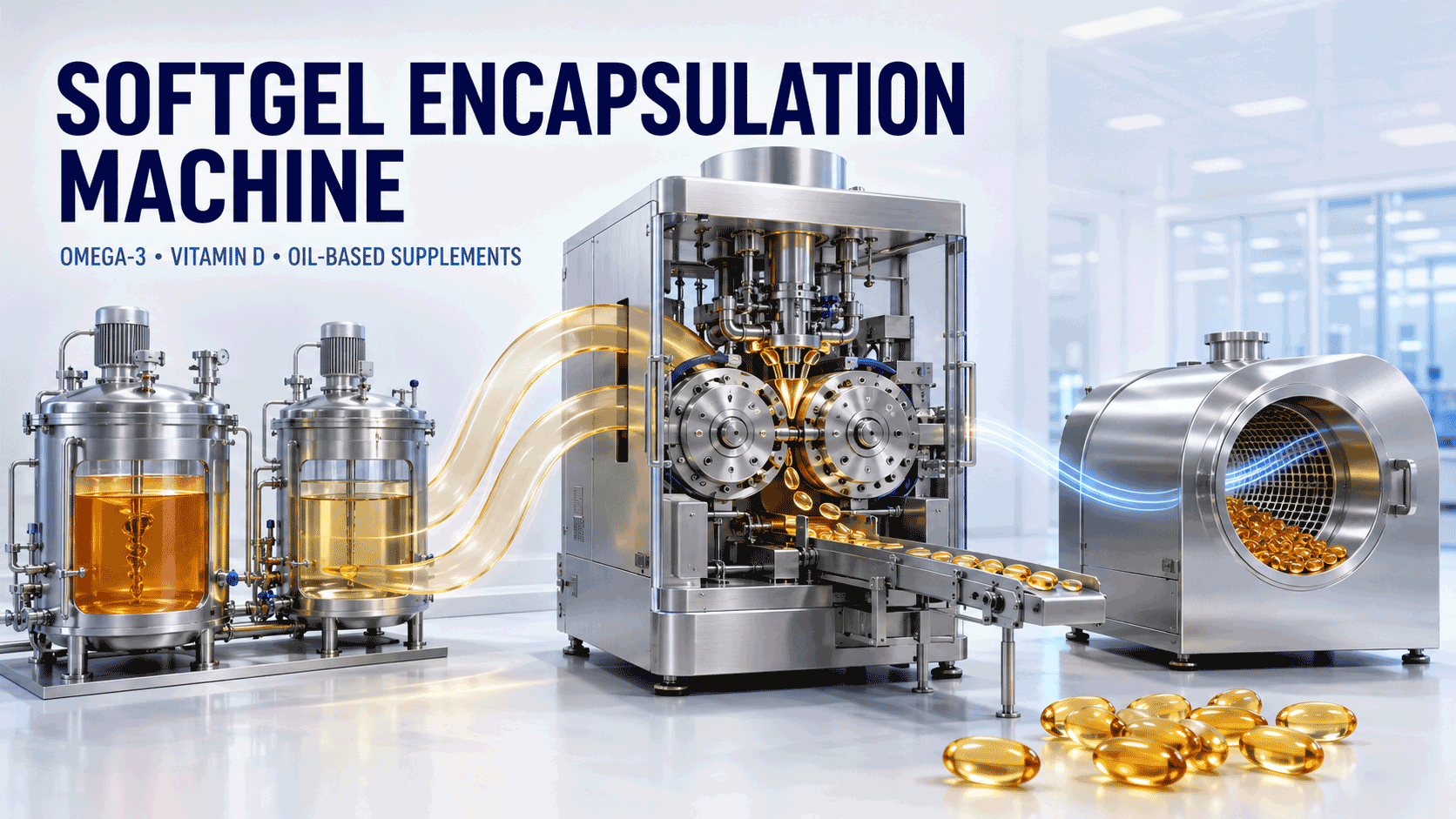
A softgel encapsulation machine is therefore only one part of a complete softgel production line. Manufacturers also need gelatin melters, fill-material preparation tanks, a cooling system, tumble dryers, drying trays or drying tunnels, inspection equipment, and suitable packaging machinery.
For factories considering an investment in softgel manufacturing, production capacity is important, but it is not the only consideration. Filling accuracy, gelatin ribbon control, die roll quality, drying capacity, cleaning time, spare parts, operator expertise, and formula compatibility can have a greater effect on actual production cost and finished-product quality.
1. Preparing Gelatin and Fill Material for Softgel Manufacturing
1.1 Gelatin Preparation with a Gelatin Melting Tank and Melting Tanks
Softgel production begins before material reaches the main machine. The shell and the fill must be prepared separately under controlled conditions.
Traditional soft gelatin capsules use pharmaceutical- or food-grade gelatin derived from collagen. The softgel factory normally purchases gelatin that already meets the required specifications. It does not produce gelatin by boiling animal skin, tendons, or other raw tissues inside the softgel manufacturing area.
During gelatin preparation, the gelatin is combined with purified water and a plasticizer. Glycerin and sorbitol are commonly used plasticizers that provide flexibility and prevent the dried shell from becoming excessively brittle. Depending on the product, the shell formula may also include approved colors, opacifiers, flavors, preservatives, or other functional materials.
These ingredients are processed in a gelatin melting tank. The tank is usually constructed from high-quality materials suitable for contact with pharmaceutical or nutraceutical products. Jacketed heating supports controlled gelatin melting, while the mixing system distributes water, plasticizer, and other ingredients throughout the mass.
Temperature must be controlled carefully. Insufficient heat can leave undissolved gelatin and produce poor uniform mixing. Excessive heat or extended holding may affect viscosity, color, or other gelatin properties. The objective is to create a homogeneous gelatin mass that can flow through the supply system and form a stable gelatin ribbon.
Gelatin preparation commonly takes place under vacuum. Entrapped air can create bubbles, weak sections, or visible defects in the gelatin ribbon. Vacuum treatment helps remove this air before the gelatin reaches the encapsulation machine.
When the gelatin reaches the required temperature, viscosity, and appearance, it can be transferred into heated service tanks. These melting tanks or service tanks maintain the material within an established operating range until production begins.
The number and capacity of gelatin melters depend on batch size, production schedule, shell colors, and machine output. A factory producing several colors or different types of shell formulas may require separate tanks to prevent long waiting times between batches.
The gelatin supply line must also maintain an appropriate temperature. If the gelatin cools too much before reaching the spreader boxes, its viscosity may increase and interfere with ribbon formation. If it is too hot, the ribbon may not set correctly on the cooling drums.
Gelatin ribbon thickness is a critical process variable. A ribbon that is too thin may produce weak seams or capsules that leak during drying, handling, or packaging. A ribbon that is unnecessarily thick consumes more gelatin, increases drying demand, and may change capsule performance.
Modern softgel machines may use thickness monitoring and controlled spreader-box settings to improve consistency. However, the machine cannot compensate for gelatin mass that is poorly prepared, contains air, or has an unsuitable viscosity. Effective softgel encapsulation begins with stable gelatin preparation.
Manufacturers should also decide whether they will use conventional gelatin or a non-gelatin shell system. Plant-based soft capsules can serve particular dietary, religious, or market requirements, but they are not simply conventional gelatin with a different label. Their shell formulations may require different gelatin melting temperatures, casting conditions, wedge temperatures, drying conditions, and machine settings.
The selected soft gelatin encapsulation machine and support equipment must therefore be compatible with the intended shell material.
1.2 Preparing Oil-Based Fill Material for Omega-3, Vitamin D and CoQ10 Softgels
The fill material determines the dose delivered by each capsule and must remain physically and chemically stable throughout mixing, encapsulation, drying, storage, and its intended shelf life.
Softgel machines commonly fill liquids, oil-based solutions, semi-liquids, pastes, and pumpable suspensions. Dry powder is generally not injected directly in the same way as a free-flowing oil. When a solid active ingredient is used, it is usually dissolved or dispersed within a suitable liquid vehicle to create a stable, pumpable formulation.
Fish oil and krill oil softgels require particular attention to oxidation. Exposure to air, heat, light, and unsuitable contact materials can damage oxidation-sensitive oils. Fill-material preparation systems may therefore use covered or closed tanks, controlled temperatures, gentle mixing, vacuum deaeration, or inert-gas protection where appropriate.
Uniform mixing is essential. Omega-3 oil may be filled as the main material, while vitamin D3, vitamin K2, CoQ10, antioxidants, flavors, or other active ingredients may be incorporated at much smaller concentrations. These ingredients must remain evenly distributed so that the amount delivered to each capsule stays within the required range.
When the active ingredients dissolve completely in the carrier oil, the resulting solution may be relatively straightforward to pump, provided the viscosity and temperature are controlled. Suspensions require more attention because solid particles can settle, agglomerate, or clog the pump system.
Particle size, suspension stability, viscosity, and mixing speed should therefore be evaluated during formulation development. A recirculation or agitation system may be necessary to keep the fill material homogeneous throughout encapsulation.
The fill formula must also be compatible with the softgel shell. Some fill components can migrate into the gelatin, extract water or plasticizer from the shell, or weaken the seal. Other ingredients may crystallize, separate, or change viscosity over time.
Softgel encapsulation may improve the delivery of certain poorly water-soluble active ingredients when they are formulated in an appropriate oil or solubilized system. However, the machine itself does not guarantee improved bioavailability. That outcome depends on the active ingredient, formulation, carrier, particle or molecular state, capsule performance, and supporting evidence.
Before production, the fill material should be tested for identity, composition, viscosity, homogeneity, temperature, and other relevant specifications. It may also pass through filtration, milling, or deaeration equipment, depending on the formula.
The fill tank is normally connected to the main machine through sanitary piping. A controlled feed or recirculation system should prevent air introduction, contamination, temperature drift, or ingredient separation.
Both the gelatin mass and the fill material must be ready at the correct time. If one material waits too long for the other, its viscosity, temperature, oxidation condition, or microbial quality may change. Production scheduling is therefore an important part of making softgels efficiently.
2. How a Softgel Encapsulation Machine Forms, Fills and Seals Capsules
2.1 Working Principle of a Rotary-Die Soft Gelatin Encapsulation Machine
The rotary-die method is commonly used in commercial softgel manufacturing because it integrates capsule forming, filling, sealing, and cutting in a continuous operation.
A soft gelatin encapsulation machine receives prepared gelatin on two sides. Each spreader box applies a controlled layer of liquid gelatin onto a rotating casting drum. The cooling system lowers the temperature of the gelatin and converts it into a flexible, continuous ribbon.
Two gelatin ribbons travel from opposite sides toward the encapsulation zone. Guide rollers and lubrication components help maintain alignment and reduce sticking or friction. Lubrication must be controlled because excessive oil on the ribbons can affect appearance and increase drying time.
At the center of the main machine, the two ribbons pass between a pair of counter-rotating die rolls. Each die roll contains cavities corresponding to the required softgel shape and size. The die roll can produce oval, oblong, round, tube-shaped, or other suitable soft capsules.
The tooling system determines more than appearance. The cavity dimensions influence the nominal fill volume, capsule dimensions, ribbon usage, number of cavities around the die, and potential machine output.
A heated wedge is positioned between the two gelatin ribbons above the die rolls. The fill material travels from the holding tank through the pump system and into the wedge. The wedge contains channels that direct a measured dose into each forming capsule.
The injection pump must operate in precise synchronization with the die rolls. As opposing die cavities meet, the pump delivers the fill material between the gelatin ribbons. Heat and mechanical pressure seal the ribbons around the liquid while the tooling simultaneously cuts the capsule from the surrounding gelatin web.
This working principle produces a one-piece, hermetically sealed capsule when the formulation and process are properly controlled. The remaining gelatin web moves away from the encapsulation area for collection or approved recovery processing.
Accurate synchronization depends on the drive system, timing gear, pump timing, die alignment, wedge position, and machine speed. If the timing is incorrect, the fill can enter too early or too late. This can create partially filled capsules, oil contamination around the seam, misshapen products, or leaks.
A modern control panel may include a touch screen through which operators set or monitor machine speed, gelatin temperature, wedge temperature, pump timing, ribbon thickness, alarms, and other operating conditions. Advanced technology can make adjustment and data collection easier, but experienced operators are still necessary.
Softgel encapsulation is sensitive to small process changes. A difference in room humidity, fill viscosity, gelatin temperature, ribbon thickness, tooling alignment, or lubrication can affect capsule quality. The production environment and softgel machine must therefore operate as one controlled system.
2.2 Filling Accuracy, Tooling and Production Capacity
Dosing accuracy is one of the most important performance criteria for a softgel capsules encapsulation machine. The injection pump must deliver a repeatable volume during every machine cycle.
Filling accuracy depends on the pump design, pump calibration, fill viscosity, temperature, pressure, valve condition, air content, and synchronization with the die roll. Worn plungers, valves, seals, or other pump components can lead to unstable fill weight.
For this reason, a universal claim that every softgel encapsulation machine should achieve at least 99.5% filling accuracy is not technically sufficient. Buyers should instead define the acceptable fill-weight range, test method, product conditions, sampling plan, and capsule size in their user requirement specification.
Precision pumps should be evaluated using the actual fill material whenever possible. A machine tested only with a low-viscosity reference oil may perform differently with a thick CoQ10 suspension or another semi-liquid formulation.
Tooling condition is equally important. Die roll cavities must be accurately manufactured, aligned, and synchronized. Worn or damaged die rolls may create irregular capsule shapes, weak seams, excessive gelatin waste, or poor cutting.
Different types of tooling allow one encapsulation machine to produce several capsule shapes and fill volumes. Nevertheless, a tooling change requires cleaning, installation, alignment, adjustment, and testing. Factories producing many SKUs should include this changeover time in their production planning.
Nominal production capacity may be calculated from machine speed and the number of cavities in the die roll. A larger die with more cavities can produce more capsules per revolution, while a large capsule may reduce the number of available cavities.
Some high-capacity softgel machines may produce more than 300,000 capsules per hour under suitable conditions. This figure should not be treated as a standard output for all machines or products. Small-scale research systems and pilot machines produce far fewer capsules, while production machines cover a broad capacity range.
Actual output is affected by capsule size, die design, operating speed, fill viscosity, gelatin behavior, drying capacity, inspection losses, cleaning, changeovers, maintenance, and unplanned downtime.
The main machine should not be selected without considering the downstream equipment. If the encapsulation machine produces more fresh capsules than the tumble dryers or drying tunnels can handle, the factory will not achieve the advertised output.
Production capacity must therefore be evaluated across the complete softgel production line. Effective capacity is determined by the slowest or most restrictive stage, not by the maximum speed of the encapsulation machine alone.
3. Drying, Quality Control and Selecting Softgel Manufacturing Equipment
3.1 Tumble Dryers, Drying Trays, Drying Tunnels and Softgel Polishing
Fresh softgel capsules are soft, warm, and high in moisture when they leave the die rolls. They cannot normally move directly into final packaging.
The capsules pass through a discharge chute and conveyor system to one or more tumble dryers. Rotating baskets expose the capsules to conditioned air while keeping them in motion. This initial drying stage removes surface moisture and helps prevent the capsules from sticking together or becoming deformed.
Tumble drying does not necessarily complete the drying process. The soft capsules may still contain too much moisture for stable storage and packaging. They are therefore commonly transferred to drying trays and placed in a controlled drying room or drying tunnel.
During secondary drying, temperature, relative humidity, airflow, tray loading, and drying time must be controlled. The objective is to remove moisture gradually until the shell reaches its defined specification without becoming brittle, distorted, or excessively hard.
Drying time varies with shell formulation, ribbon thickness, fill material, capsule size, plasticizer ratio, room conditions, and initial moisture. Oil-based products may also behave differently from suspensions or more hydrophilic fills.
A factory should not assume that every formula will dry within the same period. Drying should be supported by testing rather than a fixed time alone.
Continuous drying tunnels or in-line drying systems may reduce handling and support higher production throughput. Traditional tray drying offers flexibility but requires substantial floor space, tray inventory, controlled rooms, material movement, and production planning.
Drying capacity can become one of the largest constraints in a softgel facility. A high-speed encapsulation machine may produce many capsules within several hours, while secondary drying occupies much more time and space. The factory must calculate how many batches can enter, remain in, and leave the drying area each day.
After drying, a softgel polisher may remove surface oil and improve capsule appearance. The capsules then undergo sorting and inspection to remove products with leaks, weak seams, air bubbles, incorrect shapes, surface damage, twins, or other defects.
Quality control begins much earlier than final inspection. During encapsulation, operators may monitor ribbon thickness, capsule dimensions, fill weight, seam condition, machine timing, and visual appearance. Fill-weight verification should occur at defined intervals, with adjustments made when results approach or exceed established limits.
Leak testing, seam evaluation, moisture testing, disintegration, dissolution where applicable, assay, content uniformity, oxidation testing for sensitive oils, and microbiological controls may form part of the quality program.
The finished softgels can then move to packaging. Depending on the product and market, packaging may include bottles, blisters, pouches, or other protective formats. Oxygen-sensitive oils may require careful selection of packaging materials and headspace-control strategies.
3.2 Selecting Key Equipment for Small-Scale and Large-Scale Softgel Production
A complete softgel manufacturing line may include gelatin melting tanks, heated gelatin service tanks, fill-material mixing and holding tanks, vacuum systems, transfer piping, the main soft gelatin encapsulation machine, a cooling system, conveyors, tumble dryers, drying trays or drying tunnels, a softgel polisher, inspection equipment, sorting equipment, counting systems, and packaging machines.
Small-scale customers may require laboratory or pilot equipment for formulation development, clinical or stability batches, and market testing. These machines use less material and can reduce the cost of early development. However, the process must still generate information that can be transferred to larger equipment.
Medium- and large-scale production requires more than a faster encapsulation machine. The facility needs sufficient gelatin preparation capacity, fill preparation capacity, drying space, HVAC performance, material storage, cleaning areas, inspection capacity, packaging capacity, and trained personnel.
When comparing softgel encapsulation machine manufacturers, customers should begin with a clear user requirement specification. It should describe the intended products, shell materials, fill viscosity range, capsule sizes and shapes, batch sizes, target capacity, cleaning method, utilities, automation, environmental conditions, and documentation requirements.
Product-contact components should use high-quality materials suitable for the intended pharmaceutical or nutraceutical application. The design should support cleaning, drainage, inspection, maintenance, and protection against contamination.
Machines intended for pharmaceutical manufacturing should be designed and documented to support the manufacturer’s applicable cGMP system. It is more accurate to evaluate cGMP-compatible design and documentation than to assume that purchasing a machine automatically makes a process compliant.
Suppliers should provide the documents needed for equipment qualification and validation. Depending on the project, these may include technical specifications, drawings, material certificates, component lists, calibration information, manuals, wiring diagrams, software documentation, factory acceptance test records, and recommended installation or operational checks.
The availability of spare parts is also crucial. Pump components, seals, timing components, temperature sensors, conveyor parts, brushes, and other wear parts can stop production when replacements are unavailable. Buyers should request a recommended spare-parts package and expected supply times.
Tooling cost must be included in the investment calculation. Each additional capsule shape or fill volume may require another die roll set and related change parts. A lower main-machine price may not represent the lower total cost if tooling, installation, drying equipment, or replacement parts are expensive.
Cleaning and changeover time have a direct effect on output when a factory produces multiple products. Fish oil, krill oil, vitamin D, CoQ10, and botanical oils may require separate cleaning procedures or campaign planning. The line should provide practical access to tanks, pumps, tubes, wedges, die rolls, spreader boxes, and conveyors.
Installation, commissioning, operator training, maintenance training, and troubleshooting support should be agreed before purchase. Softgel manufacturing combines formulation science, process control, mechanical adjustment, drying expertise, and quality control. Even an advanced automatic machine requires knowledgeable operators.
The final purchasing decision should be based on total line performance rather than the main machine alone. Customers should evaluate filling accuracy under realistic conditions, gelatin ribbon stability, tooling precision, drying capacity, usable output, cleaning time, waste rate, technical documentation, safety, maintenance access, spare parts, and after-sales support.
For omega-3, krill oil, D3/K2, CoQ10, and other oil-based products, an appropriately designed softgel line can provide precise dosing, flexible capsule shapes, reliable sealing, and efficient large-scale production. Achieving these results depends on coordinating gelatin preparation, fill formulation, rotary-die encapsulation, drying, inspection, and packaging as one complete manufacturing system.


