16 Sep Tablet Press Machine for Nutraceuticals: Rotary Tablet Press vs Single Punch Tablet Press
A tablet press machine is one of the most critical pieces of equipment for factories producing tablets for nutraceutical, food supplement, and pharmaceutical-style applications. Whether a company is making vitamin tablets, herbal tablets, mineral tablets, chewable tablets, effervescent tablets, or other compressed formulations, the right tablet press directly affects tablet size, weight, hardness, shape, output, product quality, and long-term production efficiency.
In the pharmaceutical industry and the dietary supplement industry, tablet production is not only about applying pressure to powders. It is a controlled manufacturing process that turns a powder or granule blend into a consistent solid dosage form. The process requires dependable equipment, suitable tooling, stable formulations, well-designed punches and dies, accurate weight control, and the ability to maintain consistent output across every production run.
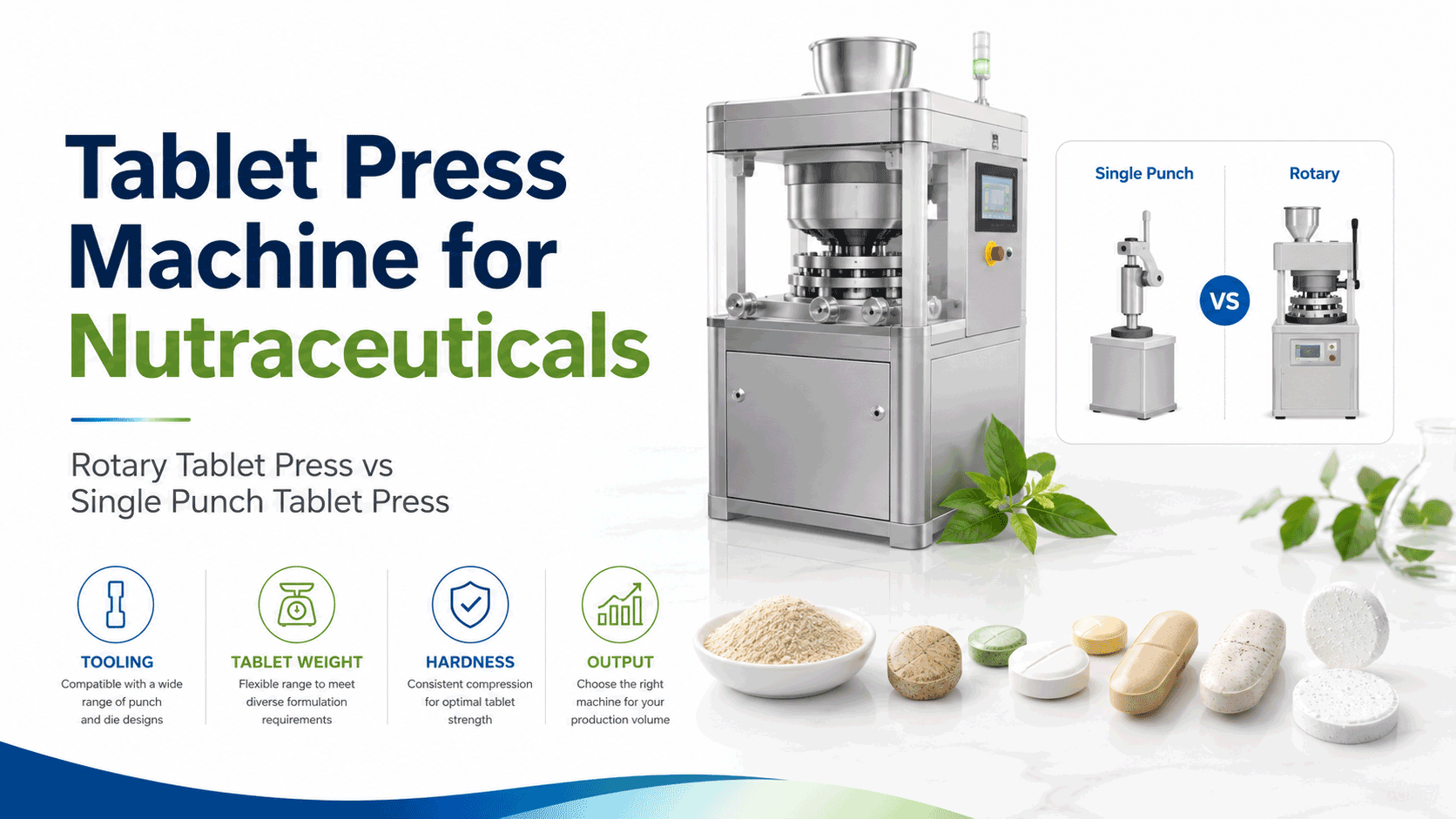
For many manufacturers, the first question is whether to choose a single station tablet press or rotary tablet presses. A single station tablet press is often used for product development, laboratory testing, small batch production, and flexible trial runs. Rotary tablet presses are designed for high speed, high efficiency, and high volume production. Both machines have value, but they serve different customers, production goals, and business stages.
The right choice depends on several factors: the type of formulation, target tablet size, maximum diameter, required output per hour, compression force, tooling design, powder flow, production budget, easy operation, easy maintenance, future scale-up plans, and quality control requirements. A machine that is perfect for small custom development may not be efficient for commercial production. A high output rotary system may be too advanced or too expensive for a small business that still needs great flexibility.
Choosing the correct tablet press machine is therefore not simply an equipment purchase. It is a production strategy decision. The machine must match the product, the process, the people, and the future growth of the company.
Understanding Tablet Press Machine Basics for Nutraceutical Tablet Production
What a Tablet Press Machine Does in Producing Tablets
A tablet press machine is designed to compress powders or granules into tablets with controlled weight, shape, thickness, and hardness. The basic tablet press process includes filling the die cavity, controlling the amount of material, applying compression force through upper and lower punches, forming the tablet, and ejecting the finished tablet from the die. Although the principle sounds simple, the actual operation requires precision, reliability, and strong process control.
In tablet production, the powder blend or granules are usually fed into a hopper. From there, the material flows into the die cavity. The lower punch helps define the fill depth, while the upper punch applies pressure to compress the material into a tablet. After compression, the tablet is pushed out of the die and collected for further inspection, coating, packaging, or other downstream processes.
The tablet press must be capable of maintaining consistent output under real production conditions. If the powder flow is unstable, the tablet weight may vary. If the compression force is not controlled, the tablet may become too soft, too hard, cracked, chipped, or slow to disintegrate. If the tooling is not suitable, the tablet shape, logo, score line, and surface quality may not meet customer expectations.
For nutraceutical products, this is especially important because many formulations contain complex ingredients. Vitamins, minerals, botanical extracts, amino acids, sweeteners, flavors, binders, and lubricants may all behave differently under pressure. Some powders flow smoothly. Others are sticky, light, dense, abrasive, or sensitive to humidity. A dependable tablet press machine must adapt to these formulation challenges while maintaining product quality and production efficiency.
Tablet presses are widely used by pharmaceutical manufacturers, nutraceutical companies, food supplement factories, and other industries that need consistent solid dosage forms. Even though nutraceutical tablets are not always regulated in the same way as pharmaceutical products, many customers still expect pharmaceutical-style quality, safety, precision, and reliability.
Why Tablet Weight, Size, Shape, Tooling, and Compression Force Matter
Tablet quality is affected by many technical factors, and the tablet press machine plays a central role in controlling them. Tablet weight is one of the most important quality parameters. If the weight is too low, the tablet may not contain the intended amount of active ingredients. If the weight is too high, it may exceed product specifications, increase cost, or affect consumer use. Consistent weight control is therefore critical for both quality and business efficiency.
Tablet size and maximum diameter also affect machine selection. A small vitamin tablet, a large mineral tablet, a chewable tablet, and an effervescent tablet may require different tooling and compression capacity. Larger tablets often need stronger compression force and suitable punches and dies. If the machine is not capable of handling the required tablet size, the final product may suffer from poor hardness, weak edges, capping, lamination, or inconsistent shape.
Tooling is another key factor. The punches and dies define the form of the tablet, including round, oval, capsule-shaped, custom shape, score line, logo, and surface profile. High-quality tooling helps ensure accurate shape, smooth ejection, and consistent performance. Poor tooling can cause sticking, picking, uneven wear, broken tablets, and production downtime.
Compression force must be optimized for each formulation. Too little pressure may produce tablets that are weak, dusty, or easy to break. Too much pressure may make tablets too hard, slow to dissolve, or difficult to chew. Excessive force may also damage tooling and reduce machine durability. A good tablet press allows operators to control pressure carefully and maintain consistent performance during operation.
For chewable tablets, texture and mouthfeel are important. For effervescent tablets, moisture control, tablet hardness, and packaging speed are critical. For herbal tablets, powder flow and sticking may become challenges. For mineral tablets, high density and abrasive ingredients may place more stress on tooling and machine parts. These differences show why tablet production requires a careful match between formulation, machine system, and quality control.
A tablet press machine should not be selected only by price or maximum output. It must be evaluated by its ability to produce the intended tablet form with consistent quality, efficient operation, easy maintenance, and long-term reliability.
Single Station Tablet Press vs Rotary Tablet Presses
Single Station Tablet Press for Development, Small Batch Production, and Great Flexibility
A single station tablet press is often the right choice for companies that need flexibility, product development support, and small batch production. This type of tablet press uses one set of punches and dies to produce one tablet at a time. Because of its simpler structure, it is commonly used for research, formulation testing, pilot production, laboratory development, and low-volume commercial orders.
For a new business or a company developing custom formulations, a single station tablet press can be very useful. It allows the team to test whether a powder blend can form a stable tablet, whether the tablet weight is consistent, whether the hardness is acceptable, and whether the final shape meets customer requirements. This is especially helpful before investing in larger rotary tablet presses.
A single station tablet press offers great flexibility because it is easier to change tooling, adjust pressure, and test different formulations. For customers producing small batches of vitamin tablets, herbal tablets, mineral tablets, or specialty food supplement tablets, this type of machine can support many product variations without requiring a large production line.
Easy operation is another advantage. A single station machine is usually simpler to understand, operate, clean, and maintain. Operators can focus on learning the basic compression process, checking tablet weight, adjusting fill depth, and observing how different powders behave under pressure. This makes it suitable for companies that are still building technical resources or training new staff.
However, the limitation is output. Because the machine produces one tablet at a time, it cannot match the efficiency or high output of rotary tablet presses. It is not ideal for high volume production, large purchase orders, or customers requiring thousands or millions of tablets per batch. As demand grows, the single station tablet press may become a bottleneck.
In many cases, the single station tablet press is best used as a development and small batch solution. It helps companies understand the formulation, optimize compression force, evaluate tablet size and shape, and prepare for future scale-up. Once the formulation and market demand are stable, the business may need to move toward rotary tablet presses for higher efficiency.
Rotary Tablet Presses for High Speed and High Volume Production
Rotary tablet presses are designed for continuous, high speed tablet production. Unlike a single station tablet press, a rotary tablet press has multiple tooling stations arranged around a rotating turret. As the turret rotates, multiple punches and dies work at the same time, allowing the machine to produce many tablets per revolution. This system is what gives rotary machines their high output and high efficiency.
For pharmaceutical companies, nutraceutical manufacturers, and supplement factories with stable demand, rotary tablet presses are often the preferred solution. They are suitable for high volume production because they can produce large quantities of tablets per hour while maintaining consistent output. Depending on machine size, number of stations, tablet size, formulation, and operating speed, rotary machines can support a wide range of production capacities.
Rotary tablet presses are especially useful when the company has mature formulations and regular orders. Once the process is optimized, the machine can operate efficiently with strong consistency. Advanced rotary systems may be equipped with automatic feeding, pre-compression, main compression, automatic lubrication, tablet weight control, rejection systems, dust extraction, and production monitoring. These features help improve precision, reduce downtime, and maintain product quality.
Pre-compression and main compression are important advantages in many rotary tablet press systems. Pre-compression removes air and begins forming the tablet gently before the main compression step applies the final force. This can improve tablet quality, especially for formulations that are difficult to compress or sensitive to capping and lamination.
Rotary machines are also better suited for integration with downstream equipment. They can be connected to dedusters, metal detectors, tablet inspection systems, coating machines, bottle filling lines, blister packaging lines, or cartoning systems. This makes them a strong option for companies building an efficient commercial production line.
However, rotary tablet presses require more investment, more technical support, more maintenance, and more trained operators. They are more complex than single station machines. Tooling costs may be higher, cleaning may take longer, and setup may require more experience. For companies without stable orders or clear production demand, buying a large rotary tablet press too early can create financial and operational pressure.
The right choice depends on the business stage. If the company needs high speed, high output, and efficient commercial production, rotary tablet presses are usually the stronger choice. If the company needs flexibility, testing, and small batch development, a single station tablet press may be more practical.
How to Choose the Right Tablet Press Machine for Nutraceuticals
Match the Tablet Press to Powders, Formulations, Tooling, and Product Quality
The best tablet press machine is the one that matches the actual formulation and production process. Many production problems begin when a company assumes that any powder can be compressed into a good tablet. In reality, powders behave differently. Some flow well into the die. Some bridge inside the hopper. Some stick to punches. Some compress poorly. Some require granulation before pressing. Others need special binders, lubricants, or moisture control.
For vitamin tablets, uniform distribution of small active ingredients may be critical. For herbal tablets, fiber content and poor flow can make tablet weight difficult to control. For mineral tablets, high density and abrasive particles may affect tooling wear and machine durability. For chewable tablets, taste, hardness, and mouthfeel are important. For effervescent tablets, moisture sensitivity and tablet integrity are critical factors.
Before choosing a tablet press, manufacturers should understand whether the formulation is suitable for direct compression or whether it requires wet granulation, dry granulation, or another preparation process. If the granules are not consistent, the tablet press may struggle to maintain weight and hardness. If the blend segregates, tablets may not contain uniform active content. If lubrication is not optimized, tablets may stick or become too weak.
Tooling must also match the product design. A simple round tablet may be easier to produce than a large chewable tablet with a custom shape and logo. The tablet size, shape, maximum diameter, thickness, score line, and surface design all affect compression force and ejection. Punches and dies must be strong, precise, and suitable for the intended tablet.
Product quality should be the central focus. A tablet should not only look good. It should have the correct weight, suitable hardness, acceptable friability, proper disintegration, stable appearance, and consistent performance. Quality control testing should be built into the process. During production, operators may need to check tablet weight, thickness, hardness, appearance, and defects at regular intervals.
An advanced tablet press can support better control, but it cannot fix a poor formulation by itself. The machine, formulation, tooling, and process must work together. A reliable manufacturer should evaluate all these factors before selecting equipment.
Evaluate Output, Efficiency, Maintenance, Support, and Long-Term Business Needs
Production output is one of the most important factors in tablet press selection. A small company may only need a machine that produces limited batches for product development or small business orders. A larger factory serving many customers may need high output rotary tablet presses capable of continuous production. The required output per hour should be calculated based on real order volume, batch size, working hours, cleaning time, changeover time, and future growth.
Efficiency is not only machine speed. A high speed machine is not efficient if it stops often, takes too long to clean, requires excessive maintenance, or produces too many defective tablets. True efficiency means stable operation, consistent output, low rejection rate, easy maintenance, and good integration with the full production line.
Easy maintenance is critical for long-term reliability. A tablet press operates under pressure, so tooling, cams, rollers, feeders, lubrication systems, and mechanical parts must be maintained carefully. If maintenance is ignored, tablet quality may decline, downtime may increase, and machine durability may suffer. Manufacturers should choose dependable equipment with available spare parts, clear maintenance instructions, and reliable technical support.
Technical support is especially important for companies moving from small-scale production to rotary tablet presses. Operators may need training in setup, tooling installation, compression adjustment, cleaning, lubrication, troubleshooting, and quality control. Without proper support, even a capable machine may not reach its expected performance.
Long-term business needs should also guide the decision. A company may start with one product today but plan to serve more customers in the future. It may need to adapt to different tablet sizes, shapes, formulations, and packaging formats. A machine with flexibility and strong support can help the company grow. A machine that only fits one narrow use may become limiting.
The right tablet press machine should also reflect a company’s commitment to quality and safety. Customers increasingly expect consistent products, reliable supply, and professional manufacturing standards. Pharmaceutical manufacturers and nutraceutical companies that invest in precision, control, durability, and efficient processes are better prepared to meet these expectations.
In the end, choosing between a single station tablet press and rotary tablet presses should be based on real production needs. A single station tablet press is a good solution for development, small batches, custom work, and flexible testing. Rotary tablet presses are better for high volume production, high speed operation, consistent output, and commercial-scale efficiency.
The best machine is not always the largest or fastest. It is the machine that can produce the desired tablet with stable weight, correct form, suitable hardness, efficient operation, easy maintenance, and long-term reliability. For vitamin tablets, herbal tablets, chewable tablets, effervescent tablets, mineral tablets, and other nutraceutical products, successful tablet production begins with choosing equipment that fits the product, the process, and the future of the business.


