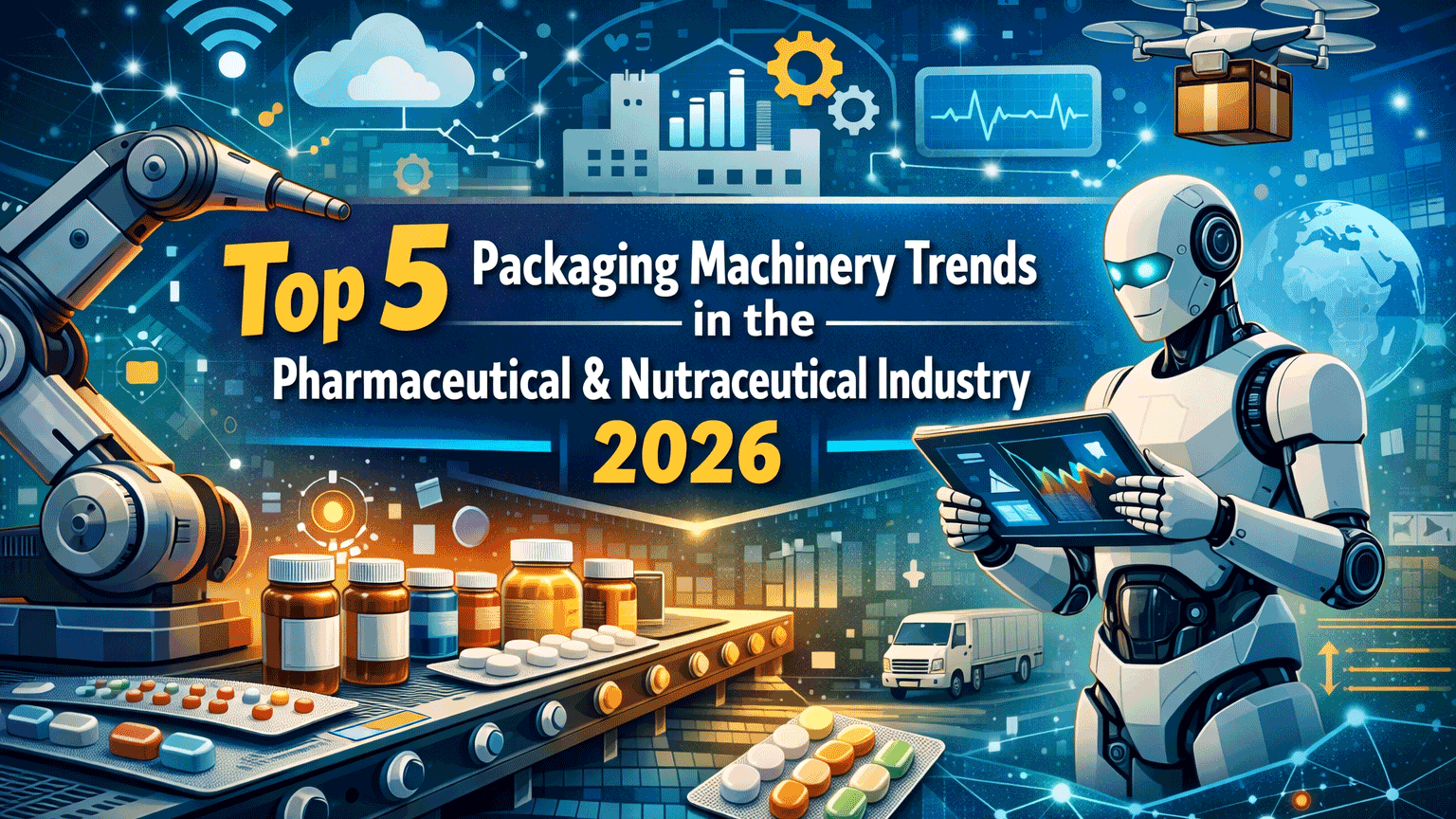
20 Mar Top 5 Packaging Machinery Trends in the Pharmaceutical & Nutraceutical Industry (2026)
Why Packaging Machinery Trends Are Redefining Pharmaceutical & Nutraceutical Manufacturing
Packaging machinery is undergoing a profound transformation in the pharmaceutical and nutraceutical industry. What was once viewed primarily as a compliance-driven function has evolved into a strategic driver of operational efficiency, product quality, and supply chain resilience. In the digital era, packaging systems are no longer isolated machines performing repetitive tasks. They are becoming intelligent, connected, and data-driven assets that influence the entire manufacturing process.
Rising regulatory pressure, the growth of personalized nutrition, and the global distribution of effective products are accelerating packaging development. Manufacturers are required to handle a broad range of SKUs, shorter product life cycles, and stricter quality expectations, all while controlling costs and minimizing risks. These demands are pushing packaging machinery toward cutting edge technologies such as artificial intelligence, smart sensors, industrial robots, and IoT technologies.
By 2026, packaging machinery trends will mark a turning point toward smart manufacturing. Packaging operations are increasingly integrated into smart factories, where machines communicate with systems, devices, and business processes in real time. This shift is creating revolutionary changes in how pharmaceutical and nutraceutical companies design, operate, and optimize their production environments.
Trend 1: Smart & Connected Packaging Machinery Driven by Artificial Intelligence
Artificial Intelligence Enabling Predictive Maintenance
Artificial intelligence is becoming a foundational technology in modern packaging machinery. Through advanced data analytics and machine learning, AI systems analyze machine behavior across industrial processes to identify patterns that indicate wear, inefficiency, or potential failure.
Predictive maintenance is one of the most valuable outcomes of this development. Instead of relying on scheduled maintenance or reactive repairs, AI-driven systems predict failures before they occur. Sensors collect data related to vibration, temperature, torque, and energy consumption, allowing algorithms to detect subtle deviations from normal operating conditions.
This ability to predict failures minimizes downtime, reduces maintenance costs, and extends the lifecycle of critical equipment. Maintenance decisions shift from reactive responses to proactive, data-informed strategies, improving operational efficiency and ensuring continuity in packaging operations.
Smart Sensors and Real Time Monitoring Across Packaging Lines
Smart sensors are at the core of intelligent packaging systems. These sensors continuously monitor sealing integrity, filling accuracy, labeling precision, and other quality-critical parameters throughout the manufacturing process. By enabling real time monitoring, packaging machinery can identify anomalies the moment they occur.
Real time monitoring supports minimal human intervention while maintaining high quality standards. When deviations are detected, systems can trigger automatic adjustments, alerts, or corrective actions without stopping production. This capability reduces waste, enhances compliance, and improves consistency across batches.
For pharmaceutical and nutraceutical manufacturing, where compliance and product safety are essential, smart sensors provide a reliable mechanism to ensure that every unit meets predefined quality requirements.
Smart Manufacturing Integration in Packaging Operations
Smart packaging machinery no longer operates in isolation. It is increasingly integrated into smart factories as a critical infrastructure component. Equipment communicates with manufacturing execution systems, quality systems, and enterprise platforms to support smarter decisions across the organization.
This integration enhances transparency across the supply chain. Real time production data enables better communication between packaging, upstream manufacturing, and downstream distribution. As a result, companies gain improved visibility into production status, capacity utilization, and potential bottlenecks.
Trend 2: Modular and Flexible Packaging Machinery for Rapid SKU Changeovers
Modular Equipment Architecture Supporting Packaging Machinery Trends
Modular packaging machinery is becoming essential as product portfolios expand. Modular designs allow manufacturers to reconfigure machines quickly to accommodate different formats, packaging materials, and product specifications.
Instead of investing in entirely new lines, businesses can upgrade or replace individual modules. This approach reduces capital expenditure, shortens implementation timelines, and supports continuous packaging development without disrupting existing operations.
Flexibility for Small Batch and Personalized Production
The shift toward personalized medicines and niche nutraceutical products requires packaging systems capable of handling small batch production efficiently. Flexible machinery supports frequent SKU changes without sacrificing productivity.
By reducing idle capacity and changeover time, flexible systems improve operational efficiency and enable manufacturers to respond rapidly to market demands. This flexibility is particularly valuable in clinical trial packaging and customized nutrition, where volumes are lower but quality requirements remain high.
Scalability Without Disrupting the Supply Chain
Scalable packaging machinery allows manufacturers to increase output incrementally as demand grows. This scalability minimizes financial risks and supports long-term supply chain stability.
Instead of overinvesting in capacity, businesses can align equipment capability with actual market needs, ensuring efficient use of resources and maintaining continuity across production and packaging operations.
Trend 3: Sustainability-Focused Packaging Machinery and Energy Efficiency
Packaging Machinery Supporting Sustainable Materials
Sustainability has become a central focus in packaging innovation. Modern packaging machinery is designed to handle biodegradable films, recycled plastics, and alternative materials without compromising performance.
These capabilities help manufacturers comply with evolving environmental regulations and meet growing expectations for environmentally responsible production. Sustainable packaging is no longer a secondary consideration but a measurable aspect of manufacturing quality and value.
Energy Efficiency as a Core Design Principle
Energy efficiency is increasingly integrated into packaging machinery design. Optimized motion control, intelligent power management, and efficient robotics reduce energy consumption across production lines.
Lower energy usage translates directly into cost savings and reduced environmental impact. Over time, energy-efficient machines offer a lower total cost of ownership while supporting corporate sustainability goals.
Waste Reduction Through Automation and Smart Controls
Automation and smart controls significantly reduce material waste. By minimizing human intervention and ensuring precise control over packaging processes, systems reduce errors that lead to rejected products or excess material usage.
Waste reduction is now a key performance metric in packaging operations, contributing to both environmental responsibility and improved profitability.
Trend 4: Automation, Robotics, and Smart Factories Enhancing Operational Efficiency
Robotics in High-Speed Pharmaceutical Packaging
Industrial robots and robotic systems are playing a growing role in pharmaceutical and nutraceutical packaging. Robots handle feeding, cartoning, palletizing, and inspection tasks with high speed and accuracy.
In cleanroom environments, robotics reduces human intervention, lowering contamination risks while increasing productivity. Robotic systems operate autonomously and consistently, making them ideal for high-volume packaging operations.
Smart Manufacturing for End-to-End Process Optimization
Automation enables synchronization across industrial processes. Packaging machinery aligns with smart factory frameworks, allowing production planning, execution, and monitoring to operate as a unified system.
Data flows seamlessly between machines, systems, and business processes, improving coordination and reducing delays. This level of integration supports increased productivity and more efficient use of resources.
Operational Efficiency Through Data-Driven Packaging Decisions
Data collected from machines supports continuous improvement initiatives. By analyzing performance metrics, manufacturers identify inefficiencies, optimize workflows, and reduce costs.
Data-driven insights shorten time-to-market for new products and improve overall manufacturing capability in competitive markets.
Trend 5: Supply Chain Visibility and IoT-Enabled Packaging Systems
IoT Challenges in Pharmaceutical Packaging Machinery
IoT sensors and IoT technologies enable unprecedented visibility into packaging operations, but they also introduce challenges. Integrating new systems with legacy equipment requires careful planning and technical expertise.
Cybersecurity and data governance are critical considerations, as connected devices increase exposure to digital risks. Manufacturers must balance connectivity with robust security measures.
Supply Chain Transparency Through Connected Packaging Equipment
Connected packaging machinery enhances traceability and compliance throughout the supply chain. Equipment-level data supports serialization, anti-counterfeiting efforts, and regulatory reporting.
Improved transparency strengthens trust between manufacturers, distributors, and regulators while protecting product integrity.
Real Time Data Supporting Resilient Global Supply Chains
Real time data enables rapid response to supply chain disruptions. Live insights into equipment status, production capacity, and output volumes allow companies to adapt quickly to changing conditions.
This responsiveness strengthens coordination between manufacturing, packaging, and distribution, ensuring consistent supply even in volatile global markets.
Challenges and Strategic Considerations
Despite the benefits, implementing smart packaging machinery presents challenges. High upfront investment, workforce upskilling, and system integration require careful planning.
Manufacturers must balance flexibility, compliance, and scalability while managing risks associated with new technologies. A phased implementation strategy often provides the most effective path forward.
Future Outlook: From Packaging Compliance to Competitive Advantage
Packaging machinery trends in 2026 emphasize intelligence, flexibility, and sustainability. Smart manufacturing, artificial intelligence, and robotics are transforming packaging from a cost center into a strategic growth engine.
Companies that invest in connected, modular, and energy-efficient equipment gain increased productivity, reduced costs, and stronger supply chain resilience. In a competitive global market, advanced packaging capability becomes a source of long-term value and differentiation.
