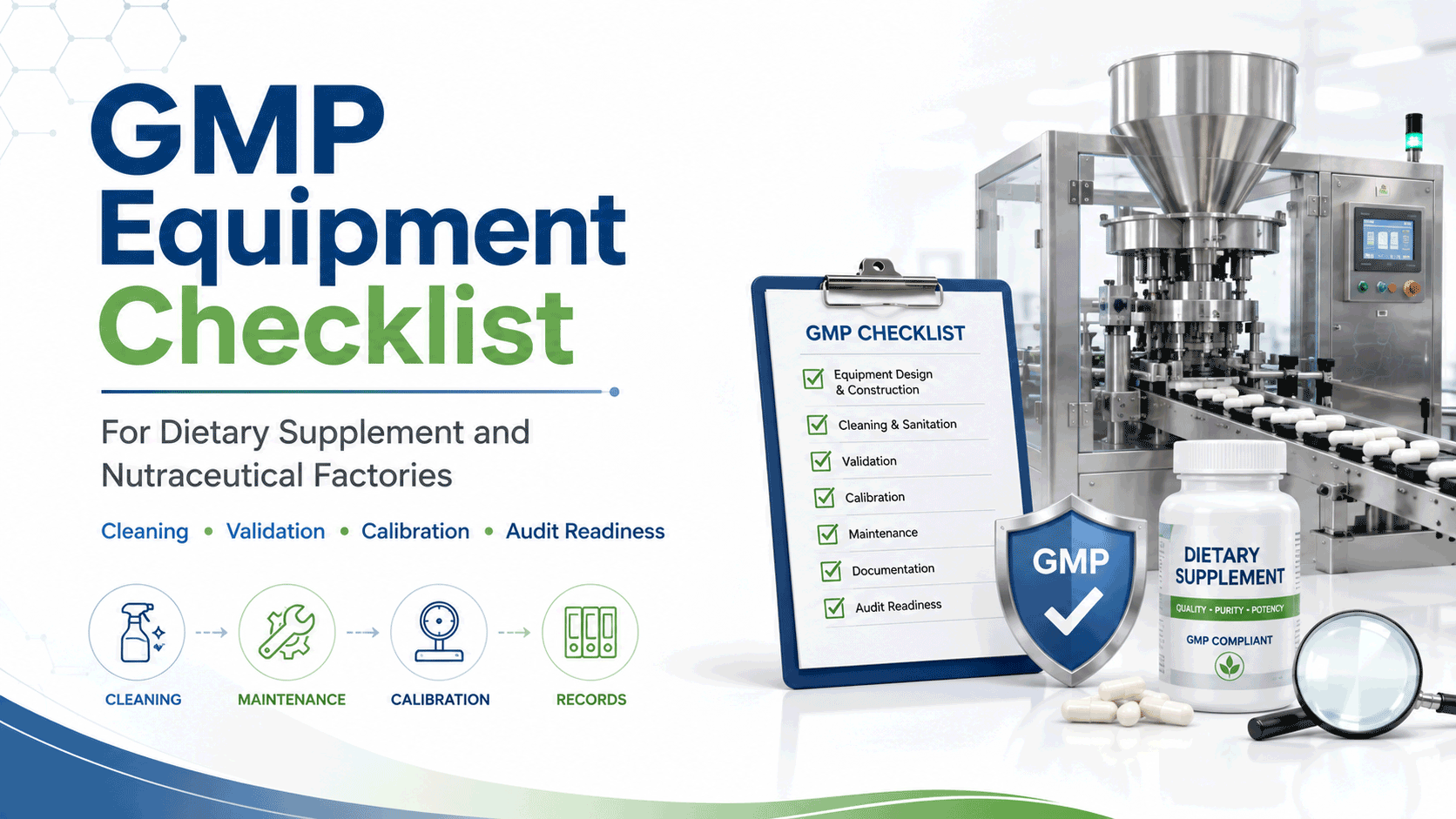
04 Sep GMP Equipment Checklist for Dietary Supplement and Nutraceutical Factories
A GMP equipment checklist is not just a purchasing document. For dietary supplements and nutraceutical factories, it is a practical quality and regulatory compliance tool that connects equipment design, production and process controls, quality control operations, master manufacturing record requirements, sanitation, calibration, documentation, and audit readiness. Many factories looking for supplement manufacturing equipment are not simply asking whether a machine can blend powder, compress tablets, fill capsules, seal bottles, or print labels. They are asking whether such equipment can support current good manufacturing practice, withstand GMP audits, prevent contamination, and provide adequate documentation when regulators, customers, or third-party auditors ask for evidence.
In the United States, the dietary supplement current good manufacturing practice framework is found in 21 CFR Part 111. The DS CGMP rule applies to persons who manufacture, package, label, or hold dietary supplements, including foreign firms that manufacture, package, label, or hold a dietary supplement imported or offered for import into the United States. It requires manufacturers to establish and follow current good manufacturing practice to ensure the quality of the dietary supplement and to ensure that the dietary supplement is packaged and labeled as specified in the master manufacturing record.
This means that equipment selection is not only an engineering decision. It is also a quality management systems decision. A blender, capsule filling machine, tablet press, coating machine, packaging line, labeler, metal detector, scale, or computer controlled process must be evaluated for its intended use. It should be suitable for the particular dietary supplement being manufactured, suitable for the operating limits required by the manufacturing process, and capable of supporting written procedures, in process testing, individual equipment logs, cleaning records, maintenance records, calibration records, and batch production records.
For factories serving the United States, Canada, Europe, Australia, or other regulated markets, the risks are similar even when legal terminology differs. Poorly designed equipment can create microbial contamination, cross contamination, mix-ups, inaccurate weights, incorrect labels, missing records, inadequate cleaning, or failures in production and process controls. In such a case, the problem is rarely only mechanical. It becomes a product quality problem, a customer trust problem, and a regulatory compliance problem.
A strong GMP equipment checklist helps factory management, QA, QC, procurement, engineering, and production teams ask the right questions before purchase, during installation, during validation, and throughout routine operation. The goal is not to buy the most expensive equipment. The goal is to choose equipment that helps dietary supplement consistently meets specifications, supports good manufacturing practices, and provides adequate documentation across the entire manufacturing process.
Start the GMP Equipment Checklist With Compliance Scope and Intended Use
Why GMP Equipment Is More Than Stainless Steel Machinery
Many people think GMP equipment means stainless steel machinery with a clean appearance. In reality, GMP equipment is equipment that can be used in such a way that it supports controlled production, cleaning, maintenance, calibration, quality control, and documentation. A polished surface is useful, but it is not enough. A beautiful machine can still fail GMP expectations if it is difficult to clean, has hidden product retention points, lacks individual equipment logs, has no preventive maintenance plan, or cannot support the process controls required by the master manufacturing record.
For dietary supplements, the manufacturing process often includes raw material receiving, quarantine, sampling, weighing, sifting, blending, granulation, encapsulation, tableting, coating, filling, packaging, labeling, holding, and finished product release. Each step may involve equipment that touches components, in process production materials, packaging, labels, or finished dietary supplement batches. If the equipment fails, the process control system fails with it.
The term “GMP equipment” should therefore be understood as equipment suitable for a defined manufacturing process. A powder blender used for botanical dietary supplements may need different cleaning controls from a blender used for mineral tablets. A packaging line used for direct retail sale bottles needs different label control from a bulk packaging station. A computer controlled process used for weighing and batching requires controls over software access, current software programs, data integrity, and record retention. The equipment must fit the process, the material, the batch size, the quality risk, and the regulatory destination.
In supplement manufacturing, equipment also has to protect against contamination from other extraneous materials, dust, residues, lubricants, cleaning agents, pests, sick or infected personnel, and other toxic materials. It must be maintained in a clean and sanitary condition. It must also be operated by qualified personnel who understand the person’s assigned functions and follow written procedures. If operators are not trained, even well-designed equipment can be misused in such a way that it creates quality failures.
A GMP equipment checklist forces the team to look beyond machine price and output. It helps them ask whether the equipment can be cleaned, inspected, identified, calibrated, maintained, documented, and verified. It helps determine compliance not only with internal standards but also with current good manufacturing practice, cGMP regulations, applicable statutory provisions, and other statutory provisions that may apply in the target market.
Defining the Particular Dietary Supplement Before Selecting Equipment
Before a factory buys equipment, it should define the particular dietary supplement or product family the equipment will support. This is one of the most important steps in building a meaningful GMP equipment checklist. Equipment that is suitable for one dietary supplement may be unsuitable for another, even if both products appear similar. A machine used for a probiotic capsule, a magnesium tablet, a botanical powder sachet, and a softgel product may face very different process controls, cleaning requirements, microbial contamination risks, storage conditions, and testing requirements.
The product definition should include the dosage form, ingredient type, active components, excipients, allergens, colorants, flavors, moisture sensitivity, particle size, density, flowability, potency, expected batch size, packaging format, dietary supplement labels, shelf life, and target market. These details affect equipment selection. For example, a hygroscopic powder may require closed transfer, humidity control, and rapid packaging. A strongly colored botanical extract may require enhanced cleaning verification. A product containing fine powders may require dust control and local extraction. A product with heat-sensitive ingredients may require controlled operating limits required by the formula.
The master manufacturing record is central to this thinking. Under 21 CFR Part 111, a written master manufacturing record is required for each unique formulation and each batch size to ensure uniformity in the finished batch from batch to batch. The master manufacturing record must establish controls and procedures to ensure each batch meets specifications. Equipment must therefore be capable of performing the steps, controls, and checks described in the master manufacturing record.
If the master manufacturing record requires blending for a defined time at a defined speed, the blender must be able to maintain and document that process. If the master manufacturing record requires an in process testing step for capsule weight, the capsule filling line must allow sampling and adjustment. If the master manufacturing record requires label reconciliation, the labeling equipment and line clearance procedure must support that requirement. If the master manufacturing record requires packaging the product as labeled dietary supplements with a defined lot number and expiration date, the packaging equipment must reliably apply and verify that information.
A generic equipment checklist is not enough. A useful GMP equipment checklist must ask whether the equipment is suitable for the intended supplement manufacturing process and whether it can help the dietary supplement meets its identity, purity, strength, composition, and contamination limits. The equipment should serve the product specification, not the other way around.
Connecting Equipment Choice With Target Markets and Other Applicable Statutory Provisions
Dietary supplements can be regulated differently across markets. In the United States, dietary supplements are regulated under the Federal Food, Drug, and Cosmetic Act and related cGMP regulations, including 21 CFR Part 111. In Canada, natural health products are subject to good manufacturing practices requirements under the Natural Health Products Regulations. Health Canada’s guidance applies to activities such as manufacturing, packaging, labelling, importing, distributing, storing, testing, and holding the product licence. In the European Union, food contact materials must meet safety and inertness principles under Regulation (EC) No 1935/2004 when placed on the European market. In Australia, many complementary medicines and related products are subject to GMP requirements through the therapeutic goods framework.
For procurement and QA teams, this means that equipment should be evaluated not only against internal expectations but also against destination-market requirements. A factory producing dietary supplement imported into the United States must understand that foreign manufacturing, packaging, labeling, and holding operations may still fall within the DS CGMP rule when the product is imported or offered for import. A factory serving European customers should understand that contact materials, gaskets, plastic parts, coatings, lubricants, and product-contact surfaces can raise food-contact compliance questions. A factory supplying Canada or Australia may need stronger documentation of GMP certification, site licensing, GMP clearance, quality systems, validation, and record keeping, depending on product classification and market pathway.
The phrase “other applicable statutory provisions” matters because GMP is not the only legal concern. Dietary supplement labels, claims, ingredient legality, contaminant limits, food contact materials, import rules, allergen declarations, and packaging requirements may all affect the equipment decision. For example, a label printer must support accurate dietary supplement labels. A coding system must print the correct lot number and expiration date. A bottle sealing system must support tamper evidence. A filling machine must help meet fill-weight and net quantity expectations. A metal detector or checkweigher may support product safety and finished product specifications.
A well-designed GMP equipment checklist should therefore begin with market scope. It should ask where the product will be sold, whether it will be a direct retail sale product, whether it will be bulk or private label, whether the product is a dietary supplement, natural health product, complementary medicine, or another category, and what records the factory must provide during GMP audits. The checklist should help the team identify the documentation that must be available before equipment is accepted into use.
When procurement buys equipment without QA review, the company may save time upfront but create compliance problems later. When QA, QC, production, engineering, and procurement work together from the start, they can assign qualified personnel, define distinct and separate responsibilities, and ensure that the equipment supports both production efficiency and regulatory compliance.
GMP Equipment Design, Cleaning, and Contamination Control
Product-Contact Surfaces, Material Compatibility, and Other Toxic Materials
Product-contact surfaces are one of the first areas to review in a GMP equipment checklist. Any surface that directly contacts raw materials, components, in process production materials, tablets, capsules, powders, liquids, gummies, softgels, packaging components, or finished dietary supplement batches must be suitable for the intended use. The surface should be smooth, cleanable, corrosion resistant, non-reactive, non-absorbent where appropriate, and durable enough to maintain its condition during normal operation, cleaning, sanitizing, and maintenance.
Material compatibility is more than a technical detail. If a gasket, seal, plastic scraper, coating, hopper liner, transfer hose, or lubricant is not suitable, it can become a source of contamination. Components may leach, shed particles, absorb product residues, react with acidic or oily ingredients, or degrade under cleaning conditions. Such contamination may not be visible during normal operation, but it can affect product quality, dietary supplement specifications, and consumer safety.
In European contexts, food contact materials are especially important because materials and articles intended to come into contact with food must meet safety and inertness principles. The European Commission notes that constituents transferring from food contact materials can affect chemical safety, human health, product quality, taste, smell, and appearance. Even outside Europe, the same principle is relevant to GMP equipment. Product-contact materials must not become other toxic materials in the manufacturing process.
The checklist should ask whether the supplier can provide material certificates for product-contact parts. It should ask whether stainless steel grade, surface finish, welding quality, gaskets, seals, belts, hoses, plastic parts, and lubricants are suitable for dietary supplements. It should ask whether there are dead legs, cracks, hollow areas, unsealed joints, rough welds, or exposed threads that can hold residues. It should also ask whether the equipment can be inspected after cleaning.
A clean and sanitary condition is not created by cleaning alone. It starts with cleanable design. If powder accumulates under inaccessible plates, if product collects behind poorly sealed guards, if liquid remains in blind pipe sections, or if cracked surfaces trap material, the equipment may become a recurring contamination source. In such a case, even strict written procedures may not be enough to overcome poor equipment design.
Material compatibility should also be reviewed for the product itself. Some dietary supplements contain oils, solvents, acids, minerals, enzymes, probiotics, botanicals, flavors, alcohol-based solutions, or abrasive powders. These materials can attack seals, stain surfaces, create residues, or require special cleaning. The GMP equipment checklist should therefore connect the equipment material review with the actual dietary supplement formulation.
Equipment Cleanability, Written Procedures, and Microbial Contamination
Cleaning is one of the most important GMP equipment concerns. Equipment used in dietary supplement manufacturing must be maintained and cleaned in such a way that it prevents contamination, microbial contamination, mix-ups, and carryover. FDA guidance for the DS CGMP rule includes written procedures for cleaning, maintenance, and sanitizing of equipment and utensils. A factory that cannot demonstrate cleaning control may struggle during GMP audits even if its machines operate well mechanically.
A strong checklist should ask whether the equipment can be disassembled without excessive difficulty. It should ask whether operators can see product-contact surfaces after cleaning. It should ask whether the equipment has areas that are difficult to reach, such as corners, seals, hidden cavities, narrow transfer points, poorly drained areas, or internal surfaces that require special tools. It should also ask whether cleaning can be performed safely by qualified personnel under written procedures.
Different dietary supplements require different cleaning strategies. Dry powder equipment may need dry cleaning, vacuum cleaning, controlled wiping, or validated wet cleaning depending on product risk. Liquid equipment may need washing, sanitizing, drying, and sometimes microbial monitoring. Equipment used for probiotics may require special microbial control. Equipment used for allergens, strong colors, strong flavors, botanicals, or high-potency materials may require enhanced cleaning verification. The checklist should not assume that one cleaning method applies to all products.
Cleaning verification and cleaning validation should be scientifically justified. For dietary supplement factories, other scientifically valid methods may be used where appropriate, but the method should be documented and suitable for the residue or contamination risk being controlled. A visual check alone may be insufficient when residues are not visible or when the product has a high safety or cross-contact risk. The factory may need swab testing, rinse testing, microbial testing, allergen testing, or product-specific residue limits depending on the equipment and product.
Written procedures must be practical. If cleaning instructions are too vague, different operators may clean the same machine in different ways. If instructions require disassembly that operators cannot safely perform, the procedure may not be followed. If drying time is not defined, moisture may remain and increase microbial contamination risk. If equipment is stored after cleaning, the storage conditions and clean-hold time should be controlled. The GMP equipment checklist should ask whether the supplier’s recommended cleaning method can be translated into factory SOPs.
Sick or infected personnel also affect equipment hygiene. GMP systems require personnel to maintain adequate personal cleanliness and avoid practices that could contaminate dietary supplements. Operators should not eat food in production areas, should not bring other personal belongings into controlled areas, and should not work with exposed products if they have a condition that could lead to contamination. Equipment design can support sanitation, but personnel practices must also be controlled.
Maintenance, Preventive Maintenance, and Proper Performance
Equipment must continue to perform properly after installation. A machine that passes initial inspection but is poorly maintained can quickly become a GMP risk. Worn seals, damaged screens, loose bolts, misaligned filling heads, inaccurate scales, worn punches, cracked belts, leaking lubricants, unstable sensors, and outdated software can all affect product quality. A GMP equipment checklist should therefore include preventive maintenance requirements before purchase and throughout routine operation.
Preventive maintenance is not simply fixing equipment after failure. It is a scheduled program designed to ensure proper performance and reduce the risk of breakdown, contamination, and process drift. The program should identify critical parts, wear points, maintenance frequency, lubrication requirements, inspection steps, responsible personnel, and documentation requirements. Individual equipment logs should record maintenance activities, repairs, replacements, adjustments, and any impact on production.
Maintenance access matters. If a machine is difficult to open, inspect, or service, maintenance may be delayed or performed incompletely. If spare parts are difficult to obtain, the factory may use inappropriate substitutes. If the supplier does not provide clear manuals, exploded drawings, electrical diagrams, pneumatic diagrams, lubrication charts, or technical support, the factory may not be able to maintain such equipment under GMP expectations.
Maintenance can also create contamination. Tools, lubricants, metal shavings, worn parts, and other extraneous materials can enter the product area if maintenance is not controlled. After maintenance, the equipment may need cleaning, inspection, line clearance, calibration, or requalification before use. The GMP equipment checklist should ask whether the machine design separates mechanical areas from product-contact areas, whether lubricants are food-grade where necessary, and whether maintenance points are protected from product flow.
Proper performance must also be monitored during production. A tablet press should maintain weight, hardness, thickness, and compression controls. A blender should maintain speed and mixing time. A capsule filler should maintain fill weight and locking performance. A packaging line should maintain fill counts, seal integrity, label placement, and coding accuracy. A checkweigher should reject out-of-range units. A metal detector should detect test pieces at defined intervals. These activities are part of production and process controls.
The checklist should also connect maintenance with quality control operations. Quality control personnel should review maintenance-related deviations if equipment failure may affect product quality. If a machine malfunctions during a batch, the batch production record should document the event, and quality control personnel review should determine whether the affected material can be released, reprocessed, rejected, or requires further investigation.
Production and Process Controls in Supplement Manufacturing
Building a Process Control System Around Equipment
Production and process controls are the backbone of GMP supplement manufacturing. They are the controls that ensure a dietary supplement consistently meets its specifications from batch to batch. Equipment is the physical tool that performs the process, but the process control system defines how the equipment should be used, monitored, adjusted, and documented. Without a process control system, even advanced equipment becomes unreliable from a GMP perspective.
A process control system begins with understanding the manufacturing process. For dietary supplements, the process may include component receipt, quarantine, sampling, testing, release, weighing, blending, granulation, drying, milling, encapsulation, tableting, coating, packaging, labeling, holding, and distribution. Each stage may have operating limits required to ensure quality. These operating limits may include time, temperature, speed, pressure, weight, humidity, screen size, fill range, compression force, seal temperature, coding accuracy, or environmental conditions.
The GMP equipment checklist should ask whether the equipment can hold these limits. If a blender has no reliable time and speed control, it may not be suitable for a process requiring controlled mixing. If a drying system cannot maintain temperature and humidity, it may not be suitable for moisture-sensitive products. If a filling machine cannot control fill weight within defined limits, it may not support dietary supplement specifications. If a labeling machine cannot reliably apply the correct label, it may create mislabeled dietary supplements.
In process testing is also part of production and process controls. In process testing may include weight checks, blend uniformity checks, hardness checks, disintegration checks, fill count checks, seal integrity checks, label verification, coding checks, or environmental checks. The equipment must allow sampling and testing without compromising cleanliness or product flow. It should also allow operators to take corrective action when results approach or exceed defined limits.
Computer controlled process systems require additional attention. If equipment uses software to control recipes, batch parameters, weighing, filling, alarms, or records, the factory should control access, software versions, backup procedures, change control, and data integrity. Current software programs should be identified and maintained. The system should not allow unauthorized changes that affect the manufacturing process. Electronic records should be reliable, retrievable, and protected against uncontrolled alteration.
A strong GMP equipment checklist should link equipment features to process control needs. It should ask what parameters the equipment controls, what parameters it displays, what parameters it records, what alarms it generates, and what happens when the equipment operates outside defined limits. It should also ask whether the equipment can provide adequate documentation during GMP audits.
Master Manufacturing Record, Master Manufacturing, and Batch Consistency
The master manufacturing record is one of the most important GMP documents for dietary supplement production. Under 21 CFR Part 111, the master manufacturing record must include required information such as the name of the dietary supplement, strength, concentration, weight, or measure, and other required manufacturing details. More broadly, the master manufacturing record provides the standard instruction set for producing a specific product and batch size consistently.
Equipment must be able to execute the master manufacturing record. This is a practical point that many factories overlook. If the master manufacturing record requires a certain blender capacity, mesh screen, compression setting, filling weight, coating temperature, seal temperature, line clearance, or label verification, the equipment must support those requirements. If the equipment cannot do so, either the equipment is unsuitable or the master manufacturing record is unrealistic.
Master manufacturing is not just a document stored in QA files. It is the bridge between formula, process, equipment, personnel, and finished dietary supplement batches. It defines what should happen, how it should happen, and what evidence should be created. The batch production record then documents what actually happened during a specific batch. If the batch production record shows deviations from the master manufacturing record, quality control personnel must review the situation and make a disposition decision.
For example, if a capsule filling machine repeatedly produces fill weights near the lower limit, the issue may involve powder flow, machine setup, operator training, or equipment wear. If a tablet press shows weight variation, the cause may involve blend segregation, feeder settings, tooling wear, or compression control. If a labeler misapplies labels, the risk may involve labeled dietary supplements reaching the wrong customer. In each case, the equipment issue becomes a master manufacturing record and quality control issue.
The checklist should ask whether each critical equipment step is reflected in the master manufacturing record. It should also ask whether operators can follow written procedures during actual production. A procedure that cannot be followed on the production floor is not useful. The equipment layout, controls, sampling points, cleaning access, and documentation workflow should all support the master manufacturing record.
Batch consistency depends on repeating the same controlled process. A dietary supplement consistently meets specifications only when raw materials, equipment, process controls, operators, environment, and quality control operations are aligned. The GMP equipment checklist should help the factory verify that alignment before the machine is approved for routine use.
In Process Production, Sampling, and Scientifically Valid Methods
In process production controls help detect problems before a full batch is completed. They allow the factory to monitor whether the dietary supplement meets intermediate expectations and whether the process remains under control. Equipment selection should consider how in process testing will be performed, where samples will be taken, and how results will be documented.
For blending operations, in process testing may focus on blend uniformity, moisture, particle size, or appearance. For capsule filling, it may include capsule weight, fill weight, capsule closure, and defect checks. For tableting, it may include tablet weight, hardness, thickness, friability, and disintegration. For packaging, it may include count accuracy, seal integrity, label accuracy, lot code, expiration date, and tamper evidence. These checks should be defined in written procedures and connected to the master manufacturing record.
A sound statistical sampling plan is important when sampling is used to represent a larger batch. Sampling should be scientifically justified and suitable for the batch size, process risk, and product type. If the sampling plan is weak, the factory may fail to detect non-uniformity or contamination. If the sampling location is poorly chosen, results may not represent the actual batch. If the equipment does not allow safe and controlled sampling, the sampling plan may not be practical.
Other scientifically valid methods may be used when appropriate, but they should be documented. The method should be suitable for determining compliance with dietary supplement specifications. For example, microbial testing methods should be appropriate for the product matrix. Heavy metal testing methods should be suitable for the ingredient or finished product. Weight checks should be performed with calibrated instruments. Visual inspection should be defined clearly enough to reduce subjective variation.
In process testing should not be treated as a formality. It is part of the process control system. If results show drift, operators and quality control personnel must know what to do. The procedure should define when to adjust equipment, when to stop production, when to segregate material, when to notify quality control personnel, and when to initiate an investigation. Such operations should be documented in real time.
The GMP equipment checklist should ask whether the equipment supports sampling without creating contamination or mix-up risks. It should ask whether sample ports are cleanable, whether samples can be identified, whether rejected material can be separated, and whether in process results can be linked to batch records. This is especially important for finished dietary supplement batches that must be released based on documented evidence.
Quality Control Operations, Personnel Responsibilities, and GMP Documentation
Implement Quality Control Operations With Distinct and Separate Responsibilities
Quality control is not a single department checking paperwork at the end of production. Under the DS CGMP framework, quality control operations must be implemented in manufacturing, packaging, labeling, and holding operations to ensure the quality of the dietary supplement and ensure that it is packaged and labeled as specified in the master manufacturing record. This requirement has direct implications for equipment.
A GMP equipment checklist should identify which equipment activities require quality control review or approval. These may include component release, equipment cleaning approval, line clearance, in process testing review, deviation review, reprocessing approval, rejected material disposition, packaging reconciliation, label control, batch production record review, and finished product release. Quality control personnel must be able to perform quality control operations with enough independence and authority to protect product quality.
Distinct and separate responsibilities matter because conflicts can occur in production. Production teams may want to keep a line running to meet output targets. Procurement may want to accept equipment because it is cheaper or faster to deliver. Engineering may focus on mechanical performance. Sales may want urgent shipment. Quality control personnel must be able to review material, process, equipment, and documentation issues objectively. Separate responsibilities related to quality decisions help prevent pressure-driven release of questionable product.
The checklist should ask whether quality control personnel have access to equipment records, calibration status, cleaning records, maintenance history, software settings, process alarms, and batch records. If quality control personnel cannot review such documentation, they cannot fully determine compliance. The equipment system should provide adequate documentation for quality control personnel review.
Quality control operations also include material review and disposition decisions. If raw materials fail to meet component specifications, they must be rejected or handled under a defined procedure. If in process material is affected by equipment malfunction, quality control personnel should review the impact. If finished dietary supplement batches show out-of-specification results, the cause must be investigated. Equipment records often become critical evidence in such a case.
A factory should assign qualified personnel to perform quality control operations. Training records should demonstrate that each person understands the person’s assigned functions. Operators should not approve their own critical quality decisions unless the quality system allows and controls that responsibility. The GMP equipment checklist should therefore include personnel access, authorization levels, training requirements, and review workflows.
Written Procedures, Adequate Documentation, and Individual Equipment Logs
Written procedures are central to GMP compliance. The DS CGMP rule requires written procedures for operations, and a compliant factory must follow written procedures rather than rely on informal knowledge. For equipment, written procedures should cover operation, cleaning, sanitizing, maintenance, calibration, setup, changeover, line clearance, troubleshooting, shutdown, and storage where applicable.
Adequate documentation is the evidence that procedures were followed. If an activity is not documented, it is difficult to prove during GMP audits. Equipment logs should show when equipment was used, for which product or batch, by whom, under what conditions, and after what cleaning or maintenance status. Individual equipment logs are especially useful for shared equipment used across multiple products.
Such records help trace product quality events. If a contamination issue appears in one batch, equipment usage logs can show what products were previously run on the same machine. Cleaning records can show whether cleaning was completed. Maintenance records can show whether parts were replaced. Calibration records can show whether instruments were accurate. Software records can show whether process settings were changed. Without such documentation, the factory may not be able to determine compliance or defend product release decisions.
Documentation should be contemporaneous, accurate, legible, complete, and retrievable. Operators should record activities when they occur, not after the shift ends from memory. Corrections should be controlled. Electronic documentation should have access controls, audit trails where appropriate, backup, and version control. Paper records should be protected from loss, damage, and uncontrolled changes.
The GMP equipment checklist should also ask whether the equipment supplier provides documentation needed to build the factory’s quality system. This may include user manuals, cleaning instructions, maintenance schedules, calibration instructions, spare parts lists, material certificates, software descriptions, electrical diagrams, pneumatic diagrams, installation requirements, and qualification support. If documentation is missing, the factory may have difficulty creating SOPs and validation records.
Such documentation should also be reviewed before purchasing. A supplier that cannot provide basic technical documentation may not be suitable for a GMP-regulated factory. Procurement should not accept vague promises. QA and engineering should review documentation requirements in advance and include them in the purchase order or technical agreement.
Qualified Personnel, Training, Hygiene, and Clean Operation
Equipment does not operate itself, even when automated. Qualified personnel are essential for ensuring proper performance, clean operation, and regulatory compliance. Operators must be trained to use equipment according to written procedures. Maintenance personnel must be trained to service equipment without creating contamination. Quality control personnel must be trained to review records, perform tests, and make disposition decisions. Supervisors must understand production and process controls.
Training documentation should show dates, topics, and types of training. It should also show that personnel are qualified for the person’s assigned functions. Training should be repeated when procedures change, equipment is modified, new products are introduced, deviations reveal knowledge gaps, or audits identify weaknesses. A GMP equipment checklist should ask what training is required before equipment is released for routine operation.
Adequate personal cleanliness is also essential. Personnel working around exposed dietary supplements, components, packaging, or equipment should follow hygiene practices that prevent contamination. They should wear appropriate garments, wash hands, control hair and beard exposure, avoid eating food in production areas, avoid bringing other personal belongings into controlled areas, and report illness or conditions that may affect product safety. Sick or infected personnel should not be assigned to operations where they may contaminate product, equipment, or contact surfaces.
Equipment layout can support good hygiene. Handwashing points, gowning areas, waste collection, cleaning tool storage, and traffic flow should be considered. Equipment should be arranged in such a way that operators do not cross dirty and clean zones unnecessarily. Maintenance access should not require personnel to walk over open product. Sampling points should be located so that samples can be taken safely and cleanly.
Operator-friendly design also helps compliance. Machines with simple controls, clear alarms, accessible cleaning points, and logical setup steps reduce the risk of misuse. If a machine is too complex, unclear, or difficult to clean, operators may create informal shortcuts. Those shortcuts can become GMP risks. The checklist should therefore ask whether the equipment is understandable and practical for the factory’s actual personnel.
Training should include not only operation but also quality awareness. Operators should understand why line clearance matters, why equipment status labels matter, why cleaning records matter, why rejected materials must be segregated, why labels must be reconciled, and why deviations must be reported. When personnel understand the quality purpose behind the task, they are more likely to follow written procedures consistently.
Equipment Qualification, Calibration, and Computer Controlled Process Control
Equipment Qualification and Ensuring Proper Performance
Equipment qualification is the documented process of demonstrating that equipment is installed correctly, operates as intended, and performs properly under actual or simulated production conditions. For GMP equipment, qualification helps provide adequate documentation that the machine is suitable for its intended use. While the specific qualification approach may vary by factory and market, the common logic is to confirm installation, operation, and performance before routine production.
Installation qualification focuses on whether the equipment is installed according to approved specifications. It may review utilities, electrical supply, compressed air, ventilation, software version, safety features, product-contact materials, manuals, drawings, and identification tags. Operational qualification focuses on whether the equipment can operate within defined ranges. It may test alarms, controls, speeds, temperatures, pressure, fill ranges, sensors, and safety interlocks. Performance qualification focuses on whether the equipment can perform the actual manufacturing process and consistently produce material or product that meets specifications.
The GMP equipment checklist should ask whether the supplier can support qualification documentation. It should also ask whether the factory has assigned qualified personnel to review and approve qualification protocols and reports. Validation reports should be compiled, reviewed, and signed by the appropriate team. If deviations occur during qualification, they should be investigated and resolved before equipment is released for routine use.
Ensuring proper performance does not stop after qualification. Equipment may drift over time. Parts wear. Software changes. Operators change. Products change. The factory should define when requalification or additional verification is needed. Major repairs, relocation, software updates, significant process changes, or repeated deviations may require additional checks. Equipment qualification should be connected to change control.
For dietary supplement factories, performance qualification should use representative materials where possible. A blender that mixes one powder well may not mix another formula with the same uniformity. A capsule filler that performs well with free-flowing powder may struggle with a sticky botanical blend. A tablet press that compresses one granulation may fail with another. Qualification should reflect the intended range of use or define limits on use.
A strong GMP equipment checklist helps prevent the purchase of equipment that looks suitable but cannot be qualified. It asks whether the machine can operate within the operating limits required by the master manufacturing record, whether it can maintain process controls, and whether it can produce product meeting component specifications, in process specifications, and finished product specifications.
Calibration, Measuring Instruments, and Sound Records
Calibration is essential for any measuring instrument used to make GMP decisions. Scales, balances, thermometers, humidity sensors, pressure gauges, tachometers, timers, load cells, metal detectors, checkweighers, pH meters, conductivity meters, and other instruments must be accurate and traceable where required. If an instrument is inaccurate, the records it produces may be unreliable.
A GMP equipment checklist should identify all instruments that require calibration. It should ask whether calibration frequency is defined, whether calibration standards are traceable, whether acceptance limits are documented, whether out-of-tolerance results trigger investigation, and whether calibration status is visible to operators. Equipment should not be used for critical GMP operations if required calibration is overdue.
Calibration records must be retained and retrievable. Such records should show the instrument identification, calibration date, calibration method, standard used, results, acceptance criteria, person performing calibration, and next due date. If a scale used for weighing components is found out of tolerance, the factory must evaluate whether previous batches may have been affected. This is why calibration is closely connected to batch release and quality control operations.
Measuring instruments should be appropriate for the intended use. A large platform scale may be suitable for bulk raw material weighing but not for weighing micro-ingredients. A temperature sensor may be suitable for room monitoring but not for critical process control. A checkweigher may be suitable for finished bottle weight but not individual tablet weight. The GMP equipment checklist should ask whether the instrument resolution, accuracy, range, and operating environment match the process.
Calibration status should be controlled during production. Operators should be trained to check calibration labels or electronic status before use. Written procedures should define what happens if an instrument is damaged, dropped, repaired, moved, or suspected of being inaccurate. The equipment log should document any event that may affect calibration.
Sound calibration control helps quality control personnel determine compliance. It supports in process testing, finished product testing, production and process controls, and batch record review. Without calibration, numerical results may appear precise but lack GMP reliability.
Computer Controlled Process, Software Control, and Data Integrity
Modern supplement manufacturing equipment often includes a computer controlled process. Automated weighing systems, blending controls, tablet press monitoring, capsule filling machines, packaging lines, labeling systems, metal detectors, checkweighers, environmental monitoring systems, and electronic batch record systems may all use software. These systems can improve consistency, but they also introduce data integrity and change control concerns.
A GMP equipment checklist should identify whether equipment uses current software programs and whether those programs affect product quality. If software controls recipe parameters, fill weights, batch records, user access, alarms, rejection systems, or electronic records, the factory should control software version, access rights, backup, data storage, and changes. Unauthorized software changes can alter the manufacturing process without visible mechanical changes.
User access should match distinct and separate responsibilities. Operators may be allowed to run approved recipes but not modify critical parameters. Supervisors may approve setup changes. Quality control personnel may review records and release batches. Engineering may maintain systems but should not make undocumented changes to production parameters. The system should support appropriate controls over who can do what.
Electronic records should be reliable. They should show when an event occurred, who performed it, and what value was recorded or changed. If the system has audit trail capability, the factory should decide how audit trails will be reviewed. If the system does not have audit trail capability but affects critical GMP records, the factory must evaluate whether manual controls are sufficient.
Computer controlled process systems should also be included in maintenance and validation planning. Software updates, sensor replacements, control panel changes, recipe updates, and data storage changes can affect equipment performance. Such operations should be controlled under written procedures and change control. The checklist should ask whether the supplier provides software documentation, backup procedures, security features, and technical support.
Automation is not a replacement for quality control. A computer controlled process can help improve precision and consistency, but only if it is properly configured, maintained, validated, and reviewed. In GMP supplement manufacturing, digital systems should strengthen the process control system, not create hidden risks.
Packaging, Labeling, Holding, and Finished Dietary Supplement Batches
Packaging Equipment for Labeled Dietary Supplements and Dietary Supplement Labels
Packaging and labeling equipment are critical parts of GMP compliance. Many quality failures occur not because the formula is wrong, but because the wrong label is applied, the wrong count is filled, the wrong lot number is printed, the expiration date is missing, or the product is packaged in a way that does not protect quality. For labeled dietary supplements, packaging equipment is not a secondary concern. It is part of the manufacturing process.
The GMP equipment checklist should review bottle fillers, tablet and capsule counters, pouch fillers, sachet machines, blister machines, cappers, induction sealers, labelers, coders, cartoners, checkweighers, metal detectors, vision systems, and tamper evidence systems. Each piece of equipment should be evaluated for accuracy, cleanability, maintainability, documentation, and ability to prevent mix-ups.
Dietary supplement labels must match the product, batch, customer, packaging format, and market. A labeler should apply labels accurately and consistently. A coding system should print correct lot numbers and expiration dates. A line should have controls to prevent obsolete, incorrect, or mixed labels from being used. Label reconciliation should be performed according to written procedures. Line clearance should confirm that labels, components, packaging, and finished products from the previous run have been removed.
Tamper evidence is also important for direct retail sale products. Induction seals, shrink bands, blister packs, pouches, or other tamper-evident features help protect consumers and support product integrity. Packaging equipment should apply these features consistently. Seal integrity checks may be needed to verify performance. Poor sealing can lead to contamination, moisture ingress, leakage, or consumer complaints.
Packaging process controls should connect with the master manufacturing record. If the master manufacturing record requires a specific bottle, cap, label, induction seal, desiccant, cotton insert, carton, or count, the packaging line must be configured and verified accordingly. Packaging equipment should also support batch production records that document actual packaging operations.
A GMP equipment checklist should ask whether packaging equipment can prevent mix-ups between similar products. This is especially important for contract manufacturing or factories serving multiple brands. Similar bottles and dietary supplement labels can easily be confused without strong line clearance, label control, and visual verification.
Holding Dietary Supplements, Storage Facilities, and Environmental Controls
After production and packaging, dietary supplements must be held under conditions that protect quality and prevent contamination, deterioration, and mix-ups. FDA’s DS CGMP guidance notes that received product must be held under conditions that protect against contamination and deterioration and avoid mix-ups. Similar principles apply throughout raw material, in process, and finished product storage.
The GMP equipment checklist should therefore include holding and storage equipment. This may include raw material racks, quarantine cages, approved material areas, rejected material areas, temperature-controlled rooms, humidity-controlled rooms, finished goods warehouses, reserve sample cabinets, refrigerators, freezers, pallets, bins, IBCs, drums, and other storage facility systems. Storage is part of the GMP system, not simply a warehouse function.
Environmental controls matter for many dietary supplements. Probiotics, softgels, botanical extracts, hygroscopic powders, vitamins, oils, and moisture-sensitive tablets may require defined storage conditions. If the label states specific storage conditions, the facility must be able to hold dietary supplements accordingly. Temperature and humidity monitoring equipment should be calibrated or verified as appropriate, and records should be reviewed.
Storage areas should be organized to prevent mix-ups. Materials should be clearly identified by status, such as quarantine, approved, rejected, returned, or released. Finished dietary supplement batches should be traceable by lot number. Returned products should not be mixed with released inventory until quality control personnel review and disposition decisions are made. Rejected materials should be clearly identified and controlled.
Holding areas should also be clean and sanitary. They should protect against pests, dust, water damage, odors, and other contamination. Personnel should not store other personal belongings, eat food, or handle materials in uncontrolled ways. Forklifts, pallets, containers, and transport equipment should be maintained so that they do not introduce contamination or damage packaging.
The checklist should ask whether storage equipment and layout support first-expire-first-out or other inventory control methods. It should ask whether expiration date information is visible and traceable. It should ask whether reserve samples are held under appropriate conditions and whether the facility can retrieve samples for investigation.
Finished Product Release, Reserve Samples, and Audit Trail
Finished dietary supplement batches should not be released only because production is complete. They should be reviewed and released through quality control operations. The review should confirm that the dietary supplement meets specifications, that the batch production record is complete, that deviations have been investigated, that in process testing and finished product testing are acceptable, and that the product is packaged and labeled as specified in the master manufacturing record.
Equipment records are part of this release decision. If a scale was out of calibration, a blender was not cleaned, a capsule filler malfunctioned, a labeler misapplied labels, or a metal detector failed a challenge test, the finished product release may be affected. Quality control personnel review should include such records when relevant.
Reserve samples provide future evidence. FDA guidance describes reserve sample requirements for packaged and labeled dietary supplements, including retention beyond shelf life when a shelf life date is used or for a defined period after distribution when no shelf life date is used. Reserve samples should be representative, properly labeled, stored under appropriate conditions, and retrievable.
An audit trail is the story of the batch. It includes component records, equipment logs, cleaning records, calibration records, maintenance records, manufacturing steps, in process testing, packaging records, label reconciliation, deviations, quality control review, finished product testing, reserve samples, storage, and distribution. When this story is complete and consistent, GMP audits are much easier. When the story has gaps, even a good product may become difficult to defend.
A GMP equipment checklist should therefore ask whether equipment creates, supports, or connects to the audit trail. Does the machine have a unique equipment ID? Does it have individual equipment logs? Does it generate electronic or paper records? Are alarms recorded? Are rejected units counted? Are maintenance activities documented? Are cleaning and usage records connected to batch numbers? Can quality control personnel access the records?
The goal is to provide adequate documentation that the finished dietary supplement batches were manufactured, packaged, labeled, and held under controlled conditions. This documentation protects the factory, the brand, the customer, and the consumer.
Procurement, GMP Certification, and Audit Readiness
How Procurement Should Use a GMP Equipment Checklist Before Purchase
Procurement teams often focus on price, delivery time, production capacity, and payment terms. These are important, but they are not enough for GMP equipment. A low-cost machine that cannot be cleaned, documented, calibrated, maintained, or qualified may become expensive later. The cost may appear in downtime, rejected batches, failed audits, customer complaints, or regulatory findings.
Before purchase, procurement should work with QA, QC, engineering, production, and management to define the equipment’s intended use. The purchase order should include technical and quality requirements, not only commercial terms. It should specify expected documentation, product-contact material information, spare parts, manuals, training, technical support, calibration requirements, cleaning expectations, and qualification support where needed.
The GMP equipment checklist should ask whether the supplier understands dietary supplements and current good manufacturing practice. It should ask whether the supplier can provide adequate documentation before shipment. It should ask whether the equipment can support production and process controls. It should ask whether the equipment is suitable for the particular dietary supplement and batch size. It should ask whether the supplier can support installation, training, maintenance, and troubleshooting.
Procurement should also consider long-term support. Equipment is not only purchased once. It must be operated, cleaned, maintained, repaired, and sometimes upgraded for years. If spare parts are unavailable or technical support is weak, the factory may face long downtime. If replacement parts differ from original parts without review, material compatibility or performance may change.
For equipment used in a computer controlled process, procurement should also ask about software support, version control, password management, backup procedures, and update policies. If the supplier cannot explain how software changes are controlled, the factory may inherit data integrity risks.
A strong procurement process treats GMP equipment as part of the quality system. The cheapest machine is not always the lowest-cost machine. The best machine is the one that supports regulatory compliance, consistent production, maintainability, audit readiness, and long-term product quality.
GMP Certification, GMP Audits, and Factory Readiness
GMP certification can enhance trust, but certification alone does not guarantee that every equipment-related practice is strong. Customers and regulators may still review equipment logs, maintenance records, cleaning procedures, calibration records, master manufacturing record links, batch production records, training files, and quality control operations. A factory preparing for GMP audits must therefore be able to show how equipment is controlled in daily practice.
GMP audits often focus on evidence. Auditors may ask to see whether written procedures exist and whether personnel follow written procedures. They may ask whether equipment is uniquely identified. They may ask whether cleaning is documented. They may ask whether calibration is current. They may ask whether maintenance was performed on schedule. They may ask whether deviations were investigated. They may ask whether quality control personnel review finished dietary supplement batches before release.
The GMP equipment checklist should become part of audit readiness. It should be used during supplier qualification, incoming equipment acceptance, installation, qualification, routine operation, internal audits, and customer audits. It should not sit in a folder after purchase. It should evolve as the factory learns from deviations, complaints, changes, and audit observations.
Internal audits should test the system. An internal auditor may choose one machine and trace its full history. The auditor may review its qualification, SOPs, cleaning records, usage logs, maintenance records, calibration status, training records, deviations, and product batches run on it. This kind of trace exercise shows whether the equipment control system is truly connected.
GMP certification and audit readiness also require management support. If production pressure routinely overrides cleaning time, maintenance schedules, or quality review, the system will fail. If procurement buys equipment without QA review, risk enters the factory. If training is rushed, personnel may not perform such operations correctly. If records are incomplete, compliance cannot be demonstrated.
A GMP equipment checklist is most useful when it is supported by a quality culture. The checklist provides structure, but people must use it honestly. The goal is not to pass one audit. The goal is to build a manufacturing system where dietary supplements are consistently produced under control.
Final Decision: Choose Equipment That Supports Quality, Compliance, and Long-Term Growth
The final equipment decision should consider quality, compliance, process performance, documentation, and long-term growth. A machine that produces high output but cannot be cleaned is not GMP-ready. A machine that is easy to buy but impossible to maintain creates risk. A computer controlled process without software control can weaken data reliability. A packaging line that cannot prevent label mix-ups may compromise labeled dietary supplements. A scale without calibration control may undermine the entire batch record.
For dietary supplement and nutraceutical factories, equipment should be selected because it supports the manufacturing process and quality control operations. It should help the dietary supplement meets specifications, protect against microbial contamination and other extraneous materials, support in process testing, maintain clean and sanitary condition, and provide adequate documentation. It should be suitable for the particular dietary supplement and flexible enough to support future product development.
The right GMP equipment checklist helps management make better decisions. It helps QA and QC implement quality control operations. It helps procurement ask better supplier questions. It helps engineering plan maintenance and calibration. It helps production follow written procedures. It helps quality control personnel review records and release finished dietary supplement batches with confidence.
A factory that uses a checklist only as a formality may still make poor decisions. A factory that uses it as a true decision-making tool can avoid many future problems. It can identify weak equipment before purchase, detect documentation gaps before audits, improve training before errors occur, and build stronger production and process controls.
In a competitive supplement manufacturing environment, GMP-ready equipment is not only a compliance requirement. It is a foundation for brand reputation, customer trust, and product quality. The factory that understands this will not ask only, “How fast can the machine run?” It will also ask, “Can this equipment help us manufacture dietary supplements that consistently meet specifications, comply with applicable statutory provisions, and withstand the scrutiny of GMP audits?”
Conclusion: A GMP Equipment Checklist Protects More Than Production Efficiency
A GMP equipment checklist is one of the most practical tools a dietary supplement or nutraceutical factory can use before buying, installing, validating, and operating production equipment. It helps the factory move beyond basic machine comparison and focus on the full compliance lifecycle of the equipment. That lifecycle begins with intended use and continues through design review, supplier documentation, installation, qualification, cleaning, calibration, maintenance, operation, batch documentation, quality control review, and audit readiness.
For dietary supplements, equipment must support current good manufacturing practice and good manufacturing practices in real production conditions. It must work within the master manufacturing record, support production and process controls, protect against microbial contamination, prevent mix-ups, and help finished dietary supplement batches meet dietary supplement specifications. It must also support dietary supplement labels, labeled dietary supplements, storage controls, reserve samples, and finished product release.
The strongest GMP equipment decisions are made when distinct and separate responsibilities are clear. Procurement should evaluate supplier capability and cost. Engineering should evaluate technical fit and maintenance. Production should evaluate usability and workflow. QA and QC should evaluate regulatory compliance, written procedures, documentation, validation, and quality control operations. Management should ensure that qualified personnel, training, resources, and quality management systems are in place.
In markets such as the United States, Canada, Europe, and Australia, equipment readiness can affect the ability to satisfy customer requirements, regulator expectations, GMP certification, and GMP audits. A factory does not need the most expensive machine to be GMP-ready, but it does need equipment that is suitable, cleanable, maintainable, verifiable, traceable, and properly documented.
Ultimately, GMP equipment protects more than production efficiency. It protects the dietary supplement, the consumer, the brand, the factory, and the long-term business. A well-built checklist turns equipment purchasing into a quality decision, and that is exactly how dietary supplement manufacturing should be managed.


